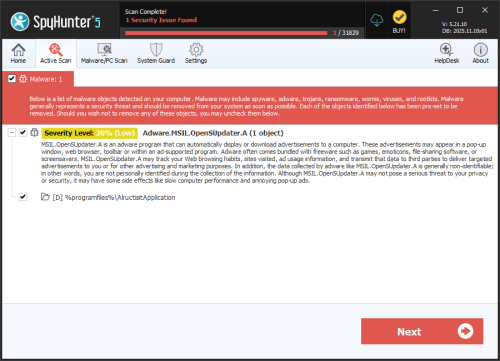
Adware.OpenSUpdater.LDA
Threat Scorecard
EnigmaSoft Threat Scorecard
EnigmaSoft Threat Scorecards are assessment reports for different malware threats which have been collected and analyzed by our research team. EnigmaSoft Threat Scorecards evaluate and rank threats using several metrics including real-world and potential risk factors, trends, frequency, prevalence, and persistence. EnigmaSoft Threat Scorecards are updated regularly based on our research data and metrics and are useful for a wide range of computer users, from end users seeking solutions to remove malware from their systems to security experts analyzing threats.
EnigmaSoft Threat Scorecards display a variety of useful information, including:
Popularity Rank: The ranking of a particular threat in EnigmaSoft’s Threat Database.
Severity Level: The determined severity level of an object, represented numerically, based on our risk modeling process and research, as explained in our Threat Assessment Criteria.
Infected Computers: The number of confirmed and suspected cases of a particular threat detected on infected computers as reported by SpyHunter.
See also Threat Assessment Criteria.
| Popularity Rank: | 21,842 |
| Threat Level: | 20 % (Normal) |
| Infected Computers: | 136 |
| First Seen: | March 26, 2022 |
| Last Seen: | September 17, 2026 |
| OS(es) Affected: | Windows |
Adware.OpenSUpdater.LDA is an adware program that targets Windows computers. Although it is rated as a relatively low danger threat, it can still disrupt your browsing experience, consume system resources, and expose you to unwanted third-party content. Understanding how it operates can help you avoid it and remove it quickly if it ends up on your system.
Table of Contents
What Adware.OpenSUpdater.LDA Does
Like most adware, Adware.OpenSUpdater.LDA is designed to automatically generate and display advertisements on an infected computer. These ads can take many forms, including pop-up windows, in-browser banners, injected advertisements on legitimate web pages, or ads embedded within a bundled, ad-supported application. The program may also run quietly in the background, launching at system startup and periodically reaching out to remote servers to fetch new advertising content.
In addition to displaying ads, adware of this type commonly monitors a user's browsing habits, such as which websites are visited, which ads are clicked, and other usage data. This information can be transmitted to third parties, who use it to build advertising profiles and deliver more "targeted" ads. While this behavior is not as overtly damaging as other malware families, it represents an invasion of privacy that many users would not willingly consent to if clearly disclosed.
How It Usually Gets Onto Computers
Adware programs such as Adware.OpenSUpdater.LDA typically spread through software bundling. They are often packaged alongside free downloads such as games, screensavers, emoticon packs, file-sharing tools, or other freeware utilities. During installation, the adware component may be included as a pre-selected "optional" offer that installs automatically unless the user actively opts out. Because many people rush through installation wizards without reading each screen carefully, adware frequently gets installed without explicit awareness or consent.
The file associated with this detection has been observed using a generic, unrelated product name and company branding, and its digital signature is issued by a certificate authority that is not trusted by Windows. This kind of mismatched or untrustworthy signing is a common tactic used to make adware appear more legitimate at a glance.
Risks for the User
While Adware.OpenSUpdater.LDA is not classified as highly dangerous, it does carry real risks:
- Constant pop-ups and injected ads can slow down browsing and degrade the overall user experience.
- Collected browsing data may be shared with advertising or other third parties without clear consent.
- Some ads displayed by adware can lead to low-quality, misleading, or unsafe websites.
- Adware can consume system resources and bandwidth, affecting performance.
Signs of Infection
Users dealing with this type of adware may notice an increase in unexpected pop-up ads, new toolbars or browser extensions they did not install, changes to browser homepage or search settings, sluggish system or browser performance, and unfamiliar processes running in the background or starting automatically with Windows.
How to Stay Protected
To reduce the risk of adware infections, always download software directly from official or reputable sources, and avoid third-party download sites that bundle extra programs. During installation, choose "custom" or "advanced" setup options whenever available so you can review and deselect any additional offered software. Keep your operating system and installed applications updated, and periodically review your list of installed programs and browser extensions for anything unfamiliar. Using reputable, up-to-date security software to scan your system regularly can also help detect and remove adware before it causes further issues.
Analysis Report
General information
| Family Name: | Adware.OpenSUpdater.LDA |
|---|---|
| Signature status: | Root Not Trusted |
Known Samples
Known Samples
This section lists other file samples believed to be associated with this family.|
MD5:
16143544d75ca751f33330ad8669fd96
SHA1:
3acc9eb2da1175fea57dd83e5ad4b6f52316b834
SHA256:
AAF3C2D0A2D34C9063F325CDD942A60363F50E2937B3C9D67F9850324AC21572
File Size:
1.94 MB, 1938528 bytes
|
Windows Portable Executable Attributes
- File doesn't have "Rich" header
- File doesn't have exports table
- File doesn't have relocations information
- File has TLS information
- File is 32-bit executable
- File is console application (IMAGE_SUBSYSTEM_WINDOWS_CUI)
- File is either console or GUI application
- File is Native application (NOT .NET application)
- File is not packed
- IMAGE_FILE_DLL is not set inside PE header (Executable)
Show More
- IMAGE_FILE_EXECUTABLE_IMAGE is set inside PE header (Executable Image)
File Icons
File Icons
This section displays icon resources found within family samples. Malware often replicates icons commonly associated with legitimate software to mislead users into believing the malware is safe.


Windows PE Version Information
Windows PE Version Information
This section displays values and attributes that have been set in the Windows file version information data structure for samples within this family. To mislead users, malware actors often add fake version information mimicking legitimate software.| Name | Value |
|---|---|
| Company Name | SlateBlueWord Ltd |
| File Description | SlateBlueWord |
| File Version | 2.0.7.8 |
| Internal Name | slateblueword |
| Legal Copyright | SlateBlueWord Ltd 2020 |
| Original Filename | slateblueword.exe |
| Product Name | SlateBlueWord |
| Product Version | 2.0.7.8 |
Digital Signatures
Digital Signatures
This section lists digital signatures that are attached to samples within this family. When analyzing and verifying digital signatures, it is important to confirm that the signature’s root authority is a well-known and trustworthy entity and that the status of the signature is good. Malware is often signed with non-trustworthy “Self Signed” digital signatures (which can be easily created by a malware author with no verification). Malware may also be signed by legitimate signatures that have an invalid status, and by signatures from questionable root authorities with fake or misleading “Signer” names.| Signer | Root | Status |
|---|---|---|
| FalxEllon | FalxEllon | Root Not Trusted |
File Traits
- x86
Block Information
Block Information
During analysis, EnigmaSoft breaks file samples into logical blocks for classification and comparison with other samples. Blocks can be used to generate malware detection rules and to group file samples into families based on shared source code, functionality and other distinguishing attributes and characteristics. This section lists a summary of this block data, as well as its classification by EnigmaSoft. A visual representation of the block data is also displayed, where available.| Total Blocks: | 6,046 |
|---|---|
| Potentially Malicious Blocks: | 970 |
| Whitelisted Blocks: | 4,358 |
| Unknown Blocks: | 718 |
Visual Map
? - Unknown Block
x - Potentially Malicious Block