Adware.OpenSUpdater.XC
Threat Scorecard
EnigmaSoft Threat Scorecard
EnigmaSoft Threat Scorecards are assessment reports for different malware threats which have been collected and analyzed by our research team. EnigmaSoft Threat Scorecards evaluate and rank threats using several metrics including real-world and potential risk factors, trends, frequency, prevalence, and persistence. EnigmaSoft Threat Scorecards are updated regularly based on our research data and metrics and are useful for a wide range of computer users, from end users seeking solutions to remove malware from their systems to security experts analyzing threats.
EnigmaSoft Threat Scorecards display a variety of useful information, including:
Popularity Rank: The ranking of a particular threat in EnigmaSoft’s Threat Database.
Severity Level: The determined severity level of an object, represented numerically, based on our risk modeling process and research, as explained in our Threat Assessment Criteria.
Infected Computers: The number of confirmed and suspected cases of a particular threat detected on infected computers as reported by SpyHunter.
See also Threat Assessment Criteria.
| Popularity Rank: | 12,949 |
| Threat Level: | 20 % (Normal) |
| First Seen: | July 25, 2026 |
| Last Seen: | October 11, 2026 |
| OS(es) Affected: | Windows |
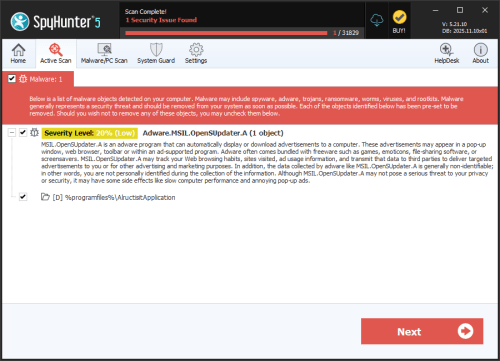
Adware.OpenSUpdater.XC is a potentially unwanted program classified as adware, designed to run on Windows systems. It is built to display or download advertisements on an infected computer, often without clearly asking for the user's permission first. While it is not considered highly dangerous, with a relatively low severity rating, it can still be a persistent nuisance and a privacy concern for everyday computer users.
Table of Contents
What Adware.OpenSUpdater.XC Does
Once active on a system, this adware is capable of generating pop-up windows, inserting ads into web browsers, or adding unwanted toolbars and ad-supported content to the user's computing experience. Like many adware families, OpenSUpdater.XC may also monitor browsing activity, including websites visited and ad interactions, and send this information to third parties. This data is typically used to build advertising profiles so that more "targeted" ads can be served to the user.
Technically, samples associated with this threat have been observed disguising themselves with file details resembling legitimate graphics library components, which can make them appear more trustworthy to an untrained eye. The program has also been seen using rundll32.exe, a legitimate Windows utility, to execute its code — a technique that can help it blend in with normal system activity and make manual detection more difficult for the average user.
How It Usually Gets Onto Computers
Adware like OpenSUpdater.XC commonly spreads by being bundled with free software downloads. This can include freeware programs such as games, emoticon packs, file-sharing tools, screensavers, and other "free" utilities obtained from unofficial or less reputable websites. During installation of the bundled software, the adware component may be included as a pre-selected option, meaning it can install itself alongside the desired program if the user doesn't carefully review and opt out of additional offers during setup.
Risks for the User
While adware is generally less severe than other forms of malware, it still carries real risks. The constant barrage of pop-ups and ads can disrupt normal browsing and reduce system performance. More importantly, the tracking of browsing habits and transmission of this data to third parties raises privacy concerns, as users often have little visibility into who receives this information or how it is used. In some cases, adware can also act as a gateway, exposing users to misleading ads that lead to other unwanted or harmful downloads.
Signs of Infection
Users dealing with this type of adware may notice unexpected pop-up ads appearing on their desktop or within their web browser, even when no browser is actively open. Browser settings such as the homepage or default search engine may change without consent. Unfamiliar toolbars or browser extensions may appear, and overall system or browser performance may feel sluggish due to background processes running without the user's knowledge.
How to Stay Protected
To reduce the risk of adware infections, users should download software only from official or well-known sources, and always choose "custom" or "advanced" installation options to review and deselect any bundled extras. Keeping the operating system and installed applications updated, avoiding suspicious download links, and running regular system scans with trusted security software are also effective habits. Reviewing installed programs and browser extensions periodically can help catch unwanted adware before it causes further issues.
Analysis Report
General information
| Family Name: | Adware.OpenSUpdater.XC |
|---|---|
| Signature status: | No Signature |
Known Samples
Known Samples
This section lists other file samples believed to be associated with this family.|
MD5:
e9f0e1046d8841661593b0c91ebdf506
SHA1:
e83071323944f29a8952061cf1ff3178a3bf09f4
SHA256:
239868F2AF6F0821DA04F4CC8B964214107D7627D44080FC2F1B803427B149D3
File Size:
2.91 MB, 2908672 bytes
|
Windows Portable Executable Attributes
- File doesn't have "Rich" header
- File doesn't have security information
- File has exports table
- File has TLS information
- File is 32-bit executable
- File is console application (IMAGE_SUBSYSTEM_WINDOWS_CUI)
- File is either console or GUI application
- File is Native application (NOT .NET application)
- File is not packed
- IMAGE_FILE_DLL is not set inside PE header (Executable)
Show 1 more
- IMAGE_FILE_EXECUTABLE_IMAGE is set inside PE header (Executable Image)
Windows PE Version Information
Windows PE Version Information
This section displays values and attributes that have been set in the Windows file version information data structure for samples within this family. To mislead users, malware actors often add fake version information mimicking legitimate software.| Name | Value |
|---|---|
| File Description | SwiftShader libGLESv2 32-bit Dynamic Link Library |
| File Version | 4.6.6.6 |
| Internal Name | libGLESv2 |
| Legal Copyright | Copyright (C) 2016 Google Inc. |
| Original Filename | libGLESv2.dll |
| Private Build | 4.6.6.6 |
| Product Name | SwiftShader libGLESv2 Dynamic Link Library |
| Product Version | 4.6.6.6 |
File Traits
- dll
- HighEntropy
- x86
Block Information
Block Information
During analysis, EnigmaSoft breaks file samples into logical blocks for classification and comparison with other samples. Blocks can be used to generate malware detection rules and to group file samples into families based on shared source code, functionality and other distinguishing attributes and characteristics. This section lists a summary of this block data, as well as its classification by EnigmaSoft. A visual representation of the block data is also displayed, where available.| Total Blocks: | 7,194 |
|---|---|
| Potentially Malicious Blocks: | 1,778 |
| Whitelisted Blocks: | 5,416 |
| Unknown Blocks: | 0 |
Visual Map
... Data truncated? - Unknown Block
x - Potentially Malicious Block
Similar Families
Similar Families
This section lists other families that share similarities with this family, based on EnigmaSoft’s analysis. Many malware families are created from the same malware toolkits and use the same packing and encryption techniques but uniquely extend functionality. Similar families may also share source code, attributes, icons, subcomponents, compromised and/or invalid digital signatures, and network characteristics. Researchers leverage these similarities to rapidly and effectively triage file samples and extend malware detection rules.- OpenSUpdater.XC
Windows API Usage
Windows API Usage
This section lists Windows API calls that are used by the samples in this family. Windows API usage analysis is a valuable tool that can help identify malicious activity, such as keylogging, security privilege escalation, data encryption, data exfiltration, interference with antivirus software, and network request manipulation.| Category | API |
|---|---|
| Syscall Use |
Show 18 more
|
| Process Manipulation Evasion |
|
| Process Shell Execute |
|
| Anti Debug |
|
Shell Command Execution
Shell Command Execution
This section lists Windows shell commands that are run by the samples in this family. Windows Shell commands are often leveraged by malware for nefarious purposes and can be used to elevate security privileges, download and launch other malware, exploit vulnerabilities, collect and exfiltrate data, and hide malicious activity.
C:\WINDOWS\SysWOW64\rundll32.exe C:\WINDOWS\system32\rundll32.exe c:\users\user\downloads\e83071323944f29a8952061cf1ff3178a3bf09f4_0002908672.,LiQMAxHB
|