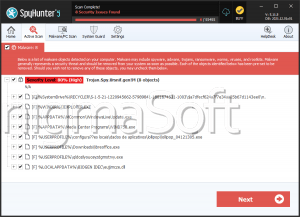
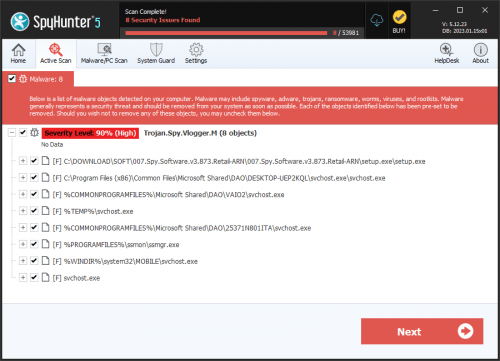
Trojan.Spy.KeyLogger.M
Threat Scorecard
EnigmaSoft Threat Scorecard
EnigmaSoft Threat Scorecards are assessment reports for different malware threats which have been collected and analyzed by our research team. EnigmaSoft Threat Scorecards evaluate and rank threats using several metrics including real-world and potential risk factors, trends, frequency, prevalence, and persistence. EnigmaSoft Threat Scorecards are updated regularly based on our research data and metrics and are useful for a wide range of computer users, from end users seeking solutions to remove malware from their systems to security experts analyzing threats.
EnigmaSoft Threat Scorecards display a variety of useful information, including:
Popularity Rank: The ranking of a particular threat in EnigmaSoft’s Threat Database.
Severity Level: The determined severity level of an object, represented numerically, based on our risk modeling process and research, as explained in our Threat Assessment Criteria.
Infected Computers: The number of confirmed and suspected cases of a particular threat detected on infected computers as reported by SpyHunter.
See also Threat Assessment Criteria.
| Popularity Rank: | 22,658 |
| Threat Level: | 80 % (High) |
| Infected Computers: | 51 |
| First Seen: | April 21, 2023 |
| Last Seen: | September 5, 2026 |
| OS(es) Affected: | Windows |
The detection of Trojan.Spy.KeyLogger.M on your system indicates a potential security threat that requires immediate attention. This type of malware is designed to secretly monitor and capture sensitive information from your computer, posing a significant risk to your personal data and online security. It is essential to understand the nature of this threat and take prompt action to remove it and prevent future infections.
Table of Contents
What Is Trojan.Spy.KeyLogger.M?
Trojan.Spy.KeyLogger.M is a type of spyware that is designed to stealthily install itself on a victim's computer and gather sensitive information such as keystrokes, login credentials, and other personal data. The name "Trojan" refers to the fact that this malware often disguises itself as legitimate software or hides within other programs, making it difficult to detect. The "Spy" and "KeyLogger" components indicate its primary functions: spying on the user's activities and logging keystrokes.
How Trojan.Spy.KeyLogger.M Operates
Once installed, Trojan.Spy.KeyLogger.M can operate in the background, unnoticed by the user. It may monitor and record keystrokes, capture screenshots, and even intercept network traffic. This malware can also communicate with its command and control servers to transmit the stolen data or receive updates and instructions. The primary goal of Trojan.Spy.KeyLogger.M is to gather valuable information that can be used for financial gain, identity theft, or other malicious purposes.
Symptoms of Infection
While Trojan.Spy.KeyLogger.M is designed to be stealthy, there may be some symptoms that indicate its presence on your system. These can include unusual keyboard or mouse behavior, slow system performance, unexpected pop-ups or advertisements, and unfamiliar programs or icons on your desktop. However, in many cases, the infection may not exhibit any noticeable symptoms, making it essential to rely on antivirus software and regular system scans for detection.
How to Remove Trojan.Spy.KeyLogger.M
- Boot your computer in Safe Mode with Networking to prevent the malware from loading and to allow for a more effective removal process.
- Use a reputable anti-malware tool, such as SpyHunter, to perform a full scan of your system and detect any malicious components related to Trojan.Spy.KeyLogger.M.
- Uninstall any suspicious programs or applications that may be associated with the malware. Be cautious and only remove programs that you are certain are malicious or unnecessary.
- Reset your web browsers, including Chrome, Firefox, and Edge, to their default settings to remove any malicious extensions or add-ons that may be related to the infection.
- Reboot your computer and perform another full scan with your anti-malware tool to ensure that all remnants of the malware have been removed.
Conclusion
The removal of Trojan.Spy.KeyLogger.M requires careful attention to detail and a thorough approach to ensure that all malicious components are eliminated. By following the steps outlined above and maintaining good security practices, such as regularly updating your operating system and software, using strong antivirus protection, and being cautious when downloading and installing programs, you can help protect your system from future infections and keep your personal data safe. Remember, prevention and vigilance are key to maintaining a secure online environment.
Analysis Report
General information
| Family Name: | Trojan.Spy.KeyLogger.M |
|---|---|
| Signature status: | No Signature |
Known Samples
Known Samples
This section lists other file samples believed to be associated with this family.|
MD5:
a5c0c472e52fcae2b6261fbb705a34d7
SHA1:
c7051392541a4f05e58d518f4460b9495ead00c3
SHA256:
FBAE5DBE41F2E614080CF9D59A85466CFED1BEC3DB30BEB6A3207D07C7D6106F
File Size:
133.63 KB, 133632 bytes
|
|
MD5:
6c8d8806b391226690f0a58e097453dd
SHA1:
7dba91f0d0402238d84e32c5cc40b69f3fa45a6e
SHA256:
82B0FC43086D8C7F5AE2846AEE333C8A566360DBD54D7E26FE15BA209B23CC0F
File Size:
145.41 KB, 145408 bytes
|
Windows Portable Executable Attributes
- File doesn't have "Rich" header
- File doesn't have exports table
- File doesn't have security information
- File is 64-bit executable
- File is console application (IMAGE_SUBSYSTEM_WINDOWS_CUI)
- File is either console or GUI application
- File is Native application (NOT .NET application)
- File is not packed
- IMAGE_FILE_DLL is not set inside PE header (Executable)
- IMAGE_FILE_EXECUTABLE_IMAGE is set inside PE header (Executable Image)
File Traits
- 2+ executable sections
- JMC
- No Version Info
- x64
Block Information
Block Information
During analysis, EnigmaSoft breaks file samples into logical blocks for classification and comparison with other samples. Blocks can be used to generate malware detection rules and to group file samples into families based on shared source code, functionality and other distinguishing attributes and characteristics. This section lists a summary of this block data, as well as its classification by EnigmaSoft. A visual representation of the block data is also displayed, where available.| Total Blocks: | 343 |
|---|---|
| Potentially Malicious Blocks: | 0 |
| Whitelisted Blocks: | 340 |
| Unknown Blocks: | 3 |
Visual Map
? - Unknown Block
x - Potentially Malicious Block
Similar Families
Similar Families
This section lists other families that share similarities with this family, based on EnigmaSoft’s analysis. Many malware families are created from the same malware toolkits and use the same packing and encryption techniques but uniquely extend functionality. Similar families may also share source code, attributes, icons, subcomponents, compromised and/or invalid digital signatures, and network characteristics. Researchers leverage these similarities to rapidly and effectively triage file samples and extend malware detection rules.- Agent.FYH
- Agent.KFF
- Agent.LEC
- Bladabindi.JA
- FaceInjector.A
Show More
- HackKMS.AI
- Injector.GFDC
- ShellcodeRunner.LU
- Spy.KeyLogger.AUB