Piccshare Ads
Threat Scorecard
EnigmaSoft Threat Scorecard
EnigmaSoft Threat Scorecards are assessment reports for different malware threats which have been collected and analyzed by our research team. EnigmaSoft Threat Scorecards evaluate and rank threats using several metrics including real-world and potential risk factors, trends, frequency, prevalence, and persistence. EnigmaSoft Threat Scorecards are updated regularly based on our research data and metrics and are useful for a wide range of computer users, from end users seeking solutions to remove malware from their systems to security experts analyzing threats.
EnigmaSoft Threat Scorecards display a variety of useful information, including:
Popularity Rank: The ranking of a particular threat in EnigmaSoft’s Threat Database.
Severity Level: The determined severity level of an object, represented numerically, based on our risk modeling process and research, as explained in our Threat Assessment Criteria.
Infected Computers: The number of confirmed and suspected cases of a particular threat detected on infected computers as reported by SpyHunter.
See also Threat Assessment Criteria.
| Popularity Rank: | 17,293 |
| Threat Level: | 20 % (Normal) |
| Infected Computers: | 12,401 |
| First Seen: | October 28, 2014 |
| Last Seen: | January 21, 2026 |
| OS(es) Affected: | Windows |
Piccshare is a piece of software developed and distributed by HTTO Group, a not so popular company in the world of software developers. The purpose of Piccshare is to provide users with a neat and convenient way to quickly browse, arrange and share photos they find on their computer or the web. However, what some users might not know is that Piccshare relies solely on paid advertising to generate profit for its authors. This means that users who opt to install Piccshare also agree to have their web browsing sessions bombarded with all kinds of advertisements that are annoying to say the least.
Piccshare may be installed stealthily, so users may see the Piccshare ads, and they have no idea that this software is installed on their computer. The reason for this is the primary propagation technique that may be used to distribute Piccshare – software bundling. The Piccshare adware may be bundled with legitimate and trustworthy applications whose installation wizard offers users to either accept or decline the installation of Piccshare. However, many users may not pay attention to the on-screen instructions, so they may end up agreeing to install the Piccshare adware accidentally If you see Picshare ads in your web browser, you should download and run a reputable anti-malware solution that can remove all of the adware's components.
Table of Contents
Aliases
2 security vendors flagged this file as malicious.
| Antivirus Vendor | Detection |
|---|---|
| AVG | Generic.F11 |
| Avast | Win32:PUP-gen [PUP] |
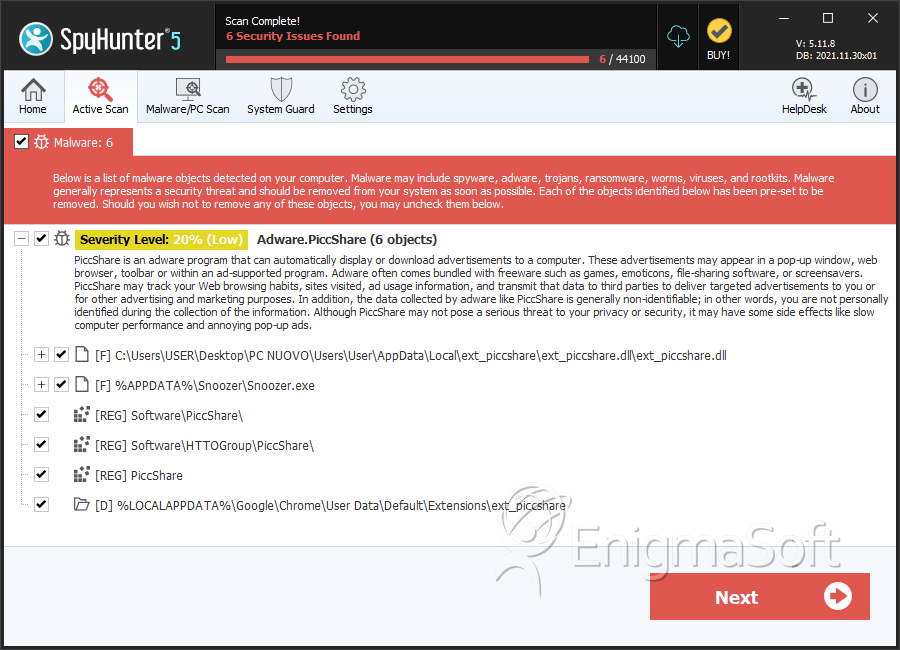
SpyHunter Detects & Remove Piccshare Ads
File System Details
| # | File Name | MD5 |
Detections
Detections: The number of confirmed and suspected cases of a particular threat detected on
infected computers as reported by SpyHunter.
|
|---|---|---|---|
| 1. | ext_piccshare.dll | 32c88d33570a4d1d5de7f1da141ab58f | 3,917 |
| 2. | Snoozer.exe | c872e69a71fe83dc43b30b1443188262 | 3,729 |
Registry Details
Directories
Piccshare Ads may create the following directory or directories:
| %LOCALAPPDATA%\Google\Chrome\User Data\Default\Extensions\ext_piccshare |