WordShark Ads
Threat Scorecard
EnigmaSoft Threat Scorecard
EnigmaSoft Threat Scorecards are assessment reports for different malware threats which have been collected and analyzed by our research team. EnigmaSoft Threat Scorecards evaluate and rank threats using several metrics including real-world and potential risk factors, trends, frequency, prevalence, and persistence. EnigmaSoft Threat Scorecards are updated regularly based on our research data and metrics and are useful for a wide range of computer users, from end users seeking solutions to remove malware from their systems to security experts analyzing threats.
EnigmaSoft Threat Scorecards display a variety of useful information, including:
Popularity Rank: The ranking of a particular threat in EnigmaSoft’s Threat Database.
Severity Level: The determined severity level of an object, represented numerically, based on our risk modeling process and research, as explained in our Threat Assessment Criteria.
Infected Computers: The number of confirmed and suspected cases of a particular threat detected on infected computers as reported by SpyHunter.
See also Threat Assessment Criteria.
| Popularity Rank: | 16,631 |
| Threat Level: | 20 % (Normal) |
| Infected Computers: | 3,252 |
| First Seen: | June 12, 2015 |
| Last Seen: | November 26, 2025 |
| OS(es) Affected: | Windows |
The abundance of WordShark ads in your browser is caused by adware on your machine that may appear as a browser extension, an add-on, a plugin and a Browser Helper Object. The WordShark adware might have entered your machine as a tool to help your search better on Google that was listed under the 'Advanced' or 'Custom' option of a freeware bundle. Security analysts report that the WordShark adware can read your browsing history, the metadata of pages you visit and record your search criteria to display related marketing content as you browse the Internet. The WordShark adware may add a registry key in Windows to start when you turn on your PC and may add a task in the Windows Task Manager to update is ad filters at set intervals of time. The WordShark adware may show banners, contextual ads, pop-up windows and place in-text hyperlinks to sponsored content and products to earn affiliate revenue. Security analysts remind web surfers that the ads by adware like WordShark are not safe, and you may be suggested to install riskware like System SpeedUp, UTAdRemovalApp, and Translate Genius. Users who want to ensure the optimal performance of their PC and secure their Internet activities should install a reputable anti-malware application and remove the WordShark adware.
Table of Contents
Aliases
4 security vendors flagged this file as malicious.
| Antivirus Vendor | Detection |
|---|---|
| AVG | Generic.1E9 |
| McAfee-GW-Edition | BehavesLike.Win64.BadFile.qh |
| Symantec | WS.Reputation.1 |
| McAfee | Artemis!724A427BFBBD |
SpyHunter Detects & Remove WordShark Ads
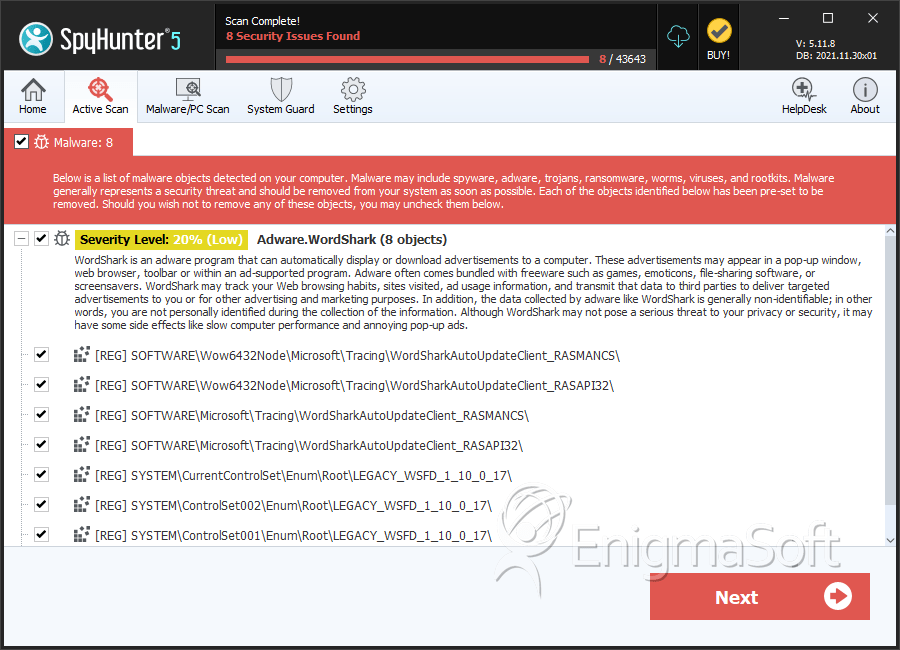
File System Details
| # | File Name | MD5 |
Detections
Detections: The number of confirmed and suspected cases of a particular threat detected on
infected computers as reported by SpyHunter.
|
|---|---|---|---|
| 1. | wsfd_1_10_0_19.sys | 724a427bfbbd6bd9f202ad029bc777bb | 45 |
| 2. | wsfd_1_10_0_17.sys | 137735d9e7152efda4ec3b6ec72d7272 | 25 |
| 3. | wordshark-setup-1.10.0.20.exe | dc2873b56986e04545409d3149f58939 | 15 |
| 4. | setup.exe | fec919904ca57b54358629294841ad04 | 6 |