Wana Decrypt0r 3.0 Ransomware
Threat Scorecard
EnigmaSoft Threat Scorecard
EnigmaSoft Threat Scorecards are assessment reports for different malware threats which have been collected and analyzed by our research team. EnigmaSoft Threat Scorecards evaluate and rank threats using several metrics including real-world and potential risk factors, trends, frequency, prevalence, and persistence. EnigmaSoft Threat Scorecards are updated regularly based on our research data and metrics and are useful for a wide range of computer users, from end users seeking solutions to remove malware from their systems to security experts analyzing threats.
EnigmaSoft Threat Scorecards display a variety of useful information, including:
Popularity Rank: The ranking of a particular threat in EnigmaSoft’s Threat Database.
Severity Level: The determined severity level of an object, represented numerically, based on our risk modeling process and research, as explained in our Threat Assessment Criteria.
Infected Computers: The number of confirmed and suspected cases of a particular threat detected on infected computers as reported by SpyHunter.
See also Threat Assessment Criteria.
| Popularity Rank: | 10,259 |
| Threat Level: | 100 % (High) |
| Infected Computers: | 15,230 |
| First Seen: | May 12, 2017 |
| Last Seen: | August 31, 2026 |
| OS(es) Affected: | Windows |
The Wana Decrypt0r 3.0 Ransomware is a ransomware Trojan that seems to be designed to attack computer users in Chinese speaking regions. The Wana Decrypt0r 3.0 Ransomware is being distributed using corrupted spam email attachments mainly. When victims open the email attachment, which may take the form of a corrupted Microsoft Office or PDF file with enabled scripts, the Wana Decrypt0r 3.0 Ransomware will be downloaded and installed on the victim's computer. The Wana Decrypt0r 3.0 Ransomware seems to take advantage of the notorious WannaCry Ransomware, which has appeared in the news in the last month repeatedly. This has led to various copycat ransomware Trojan tactics that try to leverage the name of this ransomware Trojan to carry out its attack. However, the Wana Decrypt0r 3.0 Ransomware is not related to WannaCry, despite that it uses a ransom notification window that is nearly identical to the one used by this notorious ransomware Trojan.
Table of Contents
The Wana Decrypt0r 3.0 Ransomware isn’t Able to Execute an Attack!
Ransomware Trojans like the Wana Decrypt0r 3.0 Ransomware use a common online tactic that involves encrypting the victims' files and then demanding the payment of a ransom. The Wana Decrypt0r 3.0 Ransomware is not capable of carrying out a complete ransomware attack. The Wana Decrypt0r 3.0 Ransomware in its current form is not capable of encrypting the victims' data. Apparently, there are various issues in the Wana Decrypt0r 3.0 Ransomware's code that prevent it from carrying out its attack. There may be reasons for this: the Wana Decrypt0r 3.0 Ransomware may be, in its current form, an unfinished or test version of this ransomware Trojan, being released at this point merely as a test. In that case, it is possible that a new version capable of carrying out a full-fledged ransomware attack will be released shortly after. It also is possible that the people responsible for the Wana Decrypt0r 3.0 Ransomware attack are relying on the fame of WannaCry to scare computer users into paying the Wana Decrypt0r 3.0 Ransomware ransom, without posing a threat to the victim's data.
How the Wana Decrypt0r 3.0 Ransomware and Other Ransomware Trojans may Enter a PC
Most ransomware Trojans, like the one the Wana Decrypt0r 3.0 Ransomware is emulating, carry out a variation on the same basic attack strategy. The ransomware Trojan will encrypt the victims' files using a strong encryption algorithm. These ransomware Trojans will target certain file types, looking for user-generated files and leaving the victim's operating system intact. After the victim's files have been made inaccessible, the ransomware Trojan will display a ransom notification (the Wana Decrypt0r 3.0 Ransomware does this, but does not encrypt the files). The ransom notification threatens the victims with the prospect of losing their files permanently if a ransom is not paid in exchange for the decryption key or program needed to recover the encrypted files.
Dealing with the Wana Decrypt0r 3.0 Ransomware and Other Ransomware Trojans
In the case of the Wana Decrypt0r 3.0 Ransomware infection itself, this ransomware Trojan can be removed with the help of a reliable, fully updated anti-malware program. Once removed, the files should be intact, since the Wana Decrypt0r 3.0 Ransomware does not encrypt the victims' files. However, because legitimate ransomware Trojans are very active and pose a real threat currently, PC security researchers advise computer users to take steps to safeguard their data. The best protection against ransomware Trojans is to have reliable file backups on the cloud or an external memory device. Having the possibility to recover the affected files from an attack by restoring them from a backup copy undoes most ransomware attacks completely since it removes any leverage the attackers have over the victim. This, coupled with a reliable security program, can help protect computer users from most ransomware attacks.
SpyHunter Detects & Remove Wana Decrypt0r 3.0 Ransomware
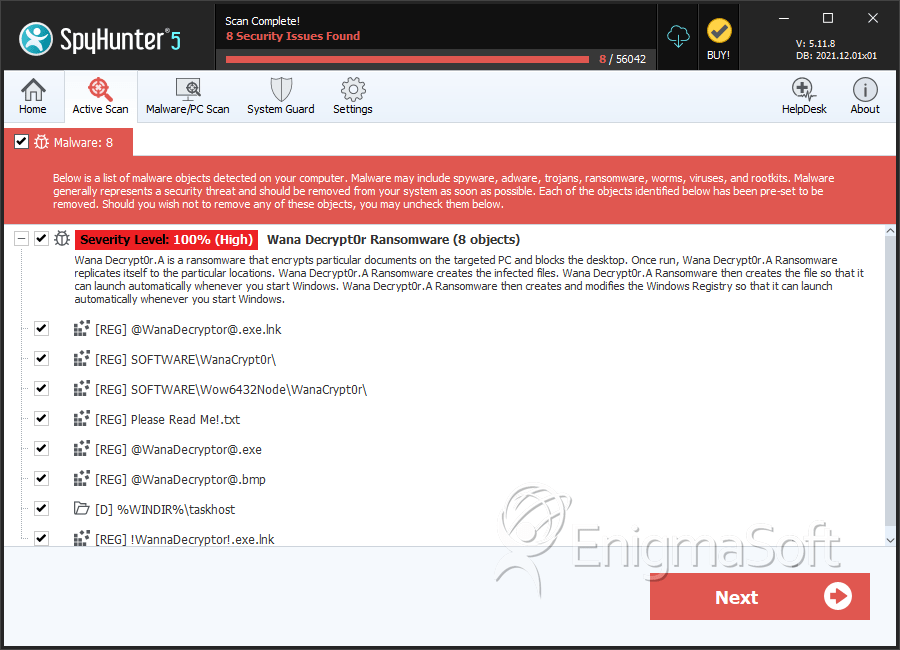
File System Details
| # | File Name | MD5 |
Detections
Detections: The number of confirmed and suspected cases of a particular threat detected on
infected computers as reported by SpyHunter.
|
|---|---|---|---|
| 1. | taskhcst.exe | 5c7fb0927db37372da25f270708103a2 | 109 |
| 2. | @WanaDecryptor@.exe | d724ea744f9056565c1dc235b8a37d3a | 3 |
| 3. | @WanaDecryptor@.exe.lnk | da694aa92d06c170e9bcebc540e3290f | 1 |
| 4. | 002f660b2867c78d57fa887549dd4df9ced41fc4e738f8d4a70e3cf555bd17c0.exe | 26b716a0017ea59f4a7e10f4045f8de6 | 0 |
| 5. | 0a73291ab5607aef7db23863cf8e72f55bcb3c273bb47f00edf011515aeb5894.exe | d5c0caf39de29dc769204d33e76c21fc | 0 |
| 6. | 0fc245e8a1134e31b7687fb7501faa05628813c87b9561ee26f2092cb76e5a36.exe | eac0133cec98c1338d721c6dff14128e | 0 |
| 7. | bb829a0394fb865eed381eb77ac9de039ad19e0f2318baaf9483b4f817250021.exe | cf7d967cf7f37075b74ae1956609f33b | 0 |
| 8. | bbf16aa9e9c3b697c1f4008a9087e2b3ed4298dbf62a607900d3b95324100327.exe | d2f5b8921d8b0ec80ca9d12a4628f4a0 | 0 |
| 9. | bc8136b40b4164afcbcb4e14f6fd54ca02275ff75b674eb6fd0a8f436f9b1181.exe | 05480f5a3237cb12416459c2660367b0 | 0 |
| 10. | c26e5eb8ec5b72e2c6368156f112f78906a57b393845233e727a8b2e3df790a4.exe | 0590e4be096701e650797f8969e3c2cf | 0 |
| 11. | c4291ec3eacfd145bbe75d7e7991753f4ea141768f6701e4bef4ca902ed58554.exe | aed6ed89e62f1cb059b5db200f30d203 | 0 |
| 12. | ca29de1dc8817868c93e54b09f557fe14e40083c0955294df5bd91f52ba469c8.exe | b0ad5902366f860f85b892867e5b1e87 | 0 |
| 13. | cd049fa3d5c193b82b13bc5c141696e7f862b448b9008a21c3c84030d5b00597.exe | d539b514ca46f0b33838a67778a4c92c | 0 |
| 14. | cd53771c1aa9d8b91d362feec69a03a02fbfcc8c922e2ed538854b77f9d806f2.exe | 994cfca9f4a14921684bd6a65997e22c | 0 |
| 15. | d849067bf9365d99088cbb935a98477cd38519e3ab8ac1bfe662588f8177d22d.exe | ae72a3d3b9ee295436ba281171c50538 | 0 |
| 16. | e28f2ee59621e1d9269213e2b5557b5066945774392b16bde3df9ad077bff107.exe | 03f75fc504c9845aaed29fdf66c13238 | 0 |
| 17. | e498f936eb56fb1f4300d973c1c869fa65e0ae368c74285dfc2feae3ae1a4f4e.exe | c1b5e18f78b644d5d59e8958fcfa8b0d | 0 |
| 18. | e5b9bfe333ee11538ae62cd9f34023d23e943970e771f74e088166e7c471166f.exe | 1eba841f8cb1d7703cecd5112bb2a3ea | 0 |
| 19. | e7a39735ee8777473c7405a70f470a0e00d6266d3126d3af59660e6a78dab2cf.exe | e8d2d6925c5581cff64670c829e5a473 | 0 |
| 20. | ea428033152445a507f4c1afb7734c8f801f27a687d8cb62bd8f393a2b0c466c.exe | 38a92fa34353ecb8777a8044248f56f2 | 0 |
| 21. | ea7974484b788d4c91044f32130159e1542bf079329179f4b1d42e93168dfdde.exe | 9873afd7cf2e1eb9e94bcbfc2dd74f40 | 0 |
| 22. | ec82b602d6389c4586730bd45302acf3366132ed63667cf8cfb24c7e72419fac.exe | b881c16467d6c3dbcb0b5a4db4d283ad | 0 |
| 23. | ed2e2be93f0dd70da08e6440521069931c0a9bbcaa1f64e88a6dd8b8953a72d7.exe | d38d30ed1bba3b9f76758eafcce71601 | 0 |
| 24. | f029548806c8074a36435241d5f5586cd7b37fc651dd2a9178e915d2cef27bae.exe | ac29e5bbe740c883baf1e83ba99eba85 | 0 |
| 25. | f5ea4c4f9a37bc84124a9ce114bb7b3dc7a35de498c6c50f457765cc7a3e7611.exe | 823564f14cdac838c31bbae713ff1ff6 | 0 |
| 26. | fecfd70406cbcd17fd17ccf4c635172249df13383d7f02fc9f0d3173da04a209.exe | a2592f41e67f1d0b9b795a3f4c71ad14 | 0 |
| 27. | home.exe | 4e259c5a7afe86eb08b45eead12d4af3 | 0 |
Registry Details
Directories
Wana Decrypt0r 3.0 Ransomware may create the following directory or directories:
| %WINDIR%\taskhost |
| %userprofile%\desktop\WannaCry |
| %userprofile%\downloads\WannaCry |
Analysis Report
General information
| Family Name: | Wana Decrypt0r Ransomware |
|---|---|
| Signature status: | No Signature |
Known Samples
Known Samples
This section lists other file samples believed to be associated with this family.|
MD5:
27bb6e665f203c1614daab07a64a5fe5
SHA1:
f292c121b8be5aaf22c2d31d675b0396e9263d0c
SHA256:
A2ECC681C8A95A83E80E165A55E9E1D32DAFBB0A8D17534BEDA12FCDB3AC4C1F
File Size:
3.78 MB, 3778886 bytes
|
|
MD5:
7e5fe61b7c70f74c8c9b66054268b6f4
SHA1:
e85f49496345ef9f2ca535aeeab5dea7a3aef691
SHA256:
783F57D2E909641207C09310AB32C07052595A8C2EAB0435ACDB7CC3094CB092
File Size:
3.72 MB, 3723264 bytes
|
Windows Portable Executable Attributes
- File doesn't have "Rich" header
- File doesn't have debug information
- File doesn't have exports table
- File doesn't have relocations information
- File doesn't have security information
- File is 32-bit executable
- File is either console or GUI application
- File is GUI application (IMAGE_SUBSYSTEM_WINDOWS_GUI)
- File is Native application (NOT .NET application)
- File is not packed
Show More
- IMAGE_FILE_DLL is not set inside PE header (Executable)
- IMAGE_FILE_EXECUTABLE_IMAGE is set inside PE header (Executable Image)
File Traits
- big overlay
- HighEntropy
- No Version Info
- x86
Block Information
Block Information
During analysis, EnigmaSoft breaks file samples into logical blocks for classification and comparison with other samples. Blocks can be used to generate malware detection rules and to group file samples into families based on shared source code, functionality and other distinguishing attributes and characteristics. This section lists a summary of this block data, as well as its classification by EnigmaSoft. A visual representation of the block data is also displayed, where available.| Total Blocks: | 275 |
|---|---|
| Potentially Malicious Blocks: | 90 |
| Whitelisted Blocks: | 185 |
| Unknown Blocks: | 0 |
Visual Map
? - Unknown Block
x - Potentially Malicious Block
Similar Families
Similar Families
This section lists other families that share similarities with this family, based on EnigmaSoft’s analysis. Many malware families are created from the same malware toolkits and use the same packing and encryption techniques but uniquely extend functionality. Similar families may also share source code, attributes, icons, subcomponents, compromised and/or invalid digital signatures, and network characteristics. Researchers leverage these similarities to rapidly and effectively triage file samples and extend malware detection rules.- Wana Decrypt0r.A
- Wana Decrypt0r.T
- Wana Decrypt0r.U
Files Modified
Files Modified
This section lists files that were created, modified, moved and/or deleted by samples in this family. File system activity can provide valuable insight into how malware functions on the operating system.| File | Attributes |
|---|---|
| c:\windows\tasksche.exe | Generic Write,Read Attributes |
Windows API Usage
Windows API Usage
This section lists Windows API calls that are used by the samples in this family. Windows API usage analysis is a valuable tool that can help identify malicious activity, such as keylogging, security privilege escalation, data encryption, data exfiltration, interference with antivirus software, and network request manipulation.| Category | API |
|---|---|
| Network Wininet |
|
| Service Control |
|
| Process Shell Execute |
|
Shell Command Execution
Shell Command Execution
This section lists Windows shell commands that are run by the samples in this family. Windows Shell commands are often leveraged by malware for nefarious purposes and can be used to elevate security privileges, download and launch other malware, exploit vulnerabilities, collect and exfiltrate data, and hide malicious activity.
C:\WINDOWS\tasksche.exe /i
|