Trojan.Necurs.A
Threat Scorecard
EnigmaSoft Threat Scorecard
EnigmaSoft Threat Scorecards are assessment reports for different malware threats which have been collected and analyzed by our research team. EnigmaSoft Threat Scorecards evaluate and rank threats using several metrics including real-world and potential risk factors, trends, frequency, prevalence, and persistence. EnigmaSoft Threat Scorecards are updated regularly based on our research data and metrics and are useful for a wide range of computer users, from end users seeking solutions to remove malware from their systems to security experts analyzing threats.
EnigmaSoft Threat Scorecards display a variety of useful information, including:
Popularity Rank: The ranking of a particular threat in EnigmaSoft’s Threat Database.
Severity Level: The determined severity level of an object, represented numerically, based on our risk modeling process and research, as explained in our Threat Assessment Criteria.
Infected Computers: The number of confirmed and suspected cases of a particular threat detected on infected computers as reported by SpyHunter.
See also Threat Assessment Criteria.
| Popularity Rank: | 13,466 |
| Threat Level: | 80 % (High) |
| Infected Computers: | 1,051 |
| First Seen: | September 30, 2011 |
| Last Seen: | October 2, 2026 |
| OS(es) Affected: | Windows |
Trojan.Necurs.A is a Trojan that encompasses malware dropper, rootkit and backdoor capabilities. Trojan.Necurs.A makes use of rootkit techniques, and, thus, once installed can add a subkey into to the Windows Registry, which allows it to start automatically whenever you boot your Windows. Trojan.Necurs.A runs surreptitiously in the system background, bypassing the detection of anti-malware applications, and it makes it hard to eliminate it. Trojan.Necurs.A proliferates via unsafe web pages and enters the compromised PC without a victim's consent and awareness.
After installation, Trojan.Necurs.A downloads a list of six web addresses. Trojan.Necurs.A tries to connect to these websites over the network without your authorization once the Trojan infiltrates into the computer system. Once the connection is generated, Trojan.Necurs.A uses an HTTP protocol to download a file from one of these addresses and then launch it. Trojan.Necurs.A can also downloads and install extra malware threats. Trojan.Necurs.A disables security applications, so that it would not be found and deleted. Trojan.Necurs.A is able to randomly restart your computer system, as a result, losing all the unsaved information.
Table of Contents
Aliases
15 security vendors flagged this file as malicious.
| Antivirus Vendor | Detection |
|---|---|
| Panda | Trj/Dtcontx.D |
| AVG | Generic32.BSSV |
| Fortinet | W32/Kryptik.AYQT |
| Sophos | Mal/Generic-S |
| AntiVir | TR/Symmi.18765 |
| Kaspersky | Trojan-Dropper.Win32.Necurs.pfa |
| McAfee | PWS-Zbot-FASG!23C68A52087F |
| AVG | Dropper.Generic8.WEG |
| AntiVir | TR/Crypt.ZPACK.Gen |
| Kaspersky | Trojan-Dropper.Win32.Necurs.pfc |
| AVG | BackDoor.Generic15.CMMC |
| AhnLab-V3 | Win-Trojan/Necurs.59776 |
| Comodo | TrojWare.Win32.UMal.~A |
| Sophos | Troj/Necurs-M |
| Kaspersky | Rootkit.Win32.Necurs.he |
SpyHunter Detects & Remove Trojan.Necurs.A
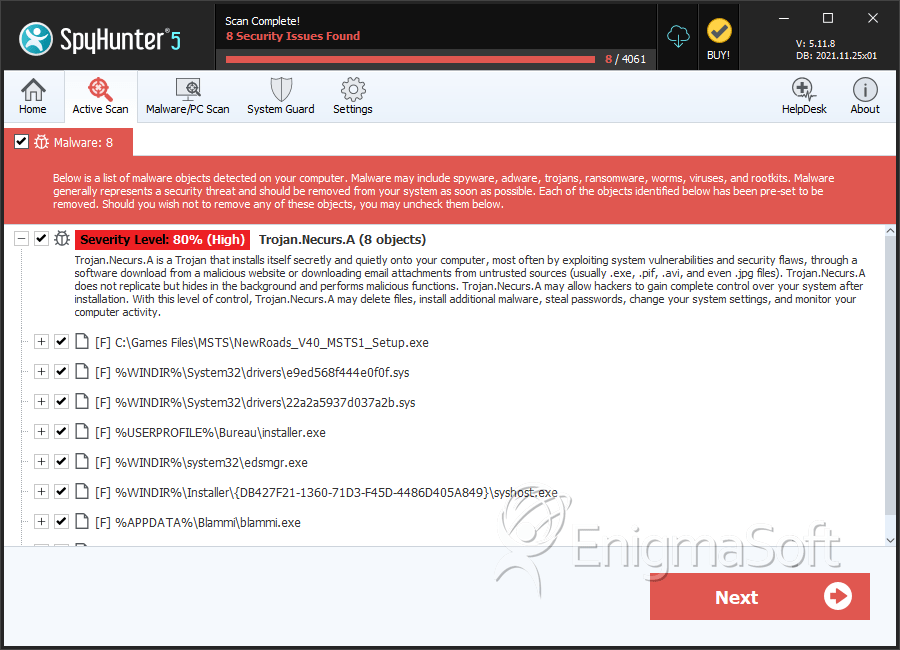
File System Details
| # | File Name | MD5 |
Detections
Detections: The number of confirmed and suspected cases of a particular threat detected on
infected computers as reported by SpyHunter.
|
|---|---|---|---|
| 1. | NewRoads_V40_MSTS1_Setup.exe | fe6029c6dd77e373e51568c8c78b650e | 225 |
| 2. | e9ed568f444e0f0f.sys | 45965a29086a6943c08951dc7061eeab | 7 |
| 3. | syshost.exe | 7063a79e9065bdb51072478eca7a470c | 6 |
| 4. | 22a2a5937d037a2b.sys | 075f1f21fd1dcf6c7f1144cc2e9fe3b6 | 5 |
| 5. | 147.sys | ec44ddcec6418a6bcd83b02ae38f1b09 | 4 |
| 6. | installer.exe | 4250135cb2e36bbc0fd16953d8dd5b51 | 3 |
| 7. | Recycle.Bin.exe | 4fdd0faad2727aa09c87c7b0cb27354a | 3 |
| 8. | edsmgr.exe | 22efaf078dd62016c49020143877fd0d | 3 |
| 9. | blammi.exe | 6c7bfaf7d9a4cdfffbe4d402c7001e56 | 2 |
| 10. | 6ef24294c953172f.sys | 72a6c1fd16ed06bb7b1474de33b78a49 | 2 |
| 11. | 41fb2af0cd745ae6.exe | 4256f11cbc40be771917f88b36d2f4fc | 1 |
| 12. | 0.3826909899607682.exe | 1d81e09b7dbc01068d3572ac9eb2f512 | 1 |
| 13. | 2479e.sys | ed8a2b1018f0b3e846b088b7bbe51585 | 1 |
| 14. | a657181eb7ee61.sys | 87a6954ec6a20cb2c6d590dbf2d18f2d | 1 |
| 15. | c7b1929d221268f1.sys | 2e992a5c03ed97cf415e49e3b08ea6eb | 1 |
| 16. | 7a513dead4b2135e.sys | f528a809992ea627e670e5c8d1c8fdff | 1 |
| 17. | e42239653e830f5b.sys | 0907292986e05a8752bc1863556d229e | 1 |
| 18. | b67753265c84af4.sys | 1fb5b5f1e8ee11c948c0389ede1f8e8e | 1 |
| 19. | 5071c.sys | 8f9ebee084f45c6b7378ea9c3bbbcea5 | 1 |
| 20. | 86dadcaae13b6bc6.sys | 279e87cc664b6e77c05560e45ef517f1 | 1 |
| 21. | 662f2.sys | 4e760d8f966a1d9f3bbe4afeb336e9da | 1 |
| 22. | 61a57491bc0649b8.sys | 8c55911cde8dd5c45e6be123f6ceaca1 | 1 |
| 23. | edsmgr.exe | ||
| 24. | 121ecb4.sys | ||
| 25. | Recycle.Bin.exe | ||
| 26. | 41fb2af0cd745ae6.exe |
Analysis Report
General information
| Family Name: | Trojan.Necurs.A |
|---|---|
| Signature status: | No Signature |
Known Samples
Known Samples
This section lists other file samples believed to be associated with this family.|
MD5:
8f4bf05cee776bec34d66dae045faca4
SHA1:
a9053bcb206ff07b7534e7c4cee1740e3cc01338
SHA256:
0E0B83B3BE0DB72343B053A7AD47B04043C5ABF003A54DDA93FB14221B52DF29
File Size:
2.11 MB, 2114560 bytes
|
|
MD5:
5e31e3fbfcbfc0a132bae3635407052b
SHA1:
46b851b774185eb46947b43d07e8c2162ce8378c
SHA256:
BB14480F7DBBAE7864DCE56E853AE8338F10887780D01EE7A8848B8E64704712
File Size:
1.91 MB, 1910784 bytes
|
Windows Portable Executable Attributes
- File doesn't have "Rich" header
- File doesn't have debug information
- File doesn't have exports table
- File doesn't have security information
- File has TLS information
- File is 32-bit executable
- File is either console or GUI application
- File is GUI application (IMAGE_SUBSYSTEM_WINDOWS_GUI)
- File is Native application (NOT .NET application)
- File is not packed
Show More
- IMAGE_FILE_DLL is not set inside PE header (Executable)
- IMAGE_FILE_EXECUTABLE_IMAGE is set inside PE header (Executable Image)
File Icons
File Icons
This section displays icon resources found within family samples. Malware often replicates icons commonly associated with legitimate software to mislead users into believing the malware is safe.


File Traits
- No Version Info
- x86
Block Information
Block Information
During analysis, EnigmaSoft breaks file samples into logical blocks for classification and comparison with other samples. Blocks can be used to generate malware detection rules and to group file samples into families based on shared source code, functionality and other distinguishing attributes and characteristics. This section lists a summary of this block data, as well as its classification by EnigmaSoft. A visual representation of the block data is also displayed, where available.| Total Blocks: | 5,344 |
|---|---|
| Potentially Malicious Blocks: | 56 |
| Whitelisted Blocks: | 4,806 |
| Unknown Blocks: | 482 |
Visual Map
? - Unknown Block
x - Potentially Malicious Block
Windows API Usage
Windows API Usage
This section lists Windows API calls that are used by the samples in this family. Windows API usage analysis is a valuable tool that can help identify malicious activity, such as keylogging, security privilege escalation, data encryption, data exfiltration, interference with antivirus software, and network request manipulation.| Category | API |
|---|---|
| Network Winsock2 |
|


