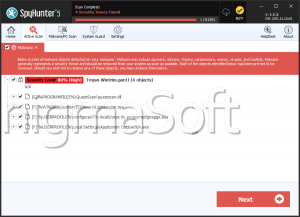
MonsterV2 Malware
Cybersecurity researchers have recently exposed a previously undocumented threat actor, tracked as TA585, that has been running sophisticated phishing and web-injection campaigns to deliver an off‑the‑shelf malware family known as MonsterV2.
Table of Contents
TA585 — An Operator That Owns The Full Kill Chain
TA585 stands out because it appears to control its entire attack chain end‑to‑end. Rather than buying distribution, leasing access from initial‑access brokers, or relying on third‑party traffic services, TA585 manages its own infrastructure, delivery mechanics, and installation tooling. Analysts describe the cluster as sophisticated: the actor uses web injections, filtering, and environment checks, and multiple delivery techniques to maximize success and avoid analysis.
Phishing, ClickFix, and IRS‑themed lures — the social engineering playbook
Early campaigns relied on classic phishing lures themed around the U.S. Internal Revenue Service (IRS). Targets received messages that pointed to fake URLs, which opened a PDF; that PDF contained a link to a web page that used the ClickFix social‑engineering tactic. ClickFix tricks a victim into running a command via the Windows Run dialog or a PowerShell terminal, which then executes a follow‑on PowerShell script to pull and deploy MonsterV2.
Web Injections And Fake CAPTCHA Overlays
In subsequent waves seen in April 2025, TA585 shifted to compromising legitimate websites via malicious JavaScript injections. Those injections produced fake CAPTCHA verification overlays that again triggered the ClickFix flow and ultimately launched a PowerShell command to download and start the malware. The JavaScript inject and related infrastructure (notably intlspring.com) have also been linked to distribution of other stealers, including Rhadamanthys Stealer.
GitHub Abuse And Bogus Security Notices
A third set of TA585 campaigns abused GitHub's notification mechanics: the actor tagged GitHub users in fraudulent 'security' notices that contained URLs directing victims to actor‑controlled sites. These bogus GitHub alerts were another vector used to drive victims into the same ClickFix/PowerShell chain.
CoreSecThree Framework — The Delivery Backbone
The web‑inject and fake‑GitHub activity clusters have been associated with CoreSecThree, a framework characterized by researchers as 'sophisticated' and in use since February 2022. CoreSecThree has been consistently used to propagate stealer malware across multiple campaigns.
MonsterV2 — Origins and Variants
MonsterV2 is a multi‑purpose threat: a remote access trojan (RAT), stealer, and loader. Researchers first saw it being advertised on criminal forums in February 2025. It's also referenced as 'Aurotun Stealer' (a misspelling of 'autorun') and has previously been distributed via CastleLoader (also known as CastleBot). Earlier iterations of TA585 activity distributed Lumma Stealer before an early‑2025 pivot to MonsterV2.
Commercial Model And Geofencing
MonsterV2 is sold by a Russian‑speaking operator. Pricing observed on criminal marketplaces: the Standard edition at USD 800 per month, and an Enterprise edition at USD 2,000 per month. The Enterprise tier includes stealer + loader, Hidden VNC (HVNC), and Chrome DevTools Protocol (CDP) support. The stealer component is configured to avoid infecting Commonwealth of Independent States (CIS) countries.
Packing, Anti‑analysis, And Runtime Behavior
MonsterV2 is typically packed with a C++ crypter named SonicCrypt. SonicCrypt provides layered anti‑analysis checks prior to decrypting and loading the payload, enabling detection evasion. At runtime the payload decrypts, resolves Windows API functions it requires, and attempts privilege elevation. It then decodes an embedded configuration which instructs it how to contact its Command‑and‑Control (C2) and what actions to take.
The config flags used by MonsterV2 include:
- anti_dbg — when True, the malware attempts to detect and evade debuggers.
- anti_sandbox — when True, the malware attempts sandbox detection and uses rudimentary anti‑sandbox techniques.
- aurotun — when True, the malware attempts to establish persistence (the misspelling is the source of the 'Aurotun' name).
- priviledge_escalation — when True, the malware attempts to elevate privileges on the host.
Networking And C2 Behavior
If MonsterV2 successfully reaches its C2, it first sends basic system telemetry and geolocation by querying a public service (researchers observed requests to api.ipify.org). The C2 response contains the commands to execute. In some observed operations, MonsterV2‑dropped payloads were configured to use the same C2 server as other payloads (for example, StealC), although those other campaigns were not directly attributed to TA585.
The documented capabilities of MonsterV2 are:
- Steal sensitive data and exfiltrate it to the server.
- Execute arbitrary commands via cmd.exe or PowerShell.
- Terminate, suspend, or resume processes.
- Establish HVNC connections to the infected host.
- Capture desktop screenshots.
- Run a keylogger.
- Enumerate, manipulate, copy, and exfiltrate files.
- Shut down or crash the system.
- Download and execute next‑stage payloads (examples observed: StealC and Remcos RAT).
Mitigation And Detection Guidance
Defenders should treat TA585 as a capable, vertically integrated operator that blends social engineering, site compromise, and layered anti‑analysis techniques. Detection opportunities include: monitoring for suspicious PowerShell/Run dialog activity originating from web‑based flows, identifying anomalous JavaScript injections on legitimate sites, blocking known SonicCrypt‑packed binaries via behavioral detections, and flagging unexpected HVNC/remote‑control connections and file exfiltration patterns. Monitoring for communications to unusual C2 hosts and queries to public IP‑discovery services (e.g., api.ipify.org) in conjunction with outbound data transfers may also uncover infections.
Summary
TA585 represents a resilient threat actor that retains control over distribution, delivery, and payload operation. By combining phishing, site‑level JavaScript injection, fake CAPTCHA overlays, and the commercial MonsterV2 payload (packed with SonicCrypt), the actor has assembled a reliable, multi‑vector capability for data theft and remote control. Given the actor's operational maturity and the modular feature set of MonsterV2, organizations should prioritize detection of web‑driven command launches, PowerShell download‑execute chains, SonicCrypt‑packed binaries, and suspicious HVNC or exfiltration activity.