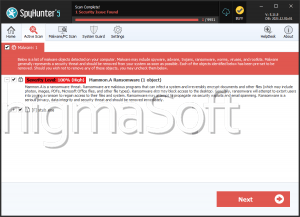
Mammon Ransomware
Malware threats continue to evolve, targeting individuals and organizations alike. One particularly destructive type is ransomware, which encrypts files and demands a ransom to restore access supposedly. A harmful threat tracked as the Mammon Ransomware has been noted for its aggressive tactics. Understanding how it works—and how to protect against it—is crucial for anyone who values their data.
Table of Contents
Inside the Mammon Ransomware Threat
The Mammon Ransomware is a newly identified malware strain with no relation to a previous threat of the same name that was linked to the Makop family. This version operates by encrypting data on a compromised system and altering filenames to include the attacker's email address, a unique victim ID, and the extension '.aaabbbccc.'
For example, a file originally named '1.png' might appear '1.png.email-[james.shaw.junior@gmail.com]id-[NHIJZ638YS].aaabbbccc.'
Once encryption is complete, a ransom note named howtoDecrypt.txt is placed on the system. Victims are informed that their data has been locked and are instructed to pay within 72 hours to receive a decryption tool. A test decryption is often offered, but this tactic is unreliable—many victims never receive working tools after payment.
How the Mammon Ransomware Spreads
Mammon uses various infection vectors to reach its victims. Cybercriminals rely heavily on deception and social engineering to distribute this ransomware. These methods often exploit user trust or inattention to slip past defenses.
Standard delivery methods include phishing emails with unsafe attachments or links, malware-laced software from suspicious sources, exploit kits delivered via fake update pop-ups or malvertising and infected external drives. The ransomware may also arrive through pirated software bundled with hidden loaders or silently through drive-by downloads triggered by simply visiting compromised websites.
Moreover, some variants are able to propagate across local networks or through removable media, increasing the damage exponentially in poorly secured environments.
The Ransom Trap: Why Paying isn’t a Solution
Victims often feel pressured to pay the ransom in hopes of regaining access to the unusable files. However, this route is highly discouraged by cybersecurity experts for several key reasons:
- No guarantee of recovery: Many attackers never provide working decryption tools, even after payment.
- Funding future crimes: Ransom payments encourage cybercriminals to continue and expand their operations.
- Risk of re-targeting: Paying once may label victims as easy marks for future attacks.
If backups are unavailable or compromised, recovery becomes difficult. However, paying a ransom remains a gamble that often results in additional financial losses.
Defending against Ransomware: Best Practices for Device Security
While ransomware like Mammon is threatening, there are practical and feasible ways to reduce your risk. The best defense lies in a combination of technical protection, cautious behavior and data resilience.
- Strengthen Your System Security
- Keep your security tools, operating system and software up to date.
- Use a reliable anti-malware solution with real-time protection.
- Block macros in documents from unknown sources.
- Enable system firewalls and restrict admin privileges.
- Scan all external devices before use.
- Build a Solid Backup Strategy
- Maintain backups in at least two separate and secure locations, such as offline drives and encrypted cloud services.
- Automate backup processes and verify that files can be restored successfully.
- Avoid connecting backup storage to devices unless necessary to prevent cross-contamination.
- Practice Smart Digital Habits
- Never access email attachments or links from unknown or untrusted senders.
- Avoid downloading software from unofficial websites or peer-to-peer networks.
- Be cautious of advertisements or pop-ups claiming urgent updates or alerts.
- Use tough, unique passwords and set up two-factor authentication where possible.
- Educate yourself and your crew on recognizing phishing and misleading tactics.
The Mammon Ransomware exemplifies the growing complexity and ruthlessness of cyber threats in the modern digital landscape. Its ability to lock down valuable files and demand payment puts individuals and organizations under extreme pressure. But with a proactive mindset, layered security measures, and a disciplined approach to data safety, you can significantly reduce the plausibility of falling victim to such attacks.