JS/ProxyChanger.CW
Threat Scorecard
EnigmaSoft Threat Scorecard
EnigmaSoft Threat Scorecards are assessment reports for different malware threats which have been collected and analyzed by our research team. EnigmaSoft Threat Scorecards evaluate and rank threats using several metrics including real-world and potential risk factors, trends, frequency, prevalence, and persistence. EnigmaSoft Threat Scorecards are updated regularly based on our research data and metrics and are useful for a wide range of computer users, from end users seeking solutions to remove malware from their systems to security experts analyzing threats.
EnigmaSoft Threat Scorecards display a variety of useful information, including:
Popularity Rank: The ranking of a particular threat in EnigmaSoft’s Threat Database.
Severity Level: The determined severity level of an object, represented numerically, based on our risk modeling process and research, as explained in our Threat Assessment Criteria.
Infected Computers: The number of confirmed and suspected cases of a particular threat detected on infected computers as reported by SpyHunter.
See also Threat Assessment Criteria.
| Popularity Rank: | 10,584 |
| Threat Level: | 90 % (High) |
| Infected Computers: | 625 |
| First Seen: | January 23, 2017 |
| Last Seen: | July 14, 2026 |
| OS(es) Affected: | Windows |
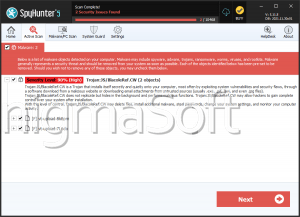
JS/ProxyChanger.CW is a detection name used by cyber security specialists to specify a Trojan written in JavaScript and used to alter the proxy settings on remote systems. JS/ProxyChanger.CW is a Trojan that uses an automatic configuration script to force users into using a particular proxy. The result is that the user's network traffic is routed to a server operated by a threat actor. Consequently, the data you sent and receive can be recorded, analyzed, modified and decrypted by a third-party. The operations of the JS/ProxyChanger.CW Trojan require an automatic configuration script that is packed as 'wpad.dat.' The Windows OS generates 'wpad.dat' when you choose the 'Detect Settings Automatically' option in the Local Area Network (LAN) Settings panel. However, the JS/ProxyChanger.CW Trojan is programmed to connect to a remote host and download a foreign Web Proxy Auto-Discovery Protocol (wpad.dat) file and reroute your traffic to servers under the control of a third-party.
JS/ProxyChanger.CW works very similarly to browser hijacking add-ons and threats like AutoConfigUrl and Hijack.AutoconfigURL. PC security researchers report that the JS/ProxyChanger.CW Trojan is used in attacks on regular computer users and members of corporate networks alike. JS/ProxyChanger.CW can be introduced to computers via tools like RIG and Infinity that exploit vulnerabilities in plug-ins like Adobe Flash and Java. Also, free program bundles offered on untrusted pages may include JS/ProxyChanger.CW and make modifications to the LAN settings of the user as part of an 'Internet optimization.' The JS/ProxyChanger.CW threat has the potential to redirect users to phishing pages and allow third parties to deploy Man-in-the-Middle (MITM) attacks. PC users that suspect JS/ProxyChanger.CW hijacked their Internet configuration may want to scan their OSes with a trustworthy anti-malware scanner.
Table of Contents
Analysis Report
General information
| Family Name: | Trojan.Zegost.G |
|---|---|
| Signature status: | No Signature |
Known Samples
Known Samples
This section lists other file samples believed to be associated with this family.|
MD5:
856d7c307e4a7ae28b56c1607453281c
SHA1:
ea2be3bfe060a15185a80ff59836b5db23f59a62
SHA256:
61F23E795677D7BC9E4A71B7D59D4ED285330D6AC5DDB24DF449BEE53EB77AB6
File Size:
63.49 KB, 63488 bytes
|
Windows Portable Executable Attributes
- File doesn't have "Rich" header
- File doesn't have debug information
- File doesn't have exports table
- File doesn't have relocations information
- File doesn't have security information
- File is 32-bit executable
- File is either console or GUI application
- File is GUI application (IMAGE_SUBSYSTEM_WINDOWS_GUI)
- File is Native application (NOT .NET application)
- File is not packed
Show More
- IMAGE_FILE_DLL is not set inside PE header (Executable)
- IMAGE_FILE_EXECUTABLE_IMAGE is set inside PE header (Executable Image)
Windows PE Version Information
Windows PE Version Information
This section displays values and attributes that have been set in the Windows file version information data structure for samples within this family. To mislead users, malware actors often add fake version information mimicking legitimate software.| Name | Value |
|---|---|
| File Description | Gh0st Microsoft 基础类应用程序 |
| File Version | 1, 0, 0, 1 |
| Internal Name | Gh0st |
| Legal Copyright | 版权所有 (C) 2014 |
| Original Filename | Gh0st.EXE |
| Product Name | Gh0st 应用程序 |
| Product Version | 1, 0, 0, 1 |
File Traits
- x86
Block Information
Block Information
During analysis, EnigmaSoft breaks file samples into logical blocks for classification and comparison with other samples. Blocks can be used to generate malware detection rules and to group file samples into families based on shared source code, functionality and other distinguishing attributes and characteristics. This section lists a summary of this block data, as well as its classification by EnigmaSoft. A visual representation of the block data is also displayed, where available.| Total Blocks: | 72 |
|---|---|
| Potentially Malicious Blocks: | 50 |
| Whitelisted Blocks: | 14 |
| Unknown Blocks: | 8 |
Visual Map
? - Unknown Block
x - Potentially Malicious Block
Files Modified
Files Modified
This section lists files that were created, modified, moved and/or deleted by samples in this family. File system activity can provide valuable insight into how malware functions on the operating system.| File | Attributes |
|---|---|
| c:\windows\syswow64\11313781.txt | Generic Write,Read Attributes |
Windows API Usage
Windows API Usage
This section lists Windows API calls that are used by the samples in this family. Windows API usage analysis is a valuable tool that can help identify malicious activity, such as keylogging, security privilege escalation, data encryption, data exfiltration, interference with antivirus software, and network request manipulation.| Category | API |
|---|---|
| Network Winsock2 |
|
| Anti Debug |
|
| User Data Access |
|
| Network Info Queried |
|