Adware.OpenSUpdater.JC
Threat Scorecard
EnigmaSoft Threat Scorecard
EnigmaSoft Threat Scorecards are assessment reports for different malware threats which have been collected and analyzed by our research team. EnigmaSoft Threat Scorecards evaluate and rank threats using several metrics including real-world and potential risk factors, trends, frequency, prevalence, and persistence. EnigmaSoft Threat Scorecards are updated regularly based on our research data and metrics and are useful for a wide range of computer users, from end users seeking solutions to remove malware from their systems to security experts analyzing threats.
EnigmaSoft Threat Scorecards display a variety of useful information, including:
Popularity Rank: The ranking of a particular threat in EnigmaSoft’s Threat Database.
Severity Level: The determined severity level of an object, represented numerically, based on our risk modeling process and research, as explained in our Threat Assessment Criteria.
Infected Computers: The number of confirmed and suspected cases of a particular threat detected on infected computers as reported by SpyHunter.
See also Threat Assessment Criteria.
| Popularity Rank: | 13,427 |
| Threat Level: | 20 % (Normal) |
| Infected Computers: | 154 |
| First Seen: | July 26, 2024 |
| Last Seen: | August 5, 2026 |
| OS(es) Affected: | Windows |
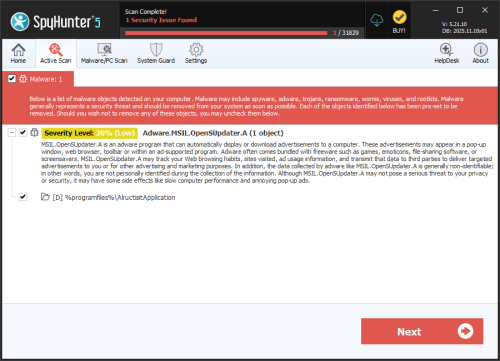
The detection of Adware.OpenSUpdater.JC on your system indicates the presence of a potentially unwanted program that may be causing unwanted advertisements and potentially collecting user data without consent. Adware, short for advertising-supported software, is a type of software that displays advertisements on your computer, often in the form of pop-ups, banners, or sponsored content. While not all adware is malicious, it can still cause significant disruptions to your computing experience and may pose privacy risks.
Table of Contents
What Is Adware.OpenSUpdater.JC?
Adware.OpenSUpdater.JC refers to a specific detection of adware that has been identified on your system. The name suggests it is related to adware, but without more specific information, it's challenging to determine its exact nature or how it operates beyond typical adware behaviors. Adware can be installed on your computer through various means, including bundled software downloads, infected websites, or email attachments. Once installed, adware can monitor your browsing habits, collect data about your online activities, and use this information to display targeted advertisements.
How Adware.OpenSUpdater.JC Operates
Adware programs, including Adware.OpenSUpdater.JC, typically operate by integrating themselves into your web browser or installing as a standalone application. They may alter your browser settings, such as changing your homepage or default search engine, to display more advertisements. Some adware can also track your browsing history, search queries, and other data to serve personalized ads. This tracking capability raises significant privacy concerns, as it can potentially lead to the misuse of your personal data.
Symptoms of Infection
Symptoms of an adware infection can vary but often include an increase in unwanted advertisements, such as pop-ups, banners, or in-text ads. You might also notice that your web browser is slower than usual, crashes frequently, or that your homepage or default search engine has been changed without your consent. Additionally, you might observe unfamiliar programs or toolbars in your browser that you did not install. These symptoms can significantly impact your computing experience, making it frustrating to use your computer for everyday tasks.
How to Remove Adware.OpenSUpdater.JC
- Boot your computer in Safe Mode with Networking to prevent the adware from loading and to give you a clean environment to work in.
- Perform a full scan of your computer using a reputable anti-malware tool, such as SpyHunter, to detect and remove all traces of the adware.
- Uninstall any suspicious programs that you do not recognize or that were installed around the time the adware was detected.
- Reset your web browsers (Chrome, Firefox, Edge, etc.) to their default settings to remove any changes made by the adware, such as altered homepages or search engines.
- Reboot your computer and perform another scan with your anti-malware tool to ensure that all components of the adware have been removed.
Conclusion
Removing Adware.OpenSUpdater.JC from your system is crucial to restoring your privacy and improving your overall computing experience. By following the steps outlined above, you can effectively remove this unwanted software and protect your system from similar threats in the future. It's also important to practice safe computing habits, such as avoiding suspicious downloads, using strong antivirus software, and regularly updating your operating system and applications to prevent future infections.
Analysis Report
General information
| Family Name: | Adware.OpenSUpdater.JC |
|---|---|
| Signature status: | No Signature |
Known Samples
Known Samples
This section lists other file samples believed to be associated with this family.|
MD5:
8ae9222fef368ff794dd5ca836581789
SHA1:
06d49d661aff5ef57d61ddbc40c00e113fcaeaa4
SHA256:
316D328C339D253C60EF291C10C54C06657B3A0BF7BA83EF0170919E3CA0183A
File Size:
451.61 KB, 451612 bytes
|
|
MD5:
841a81593f7b37776a6d56bd5048953a
SHA1:
e2f82df326592f59fdbec5b4c62c4dd76f80e4bc
SHA256:
5DF8B19507A172EBEF7904F60401B8B4931BA8252242BCD038903D7690659049
File Size:
507.50 KB, 507503 bytes
|
|
MD5:
b8a3c2257f8586c27af77a54812b26f7
SHA1:
15e3b4118d606468ecdd23ec681df4b718a962d6
SHA256:
45812A0F76BC05B152AD0836BE78EA60B979E8B479F72086E3EEB4E94C9B96F4
File Size:
502.51 KB, 502514 bytes
|
|
MD5:
5781a21fce5679576acb48862c3b041b
SHA1:
884f75c1a4c32135298d912c3e027df0857f330d
SHA256:
FA183A18588E47CCC693D5B42A5EBA403BE63901C3F31E0564A253ADA430FB83
File Size:
471.18 KB, 471180 bytes
|
|
MD5:
389558b27a1687e35dd5cf10aa00646d
SHA1:
983fdcd0b4c2feaeb84c17484a1178f346ebf5e9
SHA256:
FCAA78E3224FC34D0BD34EBDEE2FE4BA634E0994C5070D7DA0161DF7C327B6A3
File Size:
507.76 KB, 507765 bytes
|
Show More
|
MD5:
dedf3d77729a06ddfaec9c9f8c7b5d86
SHA1:
d0ff126eea94b9eac151cb33563f4bb0b459134b
SHA256:
6D9291246801AFD3AD81ED5A094239ADD3721C7C44CC3C47B016E325AE4369D0
File Size:
480.32 KB, 480323 bytes
|
|
MD5:
77f474be6c75e1fb6b03e1903ace2e53
SHA1:
fb7da9bad3fdcded26c435bb6d004008a14d557c
SHA256:
F594CB641FC0A7C8E8A08998F2AA721ECD47C40141E012D58D14A6E8E7B79E96
File Size:
566.71 KB, 566710 bytes
|
|
MD5:
af06592a4938d92a7d7d4cf6004a641a
SHA1:
6e9a4ad489c9c1e4d01dc97a8f58a0a210f5f77a
SHA256:
4AE6C689D41C61829A4CE10520BFB6E111EC30548B9D7108447926738755A877
File Size:
487.11 KB, 487113 bytes
|
|
MD5:
cbc48fdfd70a6cd8cca73191e19ede54
SHA1:
a2d094a530b9014fce40d94d5056d5d2ee957d09
SHA256:
6146806603E97F6AF00C5EE2DE4005071E653B08EC7BFC18CAEE4C1F79052EE3
File Size:
486.21 KB, 486211 bytes
|
Windows Portable Executable Attributes
- File doesn't have "Rich" header
- File doesn't have exports table
- File doesn't have security information
- File has TLS information
- File is 32-bit executable
- File is either console or GUI application
- File is GUI application (IMAGE_SUBSYSTEM_WINDOWS_GUI)
- File is Native application (NOT .NET application)
- File is not packed
- IMAGE_FILE_DLL is not set inside PE header (Executable)
Show More
- IMAGE_FILE_EXECUTABLE_IMAGE is set inside PE header (Executable Image)
File Icons
File Icons
This section displays icon resources found within family samples. Malware often replicates icons commonly associated with legitimate software to mislead users into believing the malware is safe.


File Traits
- big overlay
- No Version Info
- x86
Block Information
Block Information
During analysis, EnigmaSoft breaks file samples into logical blocks for classification and comparison with other samples. Blocks can be used to generate malware detection rules and to group file samples into families based on shared source code, functionality and other distinguishing attributes and characteristics. This section lists a summary of this block data, as well as its classification by EnigmaSoft. A visual representation of the block data is also displayed, where available.| Total Blocks: | 465 |
|---|---|
| Potentially Malicious Blocks: | 28 |
| Whitelisted Blocks: | 437 |
| Unknown Blocks: | 0 |
Visual Map
? - Unknown Block
x - Potentially Malicious Block
Similar Families
Similar Families
This section lists other families that share similarities with this family, based on EnigmaSoft’s analysis. Many malware families are created from the same malware toolkits and use the same packing and encryption techniques but uniquely extend functionality. Similar families may also share source code, attributes, icons, subcomponents, compromised and/or invalid digital signatures, and network characteristics. Researchers leverage these similarities to rapidly and effectively triage file samples and extend malware detection rules.- PSW.Agent.Z
- ShellCode.AN
- Trojan.Agent.Gen.ABT