Worm.Autorun.A
Threat Scorecard
EnigmaSoft Threat Scorecard
EnigmaSoft Threat Scorecards are assessment reports for different malware threats which have been collected and analyzed by our research team. EnigmaSoft Threat Scorecards evaluate and rank threats using several metrics including real-world and potential risk factors, trends, frequency, prevalence, and persistence. EnigmaSoft Threat Scorecards are updated regularly based on our research data and metrics and are useful for a wide range of computer users, from end users seeking solutions to remove malware from their systems to security experts analyzing threats.
EnigmaSoft Threat Scorecards display a variety of useful information, including:
Popularity Rank: The ranking of a particular threat in EnigmaSoft’s Threat Database.
Severity Level: The determined severity level of an object, represented numerically, based on our risk modeling process and research, as explained in our Threat Assessment Criteria.
Infected Computers: The number of confirmed and suspected cases of a particular threat detected on infected computers as reported by SpyHunter.
See also Threat Assessment Criteria.
| Popularity Rank: | 12,275 |
| Threat Level: | 50 % (Medium) |
| Infected Computers: | 3,082 |
| First Seen: | November 10, 2016 |
| Last Seen: | September 21, 2026 |
| OS(es) Affected: | Windows |
The detection of Worm.Autorun.A on your system indicates a potential security threat that requires immediate attention. This type of malware is designed to replicate itself and spread to other computers, making it a significant concern for both individual users and network administrators. In this report, we will provide an overview of Worm.Autorun.A, its operating methods, symptoms of infection, and steps to remove it from your system.
Table of Contents
What Is Worm.Autorun.A?
Worm.Autorun.A is a type of malware that falls under the category of worms. Worms are self-replicating malware that can spread from system to system without the need for human interaction. They often exploit vulnerabilities in operating systems or applications to infect computers. The name Worm.Autorun.A suggests it may utilize the autorun feature, which allows malicious code to execute automatically when an infected device is connected to a computer.
How Worm.Autorun.A Operates
Worm.Autorun.A, like other worms, operates by replicating itself and spreading to other computers. It can use various methods to propagate, including exploiting network vulnerabilities, using infected removable storage devices, or through email attachments. Once a system is infected, the worm can perform a variety of malicious activities, such as stealing sensitive information, installing additional malware, or using the infected computer as part of a botnet for distributed denial-of-service (DDoS) attacks or spamming.
Symptoms of Infection
Symptoms of a Worm.Autorun.A infection can vary but may include slow system performance, frequent crashes, or unusual network activity. Infected systems may also exhibit signs of unauthorized access or changes to system settings. In some cases, the presence of the worm might not be immediately apparent, making regular system monitoring and antivirus scans crucial for early detection.
How to Remove Worm.Autorun.A
- Boot your computer in Safe Mode with Networking. This will help prevent the worm from loading and make it easier to remove.
- Perform a full scan of your system using a reputable antivirus tool, such as SpyHunter. Ensure your antivirus software is up to date to increase the chances of detecting and removing the worm.
- Uninstall any suspicious programs that you do not recognize or that were installed around the time you believe your system became infected.
- Reset your web browsers (Chrome, Firefox, Edge, etc.) to their default settings. This can help remove any malicious extensions or settings changes made by the worm.
- After completing the above steps, reboot your computer and perform another full scan with your antivirus software to ensure the worm has been completely removed.
Conclusion
The removal of Worm.Autorun.A requires careful and immediate action to prevent further damage and spread of the malware. By following the steps outlined above and maintaining good cybersecurity practices, such as regularly updating your operating system and applications, using strong antivirus software, and being cautious with email attachments and downloads, you can help protect your system from future infections. Remember, prevention and early detection are key to minimizing the impact of malware infections.
SpyHunter Detects & Remove Worm.Autorun.A
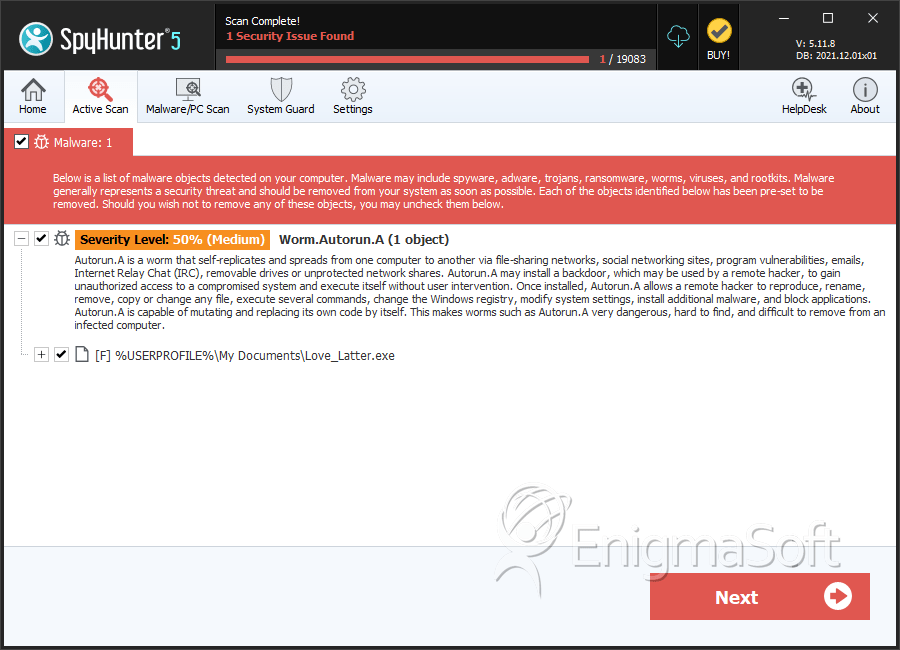
File System Details
| # | File Name | MD5 |
Detections
Detections: The number of confirmed and suspected cases of a particular threat detected on
infected computers as reported by SpyHunter.
|
|---|---|---|---|
| 1. | Love_Latter.exe | 7f35eb81aa1c2a8bcf12f79965831ba8 | 51 |
Analysis Report
General information
| Family Name: | Worm.Autorun.A |
|---|---|
| Packers: | UPX |
| Signature status: | No Signature |
Known Samples
Known Samples
This section lists other file samples believed to be associated with this family.|
MD5:
3ee98bfe43a9b94090d51894bd869d44
SHA1:
f0d4d0fcc4b5fef0d47df1324c89526f8fb4f31d
SHA256:
295AFB2D8144334A6053A91284F49912927BEF6BEF7C7F63952EB6D320E2742F
File Size:
229.45 KB, 229453 bytes
|
|
MD5:
77eefa43b8edf497e93b40f9a48efadd
SHA1:
d7f7704945c319f03246a9e38a5873c32c2c8401
SHA256:
59EB613C95CAAB43ED41A05DE3DDBC9A1A2E725AB8459231EEB59F56270ADCF2
File Size:
1.79 MB, 1785859 bytes
|
|
MD5:
8f93e85e0484522a4317f9c702653ec1
SHA1:
d4066815291fdbc36b0616626295fbae7f3bddfe
SHA256:
0E14C79FC86EBA6C1E55F9E571FD2AF125A6076394CEFDBD16326338E736FCB7
File Size:
985.47 KB, 985467 bytes
|
|
MD5:
a561370c3fe3c4fce8a08c54babacb2d
SHA1:
1ad421d906818641476de4e4116f25930c7ae389
SHA256:
2CEA878A0E390836649414E2987CF629A6B7D2626DCA9F13BCF626F27B590C4A
File Size:
253.56 KB, 253555 bytes
|
Windows Portable Executable Attributes
- File doesn't have "Rich" header
- File doesn't have debug information
- File doesn't have exports table
- File doesn't have relocations information
- File doesn't have security information
- File has been packed
- File has TLS information
- File is 32-bit executable
- File is either console or GUI application
- File is GUI application (IMAGE_SUBSYSTEM_WINDOWS_GUI)
Show More
- File is Native application (NOT .NET application)
- File is not packed
- IMAGE_FILE_DLL is not set inside PE header (Executable)
- IMAGE_FILE_EXECUTABLE_IMAGE is set inside PE header (Executable Image)
File Icons
File Icons
This section displays icon resources found within family samples. Malware often replicates icons commonly associated with legitimate software to mislead users into believing the malware is safe.


Windows PE Version Information
Windows PE Version Information
This section displays values and attributes that have been set in the Windows file version information data structure for samples within this family. To mislead users, malware actors often add fake version information mimicking legitimate software.| Name | Value |
|---|---|
| Comments | idx.exe |
| Compiled Script | AutoIt v3 Script : 3, 2, 8, 1 |
| File Description | idx.exe |
| File Version |
|
| Legal Copyright | nikzzzz |
File Traits
- Autoit
- HighEntropy
- packed
- WriteProcessMemory
- x86
Block Information
Block Information
During analysis, EnigmaSoft breaks file samples into logical blocks for classification and comparison with other samples. Blocks can be used to generate malware detection rules and to group file samples into families based on shared source code, functionality and other distinguishing attributes and characteristics. This section lists a summary of this block data, as well as its classification by EnigmaSoft. A visual representation of the block data is also displayed, where available.| Total Blocks: | 1,451 |
|---|---|
| Potentially Malicious Blocks: | 121 |
| Whitelisted Blocks: | 1,330 |
| Unknown Blocks: | 0 |
Visual Map
? - Unknown Block
x - Potentially Malicious Block
Similar Families
Similar Families
This section lists other families that share similarities with this family, based on EnigmaSoft’s analysis. Many malware families are created from the same malware toolkits and use the same packing and encryption techniques but uniquely extend functionality. Similar families may also share source code, attributes, icons, subcomponents, compromised and/or invalid digital signatures, and network characteristics. Researchers leverage these similarities to rapidly and effectively triage file samples and extend malware detection rules.- Autorun.A
Files Modified
Files Modified
This section lists files that were created, modified, moved and/or deleted by samples in this family. File system activity can provide valuable insight into how malware functions on the operating system.| File | Attributes |
|---|---|
| c:\users\user\downloads\driver.idx | Generic Read,Write Data,Write Attributes,Write extended,Append data |
Windows API Usage
Windows API Usage
This section lists Windows API calls that are used by the samples in this family. Windows API usage analysis is a valuable tool that can help identify malicious activity, such as keylogging, security privilege escalation, data encryption, data exfiltration, interference with antivirus software, and network request manipulation.| Category | API |
|---|---|
| Anti Debug |
|
| User Data Access |
|


