Trojan.Win32.Neurevt
Threat Scorecard
EnigmaSoft Threat Scorecard
EnigmaSoft Threat Scorecards are assessment reports for different malware threats which have been collected and analyzed by our research team. EnigmaSoft Threat Scorecards evaluate and rank threats using several metrics including real-world and potential risk factors, trends, frequency, prevalence, and persistence. EnigmaSoft Threat Scorecards are updated regularly based on our research data and metrics and are useful for a wide range of computer users, from end users seeking solutions to remove malware from their systems to security experts analyzing threats.
EnigmaSoft Threat Scorecards display a variety of useful information, including:
Ranking: The ranking of a particular threat in EnigmaSoft’s Threat Database.
Severity Level: The determined severity level of an object, represented numerically, based on our risk modeling process and research, as explained in our Threat Assessment Criteria.
Infected Computers: The number of confirmed and suspected cases of a particular threat detected on infected computers as reported by SpyHunter.
See also Threat Assessment Criteria.
| Ranking: | 14,446 |
| Threat Level: | 80 % (High) |
| Infected Computers: | 905 |
| First Seen: | December 5, 2013 |
| Last Seen: | July 20, 2023 |
| OS(es) Affected: | Windows |
Trojan.Win32.Neurevt is a Trojan infection that may compromise your security, install other threats and damage to your computer. Like most Trojans, Trojan.Win32.Neurevt can spread using several means, including social engineering or taking advantage of other threats. The definition of a Trojan implies that, unlike other kinds of threats, these types of infections are not able to disseminate on their own from one machine to another and often require that the computer users themselves execute their content (this is why they have their name after the Trojan Horse from the Greek literature). Once Trojan.Win32.Neurevt has been installed, Trojan.Win32.Neurevt may open a path for third parties to access your PC, allowing them to take over your computer or carry out any number of known unsafe tactics. In case of a hint that your machine has been exposed to Trojan.Win32.Neurevt, PC security researchers advise removing Trojan.Win32.Neurevt immediately with the help of a strong, reliable anti-malware application.
Table of Contents
Trojan.Win32.Neurevt has been Associated with One Social Engineering Tactic in Particular
Security researchers have reported that Trojan.Win32.Neurevt spreads using several newer spam email campaigns that try to trick inexperienced computer users into opening a fake image file. By using spoofed email addresses, these corrupted email messages convince computer users that their friends have sent them an image or that a photo of them has been uploaded to a social networking website. Some examples of misleading tactics associated with Trojan.Win32.Neurevt include fake emails from T-Mobile that claim to be associated with MMS messages and bogus notifications from Instagram and other social networking services. Fake Instagram emails in particular have been linked to the Trojan.Win32.Neurevt infection.
The victim receives an email message claiming that a friend has uploaded a photo to the victim's Instagram account. These email messages are usually badly written, containing a large quantity of spelling and grammar errors that would normally not fool more experienced computer users. The attached file in these email messages is an executable file that has been disguised as a JPEG by using a double file extension in the file's name. To prevent Trojan.Win32.Neurevt infections, malware researchers strongly advise that computer users avoid opening unsolicited email attachments.
SpyHunter Detects & Remove Trojan.Win32.Neurevt
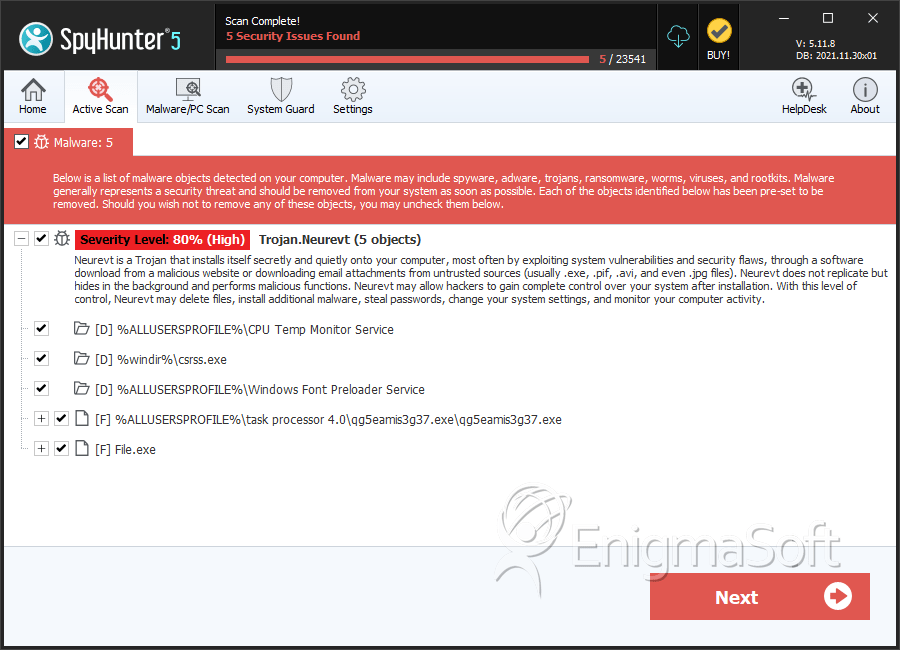
File System Details
| # | File Name | MD5 |
Detections
Detections: The number of confirmed and suspected cases of a particular threat detected on
infected computers as reported by SpyHunter.
|
|---|---|---|---|
| 1. | qg5eamis3g37.exe | 44303293b821c8e05cd9df77bacafc74 | 32 |
| 2. | 23-10-2013 13_64_09.jpeg.exe | ||
| 3. | File.exe | 4d6989bc140ba8d3fce6cd9cef507279 | 0 |
| 4. | file.exe | ef4fb201b46b0aac3fc73d27cbaa37d1 | 0 |
| 5. | file.exe | 3d8579c93c808a0b35e796c7ea601744 | 0 |
Directories
Trojan.Win32.Neurevt may create the following directory or directories:
| %ALLUSERSPROFILE%\CPU Temp Monitor Service |
| %ALLUSERSPROFILE%\Windows Font Preloader Service |
| %windir%\csrss.exe |




Submit Comment
Please DO NOT use this comment system for support or billing questions. For SpyHunter technical support requests, please contact our technical support team directly by opening a customer support ticket via your SpyHunter. For billing issues, please refer to our "Billing Questions or Problems?" page. For general inquiries (complaints, legal, press, marketing, copyright), visit our "Inquiries and Feedback" page.