Trojan.Delf.S
Threat Scorecard
EnigmaSoft Threat Scorecard
EnigmaSoft Threat Scorecards are assessment reports for different malware threats which have been collected and analyzed by our research team. EnigmaSoft Threat Scorecards evaluate and rank threats using several metrics including real-world and potential risk factors, trends, frequency, prevalence, and persistence. EnigmaSoft Threat Scorecards are updated regularly based on our research data and metrics and are useful for a wide range of computer users, from end users seeking solutions to remove malware from their systems to security experts analyzing threats.
EnigmaSoft Threat Scorecards display a variety of useful information, including:
Popularity Rank: The ranking of a particular threat in EnigmaSoft’s Threat Database.
Severity Level: The determined severity level of an object, represented numerically, based on our risk modeling process and research, as explained in our Threat Assessment Criteria.
Infected Computers: The number of confirmed and suspected cases of a particular threat detected on infected computers as reported by SpyHunter.
See also Threat Assessment Criteria.
| Popularity Rank: | 14,891 |
| Threat Level: | 90 % (High) |
| Infected Computers: | 114 |
| First Seen: | July 24, 2009 |
| Last Seen: | September 3, 2026 |
| OS(es) Affected: | Windows |
The detection of Trojan.Delf.S on your system indicates a potential security threat that requires immediate attention. This malware is designed to compromise the integrity of your computer, potentially leading to unauthorized access, data theft, and other malicious activities. It is essential to understand the nature of this threat and take prompt action to remove it and prevent future infections.
Table of Contents
What Is Trojan.Delf.S?
Trojan.Delf.S is a type of malware that disguises itself as a legitimate program or file, allowing it to bypass security measures and gain unauthorized access to your system. The name "Trojan" refers to the malicious program's ability to masquerade as something harmless, much like the Trojan Horse of legend. Once inside, it can cause significant damage, including data theft, system crashes, and the installation of additional malware.
How Trojan.Delf.S Operates
Malware like Trojan.Delf.S typically operates by exploiting vulnerabilities in software or tricking users into installing it. It may spread through various means, including infected email attachments, compromised websites, or infected software downloads. Once installed, it can communicate with its creators, allowing them to control your system remotely, steal sensitive information, or use your computer as part of a larger botnet for malicious activities.
Symptoms of Infection
Identifying a Trojan.Delf.S infection can be challenging, as it is designed to remain stealthy. However, some common symptoms include slow system performance, unexpected pop-ups, and unfamiliar programs or toolbars. You might also notice that your browser homepage has changed or that you are being redirected to suspicious websites. Additionally, your antivirus software may alert you to the presence of malware, although some Trojans are designed to evade detection.
- Unexplained changes in system settings or performance
- Appearance of unfamiliar programs or icons
- Frequent crashes or system freezes
- Unwanted pop-ups or browser redirects
How to Remove Trojan.Delf.S
- Boot your computer in Safe Mode with Networking to prevent the malware from loading and to allow for a clean environment to perform removal steps.
- Download and install a reputable anti-malware tool, such as SpyHunter, and perform a full scan of your system to detect and remove all traces of the malware.
- Manually uninstall any suspicious programs that were installed without your knowledge or consent, as these could be part of the malware or other unwanted programs.
- Reset your web browsers (Chrome, Firefox, Edge, etc.) to their default settings to remove any malicious extensions or settings changes made by the malware.
- Reboot your computer and perform another full scan with your anti-malware tool to ensure that all malware components have been removed.
Conclusion
Removing Trojan.Delf.S requires careful and thorough action to ensure that all components of the malware are eliminated from your system. By following the steps outlined above and maintaining vigilance in your online activities, you can help protect your computer and personal data from future threats. Regularly updating your operating system, browser, and other software, as well as using reputable security software, are key practices in preventing malware infections. Remember, prevention and prompt action are crucial in the fight against malware and other cyber threats.
Aliases
15 security vendors flagged this file as malicious.
| Antivirus Vendor | Detection |
|---|---|
| Panda | Trj/Downloader.MDW |
| NOD32 | probably a variant of Win32/TrojanDownloader.Delf |
| McAfee-GW-Edition | Trojan.Dldr.Delf.njq.1 |
| McAfee | Generic Downloader.x |
| Ikarus | Trojan-Downloader.Win32.Delf |
| F-Secure | Trojan-Downloader.Win32.Delf.njq |
| eSafe | Suspicious File |
| Comodo | TrojWare.Win32.TrojanDownloader.Delf.njq |
| BitDefender | Trojan.Generic.892770 |
| AVG | Downloader.Generic7.ANSL |
| Avast | Win32:Trojan-gen {Other} |
| Authentium | W32/Downldr2.EILE |
| Antiy-AVL | Trojan/Win32.Delf |
| AntiVir | TR/Dldr.Delf.njq.1 |
| AhnLab-V3 | Win-Trojan/Xema.variant |
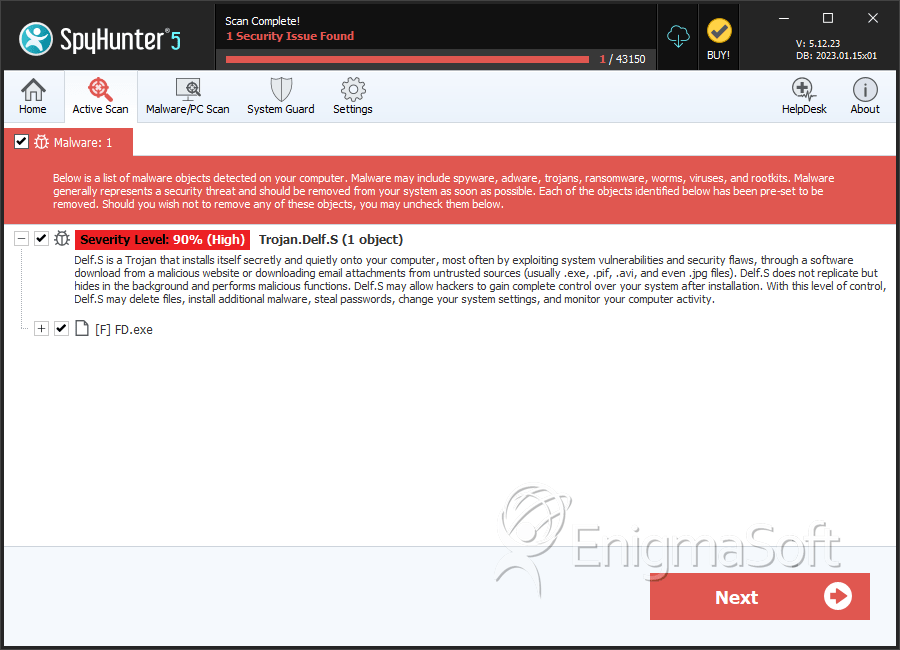
SpyHunter Detects & Remove Trojan.Delf.S
File System Details
| # | File Name | MD5 |
Detections
Detections: The number of confirmed and suspected cases of a particular threat detected on
infected computers as reported by SpyHunter.
|
|---|---|---|---|
| 1. | FD.exe | 5fcfa14bdfcd3d202225c826cf905143 | 0 |
Analysis Report
General information
| Family Name: | Trojan.Delf.S |
|---|---|
| Signature status: | No Signature |
Known Samples
Known Samples
This section lists other file samples believed to be associated with this family.|
MD5:
ae0dd3bb91186b27fa713ecabe10e4c7
SHA1:
6bf70bd55296ea42234d428e8a169c00847ec8a1
SHA256:
7FC0ABDFFA6B2DD1C68676CDEB711DFD39C902C9DF6ABFDB009FC5F237C863F9
File Size:
53.63 KB, 53632 bytes
|
|
MD5:
59c52b086ed72faffb65bc1d0cce96e6
SHA1:
046a941244f3f25f6c4da477235d60f42c57b11b
SHA256:
9FF10628061DE9F7599779FCEB4857C4EDB067CDFCCA2154592DAE25F3A5EE55
File Size:
62.98 KB, 62976 bytes
|
|
MD5:
2c9d2f9e6a758bfd92b241cc29ba5eed
SHA1:
c40fd1ac44f565453d35ec6ea1cf88f373a2f9df
SHA256:
58DCCD806B88CF3F2759A27FFB7CDC3E66564404F16703E43AB0D735E2414DB4
File Size:
5.60 MB, 5595813 bytes
|
Windows Portable Executable Attributes
- File doesn't have "Rich" header
- File doesn't have debug information
- File doesn't have exports table
- File doesn't have security information
- File has TLS information
- File is 32-bit executable
- File is either console or GUI application
- File is GUI application (IMAGE_SUBSYSTEM_WINDOWS_GUI)
- File is Native application (NOT .NET application)
- File is not packed
Show More
- IMAGE_FILE_DLL is not set inside PE header (Executable)
- IMAGE_FILE_EXECUTABLE_IMAGE is set inside PE header (Executable Image)
File Icons
File Icons
This section displays icon resources found within family samples. Malware often replicates icons commonly associated with legitimate software to mislead users into believing the malware is safe.


Windows PE Version Information
Windows PE Version Information
This section displays values and attributes that have been set in the Windows file version information data structure for samples within this family. To mislead users, malware actors often add fake version information mimicking legitimate software.| Name | Value |
|---|---|
| Comments | Packed with Paquet Builder, see http://www.gdgsoft.com |
| Company Name | DJ, dj@oldgames.sk |
| File Description |
|
| File Version |
|
| Legal Copyright |
|
| Product Name |
|
| Product Version |
|
| Web | http://www.oldgames.sk |
File Traits
- Installer Manifest
- Installer Version
- x86
Files Modified
Files Modified
This section lists files that were created, modified, moved and/or deleted by samples in this family. File system activity can provide valuable insight into how malware functions on the operating system.| File | Attributes |
|---|---|
| c:\users\user\appdata\local\temp\pb4ac0.tmp | Generic Read,Write Data,Write Attributes,Write extended,Append data |


