Trojan.ArchiveLock
Trojan.ArchiveLock Image
The ArchiveLock Trojan is a file encryptor that has been used in attacks against computer users located mainly in Spain and France. However, it is highly likely that attacks involving the ArchiveLock Trojan will spread to other countries, particularly in the European Union. The ArchiveLock Trojan is designed to prevent computer users from gaining access to their files, using a threatening ransom message after holding hostage the contents of the victim's hard drive. The ArchiveLock Trojan demands the staggeringly high amount of $5,000 USD in order to decrypt the victim's files. Security experts strongly counsel PC users against spending this amount; your files can be recovered without having to cave in to the people responsible for the ArchiveLock Trojan attack
The ArchiveLock Trojan Target the 'Big Books' Accounts
The ArchiveLock Trojan is mainly being distributed through brute force attacks specifically targeting the RDP protocol. Apparently, criminals are not casting a wide net but are instead targeting computers of individuals with large bank accounts or associated with businesses that have higher cash flow and potential earning. Once the ArchiveLock Trojan manages to break through the victim's computer's defenses, its attack is not complicated. The ArchiveLock Trojan attack may have the following steps:
- First the ArchiveLock Trojan will make a copy of WinRAR on the infected computer. It is preeminent to know that it is the console version of WinRAR, meaning that this program is not installed but is placed in a local folder. WinRAR is a utility typically used to create and read RAR files, compressed archives typically used to send or store files.
- Once this is done, the ArchiveLock Trojan will empty the infected computer's Recycle Bin, create a list of files on the infected computer that will be encrypted (typically media files, photographs and Microsoft Office documents), and delete all detected backups on the infected computer.
- The ArchiveLock Trojan uses WinRAR to create an archive with these files. This archive is password protected, meaning that one is not able to access it without the password associated with it.
- Finally, the original files are deleted from the infected computer.
Taking a Look at the ArchiveLock Trojan Ransom Note
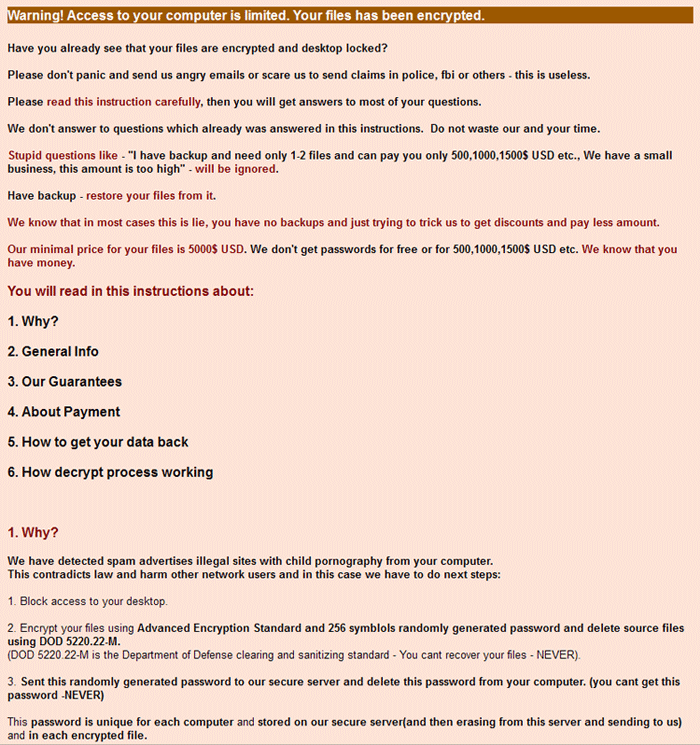
As soon as the victim's files have been encrypted, the ArchiveLock Trojan displays a threatening message demanding the payment of $5,000 USD in exchange for the password. Security researchers advise against doing this or reinstalling your operating system and wiping your hard drive. It is possible to recover your files with the aid of anti-malware specialists or advanced anti-malware software.
Analysis Report
General information
| Family Name: | Trojan.Ulise.C |
|---|---|
| Signature status: | Self Signed |
Known Samples
Known Samples
This section lists other file samples believed to be associated with this family.|
MD5:
9d260a7440b94f4b4d86d2fff071b6db
SHA1:
07f04799299db985ee866bbd6e581f795775c0bd
SHA256:
1F067171A7E0A4AC864B8F8A63E6F30A5833187BD7FDB839DA729B7AE670E3A4
File Size:
4.30 MB, 4299144 bytes
|
Windows Portable Executable Attributes
- File doesn't have "Rich" header
- File doesn't have exports table
- File has TLS information
- File is 32-bit executable
- File is either console or GUI application
- File is GUI application (IMAGE_SUBSYSTEM_WINDOWS_GUI)
- File is Native application (NOT .NET application)
- File is not packed
- IMAGE_FILE_DLL is not set inside PE header (Executable)
- IMAGE_FILE_EXECUTABLE_IMAGE is set inside PE header (Executable Image)
File Icons
File Icons
This section displays icon resources found within family samples. Malware often replicates icons commonly associated with legitimate software to mislead users into believing the malware is safe.


Windows PE Version Information
Windows PE Version Information
This section displays values and attributes that have been set in the Windows file version information data structure for samples within this family. To mislead users, malware actors often add fake version information mimicking legitimate software.| Name | Value |
|---|---|
| Company Name | NEXON Korea Corporation |
| File Description | Nexon Game Security |
| File Version | 5.4.0.3 |
| Internal Name | NGService |
| Legal Copyright | (C) NEXON Korea Corporation All Rights Reserved. |
| Original Filename | NGService.aes |
| Product Name | Nexon Game Security |
| Product Version | 5.4.0.3 |
Digital Signatures
Digital Signatures
This section lists digital signatures that are attached to samples within this family. When analyzing and verifying digital signatures, it is important to confirm that the signature’s root authority is a well-known and trustworthy entity and that the status of the signature is good. Malware is often signed with non-trustworthy “Self Signed” digital signatures (which can be easily created by a malware author with no verification). Malware may also be signed by legitimate signatures that have an invalid status, and by signatures from questionable root authorities with fake or misleading “Signer” names.| Signer | Root | Status |
|---|---|---|
| NEXON Korea Corporation | DigiCert Trusted G4 Code Signing RSA4096 SHA384 2021 CA1 | Self Signed |
| NEXON Korea Corporation | DigiCert Trusted G4 Code Signing RSA4096 SHA384 2021 CA1 | Self Signed |
File Traits
- 2+ executable sections
- HighEntropy
- x86
Block Information
Block Information
During analysis, EnigmaSoft breaks file samples into logical blocks for classification and comparison with other samples. Blocks can be used to generate malware detection rules and to group file samples into families based on shared source code, functionality and other distinguishing attributes and characteristics. This section lists a summary of this block data, as well as its classification by EnigmaSoft. A visual representation of the block data is also displayed, where available.| Total Blocks: | 2,014 |
|---|---|
| Potentially Malicious Blocks: | 0 |
| Whitelisted Blocks: | 1,991 |
| Unknown Blocks: | 23 |
Visual Map
? - Unknown Block
x - Potentially Malicious Block
Files Modified
Files Modified
This section lists files that were created, modified, moved and/or deleted by samples in this family. File system activity can provide valuable insight into how malware functions on the operating system.| File | Attributes |
|---|---|
| \device\harddisk0\dr0 | Generic Read,Write Data,Write Attributes,Write extended,Append data |
| c:\programdata\mntemp | Generic Read,Write Data,Write Attributes,Write extended,Append data |
| c:\users\user\downloads\ngservice.log | Generic Write,Read Attributes |


