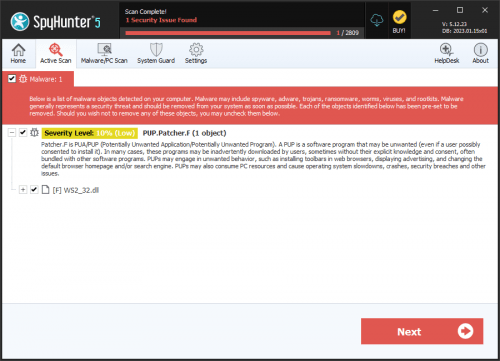
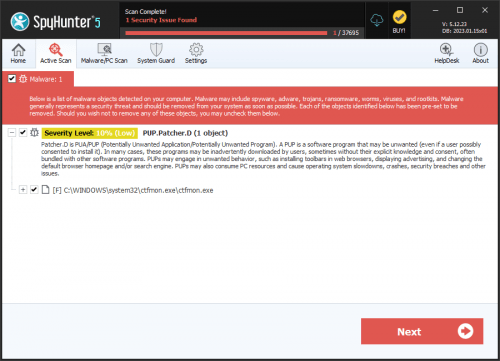
PUP.Patcher.E
Threat Scorecard
EnigmaSoft Threat Scorecard
EnigmaSoft Threat Scorecards are assessment reports for different malware threats which have been collected and analyzed by our research team. EnigmaSoft Threat Scorecards evaluate and rank threats using several metrics including real-world and potential risk factors, trends, frequency, prevalence, and persistence. EnigmaSoft Threat Scorecards are updated regularly based on our research data and metrics and are useful for a wide range of computer users, from end users seeking solutions to remove malware from their systems to security experts analyzing threats.
EnigmaSoft Threat Scorecards display a variety of useful information, including:
Popularity Rank: The ranking of a particular threat in EnigmaSoft’s Threat Database.
Severity Level: The determined severity level of an object, represented numerically, based on our risk modeling process and research, as explained in our Threat Assessment Criteria.
Infected Computers: The number of confirmed and suspected cases of a particular threat detected on infected computers as reported by SpyHunter.
See also Threat Assessment Criteria.
| Popularity Rank: | 14,894 |
| Threat Level: | 10 % (Normal) |
| Infected Computers: | 1,355 |
| First Seen: | July 24, 2009 |
| Last Seen: | August 6, 2026 |
| OS(es) Affected: | Windows |
The detection of PUP.Patcher.E on your system indicates the presence of a potentially unwanted program (PUP) that may be causing issues with your computer's performance and security. It's essential to understand the nature of this threat and take immediate action to remove it and prevent further damage.
Table of Contents
What Is PUP.Patcher.E?
PUP.Patcher.E is a type of malware that is classified as a potentially unwanted program. This means that while it may not be as malicious as other types of malware, such as viruses or Trojans, it can still cause problems with your system and compromise your privacy. PUPs are often installed unintentionally by users, usually when they download and install free software or applications from the internet.
How PUP.Patcher.E Operates
PUP.Patcher.E operates by installing itself on your system and then executing its payload, which can include a range of activities such as displaying unwanted advertisements, collecting user data, and modifying system settings. It may also attempt to install additional malware or PUPs on your system, which can further compromise your security. PUP.Patcher.E may use various techniques to evade detection, such as disguising itself as a legitimate program or using code obfuscation to hide its true intentions.
Symptoms of Infection
If your system is infected with PUP.Patcher.E, you may notice a range of symptoms, including unwanted pop-ups and advertisements, slow system performance, and unexpected changes to your system settings. You may also notice that your browser homepage or search engine has been changed, or that new toolbars or extensions have been installed without your consent. In some cases, PUP.Patcher.E may also cause system crashes or freezes, or prevent you from installing or running certain programs.
- Unwanted advertisements and pop-ups
- Slow system performance
- Unexpected changes to system settings
- Changes to browser homepage or search engine
- New toolbars or extensions installed without consent
- System crashes or freezes
- Difficulty installing or running certain programs
How to Remove PUP.Patcher.E
- Boot your system in Safe Mode with Networking to prevent PUP.Patcher.E from loading and to allow you to install and run removal tools
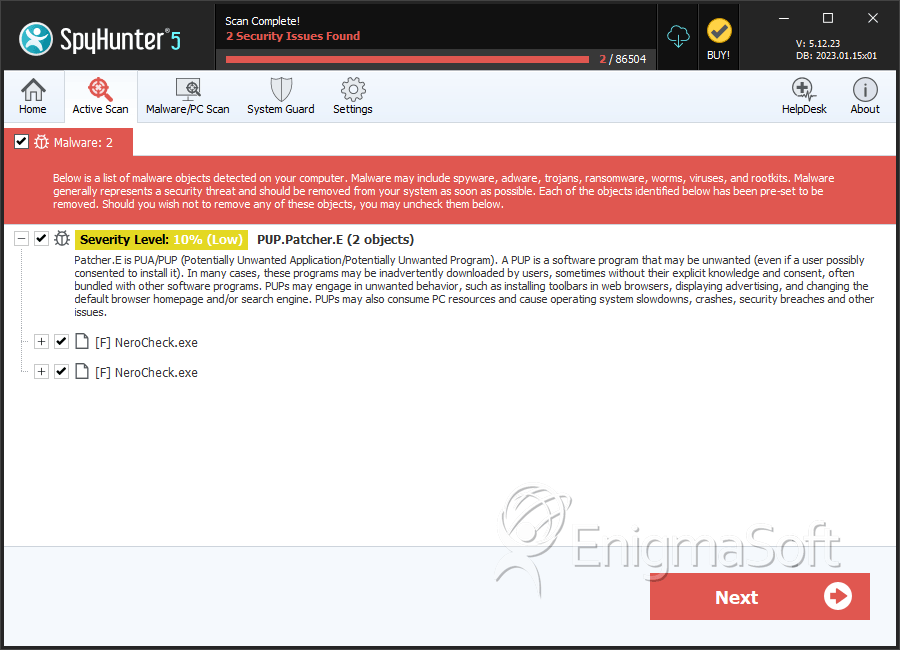
- Use a reputable anti-malware tool, such as SpyHunter, to perform a full scan of your system and detect and remove PUP.Patcher.E and any other malware or PUPs that may be present
- Uninstall any suspicious programs or applications that you do not recognize or that you did not intentionally install
- Reset your browser settings to their default values, including Chrome, Firefox, and Edge, to remove any changes made by PUP.Patcher.E
- Reboot your system and run another scan with your anti-malware tool to ensure that PUP.Patcher.E has been completely removed
Conclusion
Removing PUP.Patcher.E from your system requires a combination of technical knowledge and the right tools. By following the steps outlined above, you can help to ensure that your system is free from this potentially unwanted program and that your personal data and security are protected. It's also essential to take steps to prevent future infections, such as being cautious when downloading and installing software, avoiding suspicious websites and links, and keeping your operating system and security software up to date.
Aliases
2 security vendors flagged this file as malicious.
| Antivirus Vendor | Detection |
|---|---|
| Panda | Trj/Wixud.B |
| AntiVir | TR/Patched.BZ.13 |
SpyHunter Detects & Remove PUP.Patcher.E
File System Details
| # | File Name | MD5 |
Detections
Detections: The number of confirmed and suspected cases of a particular threat detected on
infected computers as reported by SpyHunter.
|
|---|---|---|---|
| 1. | NeroCheck.exe | 52ece4f9332838cc15829531239f674d | 0 |
Analysis Report
General information
| Family Name: | PUP.Patcher.E |
|---|---|
| Packers: | PECompact v[1.40-1.45] |
| Signature status: | No Signature |
Known Samples
Known Samples
This section lists other file samples believed to be associated with this family.|
MD5:
e604df3552a879efb56f51134a52ef2b
SHA1:
8e0ef349c970720de70b39057aac5bc228eef84c
SHA256:
24E58822C5DB045F2C5F2F2047606F31F9EDFD3B8DB083B90AF70275A3C48481
File Size:
18.94 KB, 18944 bytes
|
|
MD5:
6255522155df69a09829e392bea862df
SHA1:
450df41dbee739479aa78c8304834c2f494d9dd4
SHA256:
87EEDF266E83BB4BA264F4473332E157ACBD44BE99252FA05769332AFDFBD98E
File Size:
7.17 KB, 7168 bytes
|
|
MD5:
2715adca3a72369ea28297d1abb05adf
SHA1:
7a9f6c6a0c9d9cae1d72adfc3f9647018df8d423
SHA256:
74A3C8CC80748E62C459E3CEC01D22E1DE9B422493FC01C1F21D1C1FFF343E80
File Size:
7.17 KB, 7168 bytes
|
|
MD5:
2795ad4f8803dc2740507c3b789fa4e5
SHA1:
95ef9cfaba0535ba686b4e1aa49f0e6150b97f61
SHA256:
4A57EC06621B966C696BBA00A54F6EDD0C0B13018AF99E6DFC983D2C38115CA2
File Size:
5.63 KB, 5632 bytes
|
Windows Portable Executable Attributes
- File doesn't have "Rich" header
- File doesn't have debug information
- File doesn't have exports table
- File doesn't have relocations information
- File doesn't have security information
- File has been packed
- File is 32-bit executable
- File is either console or GUI application
- File is GUI application (IMAGE_SUBSYSTEM_WINDOWS_GUI)
- File is Native application (NOT .NET application)
Show More
- IMAGE_FILE_DLL is not set inside PE header (Executable)
- IMAGE_FILE_EXECUTABLE_IMAGE is set inside PE header (Executable Image)
File Icons
File Icons
This section displays icon resources found within family samples. Malware often replicates icons commonly associated with legitimate software to mislead users into believing the malware is safe.


File Traits
- $Id: UPX
- .UPX
- 2+ executable sections
- HighEntropy
- No Version Info
- packed
- PECompact v1.4x
- PECompact v[0.977-1.20.1]
- PECompact v[1.40-1.45]
- PECompact v[1.47-1.50]
Show More
- upx
- UPX!
- x86
Block Information
Block Information
During analysis, EnigmaSoft breaks file samples into logical blocks for classification and comparison with other samples. Blocks can be used to generate malware detection rules and to group file samples into families based on shared source code, functionality and other distinguishing attributes and characteristics. This section lists a summary of this block data, as well as its classification by EnigmaSoft. A visual representation of the block data is also displayed, where available.| Total Blocks: | 7 |
|---|---|
| Potentially Malicious Blocks: | 4 |
| Whitelisted Blocks: | 3 |
| Unknown Blocks: | 0 |
Visual Map
? - Unknown Block
x - Potentially Malicious Block
Similar Families
Similar Families
This section lists other families that share similarities with this family, based on EnigmaSoft’s analysis. Many malware families are created from the same malware toolkits and use the same packing and encryption techniques but uniquely extend functionality. Similar families may also share source code, attributes, icons, subcomponents, compromised and/or invalid digital signatures, and network characteristics. Researchers leverage these similarities to rapidly and effectively triage file samples and extend malware detection rules.- Patcher.E
Windows API Usage
Windows API Usage
This section lists Windows API calls that are used by the samples in this family. Windows API usage analysis is a valuable tool that can help identify malicious activity, such as keylogging, security privilege escalation, data encryption, data exfiltration, interference with antivirus software, and network request manipulation.| Category | API |
|---|---|
| Anti Debug |
|
| User Data Access |
|