Pup.Offerware
Threat Scorecard
EnigmaSoft Threat Scorecard
EnigmaSoft Threat Scorecards are assessment reports for different malware threats which have been collected and analyzed by our research team. EnigmaSoft Threat Scorecards evaluate and rank threats using several metrics including real-world and potential risk factors, trends, frequency, prevalence, and persistence. EnigmaSoft Threat Scorecards are updated regularly based on our research data and metrics and are useful for a wide range of computer users, from end users seeking solutions to remove malware from their systems to security experts analyzing threats.
EnigmaSoft Threat Scorecards display a variety of useful information, including:
Popularity Rank: The ranking of a particular threat in EnigmaSoft’s Threat Database.
Severity Level: The determined severity level of an object, represented numerically, based on our risk modeling process and research, as explained in our Threat Assessment Criteria.
Infected Computers: The number of confirmed and suspected cases of a particular threat detected on infected computers as reported by SpyHunter.
See also Threat Assessment Criteria.
| Popularity Rank: | 2,906 |
| Threat Level: | 10 % (Normal) |
| Infected Computers: | 18,288 |
| First Seen: | February 22, 2013 |
| Last Seen: | October 8, 2026 |
| OS(es) Affected: | Windows |
Pup.Offerware is a potentially unwanted program that comes packed with a rootkit. Pup.Offerware needs to be uninstalled from the targeted computer system together with a rootkit because, otherwise, the rootkit will restore the uninstalled application. The payload of Pup.Offerware incorporates, but is not limited to, bringing and showing random pop-up ads unauthorized by computer users into compromised Internet browsers. PC users should eliminate Pup.Offerware together with a related rootkit by using a legitimate anti-malware program.
Table of Contents
SpyHunter Detects & Remove Pup.Offerware
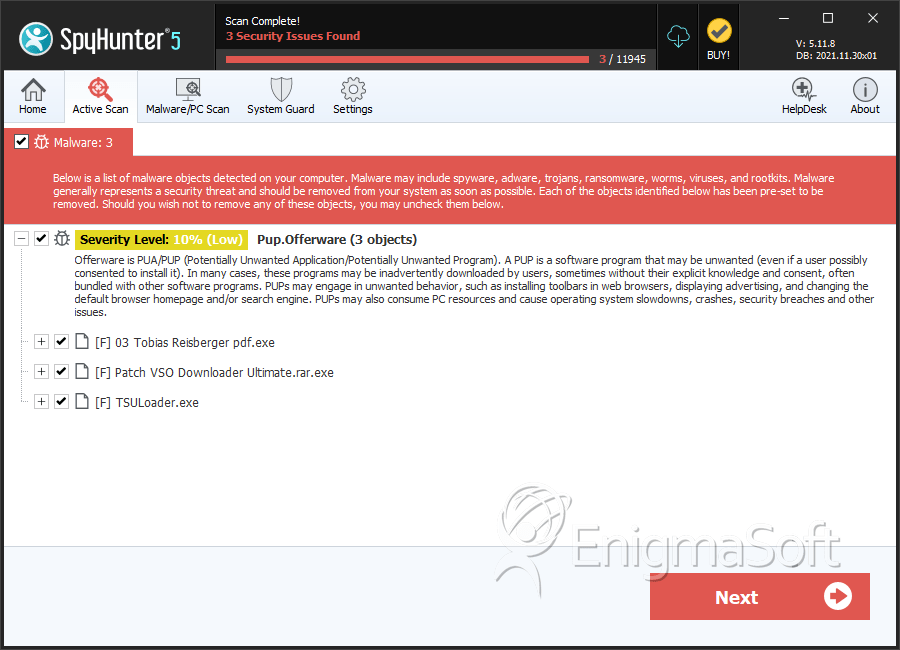
File System Details
| # | File Name | MD5 |
Detections
Detections: The number of confirmed and suspected cases of a particular threat detected on
infected computers as reported by SpyHunter.
|
|---|---|---|---|
| 1. | 03 Tobias Reisberger pdf.exe | 5fcf9f71dd9caa14886475f9b6a099aa | 0 |
| 2. | Patch VSO Downloader Ultimate.rar.exe | a28936238eca8ec299d0334c2554c019 | 0 |
| 3. | TSULoader.exe | 3e0a7bac1139dd4bf03cf829f162585d | 0 |
Analysis Report
General information
| Family Name: | Pup.Offerware |
|---|---|
| Signature status: | Self Signed |
Known Samples
Known Samples
This section lists other file samples believed to be associated with this family.|
MD5:
3d2c4f00a1ea8c4d12560a4e1c9464cb
SHA1:
eca4f290f83894393fb41d464b6130f3e706def1
SHA256:
70CC1E2B56CFE037923D50292A8EB8F448A43AA6B023C3C612C058C1AC6D2505
File Size:
599.00 KB, 599000 bytes
|
|
MD5:
e740c3c41c946d33540ef8902984446c
SHA1:
7b7a67173846e2fd9afa3181f067d9b315c04a92
SHA256:
BEAE196D1397E8B20A1B98D46CF8917DC3D613F46744E69479E9E53AF88E4A9C
File Size:
618.97 KB, 618968 bytes
|
|
MD5:
d3b5a5f18c42dea3cff912e4916fedda
SHA1:
08a5f70c07318ad5c34e624f5aa89cc98ae70ebe
SHA256:
AA159454BF83BB05DBC58422AF2BE2485EF52A644B4614D1B559352596E1CC81
File Size:
1.53 MB, 1525416 bytes
|
|
MD5:
403ff92d4ffe2493eefc89e04fa300d1
SHA1:
eaa41b8f02ca6c82363565309f17c5a7f4f0353e
SHA256:
B08FC19A1944706F01E60416E034569ED0C143D137951B9CD5D8B0C7B6BB42ED
File Size:
5.65 MB, 5650833 bytes
|
|
MD5:
ece07fac5dc006fece400836a7a5a837
SHA1:
378be3087a639e3a15fabadb8e005fda5dbc1d8d
SHA256:
EE1C81CA45B02A60D109D1D128357E0D9AE0C243DE0801E8F2D586720D35150B
File Size:
1.28 MB, 1281776 bytes
|
Show More
|
MD5:
90150dd4458e18eaf50598d47c8ae93d
SHA1:
740998ad40d4848b8988077709e05c9de8d968df
SHA256:
0D39B7A5C771BF9CA2E3A73D0B31B547D9DA4D149484DCDE98AAD57CBC6AFCE0
File Size:
599.00 KB, 599000 bytes
|
|
MD5:
42ba701b3a7b126946dd5e4442fe0e93
SHA1:
1faeee1f3dc4124fdf4b2abecbf378d03e69358a
SHA256:
B0F4BC5773AB22B63C49339E2DD854DF5DFE98D3D2ED1181D47FB154B9D535C9
File Size:
718.73 KB, 718728 bytes
|
|
MD5:
2e37c309f75f00ffc64d4eff21fa0427
SHA1:
d147d40b5ab42843db1401a5ddfe662282432a27
SHA256:
A7E46A07EE091890B151FB81160181638AD384C4EB58D4524DB676B127DE88B2
File Size:
719.24 KB, 719240 bytes
|
|
MD5:
cc3d00de3adebde3b8bada8148d3de2b
SHA1:
319b26cfe9537c5fd3d6599ef38be579f17885cb
SHA256:
87AFF4322A85CB375376F38D294A052CC9A31E4D40DB5583F5B34FA93AA155D5
File Size:
719.75 KB, 719752 bytes
|
|
MD5:
77f8a77ae73b41044db787aecfbee35d
SHA1:
5e5e23441a6259befbc0b1e6b7755e61937ac186
SHA256:
74B57E66864831C686F2A1BB445C7BA2A4BD5D985AA9879E67BB8A7C847E04F5
File Size:
719.75 KB, 719752 bytes
|
Windows Portable Executable Attributes
- File doesn't have "Rich" header
- File doesn't have debug information
- File doesn't have exports table
- File doesn't have relocations information
- File doesn't have security information
- File has TLS information
- File is 32-bit executable
- File is 64-bit executable
- File is either console or GUI application
- File is GUI application (IMAGE_SUBSYSTEM_WINDOWS_GUI)
Show More
- File is Native application (NOT .NET application)
- File is not packed
- IMAGE_FILE_DLL is not set inside PE header (Executable)
- IMAGE_FILE_EXECUTABLE_IMAGE is set inside PE header (Executable Image)
File Icons
File Icons
This section displays icon resources found within family samples. Malware often replicates icons commonly associated with legitimate software to mislead users into believing the malware is safe.


Windows PE Version Information
Windows PE Version Information
This section displays values and attributes that have been set in the Windows file version information data structure for samples within this family. To mislead users, malware actors often add fake version information mimicking legitimate software.| Name | Value |
|---|---|
| Comments | This installation was built with Inno Setup. |
| Company Name |
|
| File Description |
|
| File Version |
|
| Internal Name |
|
| Legal Copyright |
|
| Original Filename | Win.exe |
| Product Name |
|
| Product Version |
|
Digital Signatures
Digital Signatures
This section lists digital signatures that are attached to samples within this family. When analyzing and verifying digital signatures, it is important to confirm that the signature’s root authority is a well-known and trustworthy entity and that the status of the signature is good. Malware is often signed with non-trustworthy “Self Signed” digital signatures (which can be easily created by a malware author with no verification). Malware may also be signed by legitimate signatures that have an invalid status, and by signatures from questionable root authorities with fake or misleading “Signer” names.| Signer | Root | Status |
|---|---|---|
| AN Soft | SSL.com Code Signing Intermediate CA ECC R2 | Self Signed |
| AN Soft | Sectigo Public Code Signing Root R46 | Root Not Trusted |
| AN Soft | thawte SHA256 Code Signing CA | Self Signed |
Block Information
Block Information
During analysis, EnigmaSoft breaks file samples into logical blocks for classification and comparison with other samples. Blocks can be used to generate malware detection rules and to group file samples into families based on shared source code, functionality and other distinguishing attributes and characteristics. This section lists a summary of this block data, as well as its classification by EnigmaSoft. A visual representation of the block data is also displayed, where available.| Total Blocks: | 2,198 |
|---|---|
| Potentially Malicious Blocks: | 147 |
| Whitelisted Blocks: | 2,051 |
| Unknown Blocks: | 0 |
Visual Map
? - Unknown Block
x - Potentially Malicious Block
Similar Families
Similar Families
This section lists other families that share similarities with this family, based on EnigmaSoft’s analysis. Many malware families are created from the same malware toolkits and use the same packing and encryption techniques but uniquely extend functionality. Similar families may also share source code, attributes, icons, subcomponents, compromised and/or invalid digital signatures, and network characteristics. Researchers leverage these similarities to rapidly and effectively triage file samples and extend malware detection rules.- Agent.KPSTA
- Rozena.VE
Files Modified
Files Modified
This section lists files that were created, modified, moved and/or deleted by samples in this family. File system activity can provide valuable insight into how malware functions on the operating system.| File | Attributes |
|---|---|
| \device\namedpipe\gmdasllogger | Generic Write,Read Attributes |
| c:\users\user\appdata\local\microsoft\windows\usrclass.dat{dba6b5ef-640a-11ed-9bcb-f677369d361c}.txr.0.regtrans-ms | Generic Read,Write Data,Write Attributes,Write extended,Append data |
| c:\users\user\appdata\local\microsoft\windows\usrclass.dat{dba6b5ef-640a-11ed-9bcb-f677369d361c}.txr.1.regtrans-ms | Generic Read,Write Data,Write Attributes,Write extended,Append data |
| c:\users\user\appdata\local\microsoft\windows\usrclass.dat{dba6b5ef-640a-11ed-9bcb-f677369d361c}.txr.2.regtrans-ms | Generic Read,Write Data,Write Attributes,Write extended,Append data |
Windows API Usage
Windows API Usage
This section lists Windows API calls that are used by the samples in this family. Windows API usage analysis is a valuable tool that can help identify malicious activity, such as keylogging, security privilege escalation, data encryption, data exfiltration, interference with antivirus software, and network request manipulation.| Category | API |
|---|---|
| Network Wininet |
|
| Anti Debug |
|
| Network Winhttp |
|
| Other Suspicious |
|
| Syscall Use |
Show More
|
| Service Control |
|
| User Data Access |
|


