Hidden-Tear.Gen Ransomware
Threat Scorecard
EnigmaSoft Threat Scorecard
EnigmaSoft Threat Scorecards are assessment reports for different malware threats which have been collected and analyzed by our research team. EnigmaSoft Threat Scorecards evaluate and rank threats using several metrics including real-world and potential risk factors, trends, frequency, prevalence, and persistence. EnigmaSoft Threat Scorecards are updated regularly based on our research data and metrics and are useful for a wide range of computer users, from end users seeking solutions to remove malware from their systems to security experts analyzing threats.
EnigmaSoft Threat Scorecards display a variety of useful information, including:
Popularity Rank: The ranking of a particular threat in EnigmaSoft’s Threat Database.
Severity Level: The determined severity level of an object, represented numerically, based on our risk modeling process and research, as explained in our Threat Assessment Criteria.
Infected Computers: The number of confirmed and suspected cases of a particular threat detected on infected computers as reported by SpyHunter.
See also Threat Assessment Criteria.
| Popularity Rank: | 21,309 |
| Threat Level: | 100 % (High) |
| Infected Computers: | 459 |
| First Seen: | May 22, 2017 |
| Last Seen: | July 23, 2026 |
| OS(es) Affected: | Windows |
The detection of Hidden-Tear.Gen Ransomware on your system indicates a potentially severe security threat. Ransomware is a type of malware designed to encrypt and hold hostage the data on a victim's computer, demanding payment in exchange for the decryption key. In this case, the Hidden-Tear.Gen Ransomware detection suggests that your system has been compromised by a ransomware threat, although the specific characteristics and behaviors of this malware are not detailed here.
Table of Contents
What Is Hidden-Tear.Gen Ransomware?
Ransomware, like Hidden-Tear.Gen Ransomware, typically spreads through phishing emails, exploited vulnerabilities in software, or infected software downloads. Once inside a system, it begins to encrypt files, making them inaccessible to the user. The goal of ransomware is to extort money from the victim by demanding payment, usually in cryptocurrency, in exchange for the decryption key. It's essential to understand that paying the ransom does not guarantee that the decryption key will be provided or that the files will be restored.
How Hidden-Tear.Gen Ransomware Operates
The operation of ransomware involves several steps, starting with the initial infection. After gaining access to a system, the malware begins to scan for files to encrypt. It targets various file types, including documents, images, and videos, using encryption algorithms that make the files unreadable without the decryption key. The ransomware then displays a ransom note, explaining the situation to the victim and providing instructions on how to pay the ransom. In some cases, ransomware may also attempt to spread to other connected devices or networks.
Symptoms of Infection
Symptoms of a ransomware infection can include the inability to access files, the presence of ransom notes or messages demanding payment, and significant slowdowns in system performance. In some cases, the malware may also cause system crashes or freezes. If you suspect that your system has been infected with Hidden-Tear.Gen Ransomware or any other type of malware, it's crucial to act quickly to minimize damage and prevent further encryption of files.
How to Remove Hidden-Tear.Gen Ransomware
- Boot your computer in Safe Mode with Networking to prevent the malware from loading and to allow for internet access. This will make it easier to download and install removal tools.
- Download and install a reputable anti-malware tool, such as SpyHunter, and perform a full scan of your system to detect and remove the Hidden-Tear.Gen Ransomware and any other malware that may be present.
- Uninstall any suspicious programs or applications that you do not recognize or that were installed around the time of the infection. Be cautious and only remove programs that you are sure are not essential to your system's operation.
- Reset your web browsers, including Chrome, Firefox, and Edge, to their default settings to remove any malicious extensions or settings that the ransomware may have altered.
- Reboot your computer and perform another full scan with your anti-malware tool to ensure that all traces of the malware have been removed. Regularly updating your operating system, software, and security tools can help prevent future infections.
Conclusion
The detection and removal of Hidden-Tear.Gen Ransomware require careful and immediate action to prevent further damage. Understanding how ransomware operates and taking steps to protect your system, such as regularly backing up important files and being cautious with emails and downloads, can significantly reduce the risk of infection. If you have already been infected, following the removal steps outlined above can help restore your system to a safe state. Remember, prevention and vigilance are key in the fight against malware and ransomware threats.
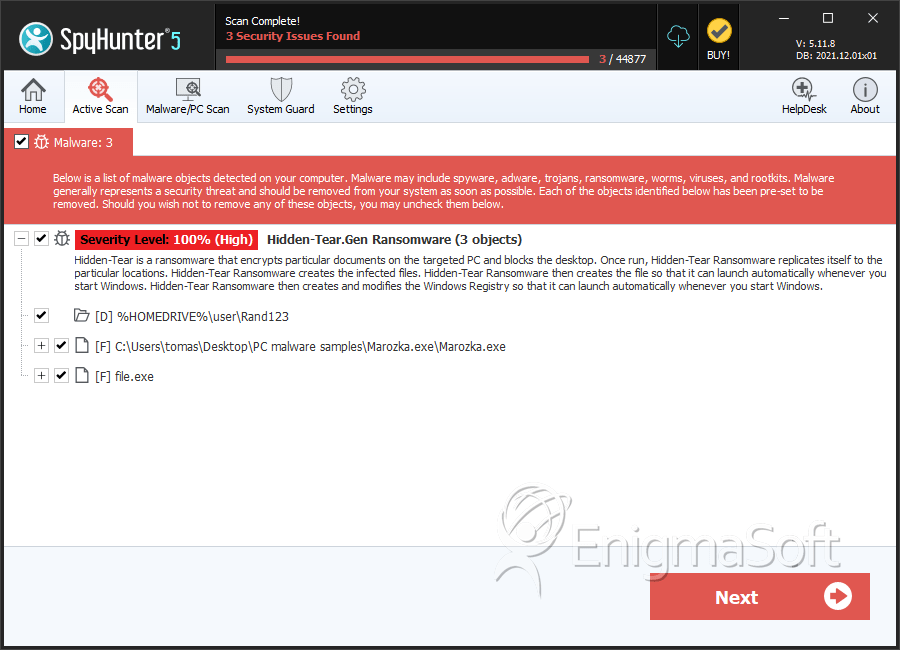
SpyHunter Detects & Remove Hidden-Tear.Gen Ransomware
File System Details
| # | File Name | MD5 |
Detections
Detections: The number of confirmed and suspected cases of a particular threat detected on
infected computers as reported by SpyHunter.
|
|---|---|---|---|
| 1. | Marozka.exe | 7b34f5ecb7c14244aaa6e330c620584a | 1 |
| 2. | file.exe | e1a88ddb222b48f55f5be7eb9ea9164e | 0 |
Registry Details
Directories
Hidden-Tear.Gen Ransomware may create the following directory or directories:
| %HOMEDRIVE%\user\Rand123 |
Analysis Report
General information
| Family Name: | Hidden-Tear.Gen Ransomware |
|---|---|
| Signature status: | No Signature |
Known Samples
Known Samples
This section lists other file samples believed to be associated with this family.|
MD5:
76f7d852e1fab2295e4922a974d47caa
SHA1:
8691b22978a9b9110a332fa348b5f7aa64ecd489
SHA256:
9A1592CE558C00A19F816BAC310D99FB432EA0CBB3FAB540B02582CB12C46621
File Size:
595.24 KB, 595238 bytes
|
|
MD5:
f78eff4667708137132051ee4a976200
SHA1:
9e5f0bc15a8e630947cc5437e0b912b6c04f48e9
SHA256:
D2CC3CA1137F80635AFF3676F09B913D0FBD9A65FCF09B519C990C4CAE342E28
File Size:
1.05 MB, 1051136 bytes
|
|
MD5:
b19b4cb9e8443a5ca13b7dae8d2fb8b3
SHA1:
260714dcf6fbcedcdedf5918ce2583acf077606d
SHA256:
915078A6E0FE0A5C75A3AA5FCE2238F84CB9F3098D747C39F6556436279EAB7A
File Size:
818.69 KB, 818688 bytes
|
|
MD5:
4ca8fc4ae35f666dee0fc51b60859b7c
SHA1:
a80ab68bdcb3b13d3d42c344d7da8e8b453c16fb
SHA256:
C2B53962D38B79141FB158D3E3B6BF3E387AEBB6E64B7ABBBDF02CA3CFE18011
File Size:
2.66 MB, 2663424 bytes
|
|
MD5:
18074776556ac6ccc3b5a2580810be0d
SHA1:
104f635fed0dfeaad41e0c5756aa9ae9bcf0a20c
SHA256:
D0C8468A6A81EA283A624F864FAE581D9C079126C7195D887BD2306228AC455B
File Size:
101.38 KB, 101376 bytes
|
Show More
|
MD5:
3a73d29d74e0930a508f368dc87ca333
SHA1:
aee02b10a74c2fdd257d161fd8e03b37878a803f
SHA256:
73A7AB4DD80364A090BC41971D6EBE95A4451F9BBD8340DC07AF4DC86071999C
File Size:
637.95 KB, 637952 bytes
|
Windows Portable Executable Attributes
- File doesn't have "Rich" header
- File doesn't have debug information
- File doesn't have exports table
- File doesn't have relocations information
- File doesn't have security information
- File is .NET application
- File is 32-bit executable
- File is console application (IMAGE_SUBSYSTEM_WINDOWS_CUI)
- File is either console or GUI application
- File is GUI application (IMAGE_SUBSYSTEM_WINDOWS_GUI)
Show More
- File is Native application (NOT .NET application)
- File is not packed
- IMAGE_FILE_DLL is not set inside PE header (Executable)
- IMAGE_FILE_EXECUTABLE_IMAGE is set inside PE header (Executable Image)
File Icons
File Icons
This section displays icon resources found within family samples. Malware often replicates icons commonly associated with legitimate software to mislead users into believing the malware is safe.


Windows PE Version Information
Windows PE Version Information
This section displays values and attributes that have been set in the Windows file version information data structure for samples within this family. To mislead users, malware actors often add fake version information mimicking legitimate software.| Name | Value |
|---|---|
| Assembly Version |
|
| File Description |
|
| File Version |
|
| Internal Name |
|
| Legal Copyright | Copyright © 2016 |
| Original Filename |
|
| Product Name |
|
| Product Version |
|
File Traits
- .NET
- dll
- RijndaelManaged
- Run
- x86
Block Information
Block Information
During analysis, EnigmaSoft breaks file samples into logical blocks for classification and comparison with other samples. Blocks can be used to generate malware detection rules and to group file samples into families based on shared source code, functionality and other distinguishing attributes and characteristics. This section lists a summary of this block data, as well as its classification by EnigmaSoft. A visual representation of the block data is also displayed, where available.| Total Blocks: | 25 |
|---|---|
| Potentially Malicious Blocks: | 1 |
| Whitelisted Blocks: | 9 |
| Unknown Blocks: | 15 |
Visual Map
? - Unknown Block
x - Potentially Malicious Block
Files Modified
Files Modified
This section lists files that were created, modified, moved and/or deleted by samples in this family. File system activity can provide valuable insight into how malware functions on the operating system.| File | Attributes |
|---|---|
| \device\namedpipe\gmdasllogger | Generic Write,Read Attributes |
| c:\users\user\appdata\local\microsoft\windows\usrclass.dat{dba6b5ef-640a-11ed-9bcb-f677369d361c}.txr.1.regtrans-ms | Generic Read,Write Data,Write Attributes,Write extended,Append data |
| c:\users\user\appdata\local\microsoft\windows\usrclass.dat{dba6b5ef-640a-11ed-9bcb-f677369d361c}.txr.2.regtrans-ms | Generic Read,Write Data,Write Attributes,Write extended,Append data |
| c:\windows\appcompat\programs\amcache.hve | Read Data,Read Control,Write Data |
| c:\windows\appcompat\programs\amcache.hve | Write Attributes |
Registry Modifications
Registry Modifications
This section lists registry keys and values that were created, modified and/or deleted by samples in this family. Windows Registry activity can provide valuable insight into malware functionality. Additionally, malware often creates registry values to allow itself to automatically start and indefinitely persist after an initial infection has compromised the system.| Key::Value | Data | API Name |
|---|---|---|
| HKLM\system\software\microsoft\tip\aggregateresults::data | 隞̃ā耀꧌Ј | RegNtPreCreateKey |
Windows API Usage
Windows API Usage
This section lists Windows API calls that are used by the samples in this family. Windows API usage analysis is a valuable tool that can help identify malicious activity, such as keylogging, security privilege escalation, data encryption, data exfiltration, interference with antivirus software, and network request manipulation.| Category | API |
|---|---|
| Other Suspicious |
|
| Syscall Use |
Show More
|
| User Data Access |
|
| Anti Debug |
|
| Process Manipulation Evasion |
|
| Process Shell Execute |
|
| Encryption Used |
|
Shell Command Execution
Shell Command Execution
This section lists Windows shell commands that are run by the samples in this family. Windows Shell commands are often leveraged by malware for nefarious purposes and can be used to elevate security privileges, download and launch other malware, exploit vulnerabilities, collect and exfiltrate data, and hide malicious activity.
C:\Windows\Microsoft.NET\Framework64\v2.0.50727\\dw20.exe dw20.exe -x -s 852
|


