HahoMedia
Threat Scorecard
EnigmaSoft Threat Scorecard
EnigmaSoft Threat Scorecards are assessment reports for different malware threats which have been collected and analyzed by our research team. EnigmaSoft Threat Scorecards evaluate and rank threats using several metrics including real-world and potential risk factors, trends, frequency, prevalence, and persistence. EnigmaSoft Threat Scorecards are updated regularly based on our research data and metrics and are useful for a wide range of computer users, from end users seeking solutions to remove malware from their systems to security experts analyzing threats.
EnigmaSoft Threat Scorecards display a variety of useful information, including:
Popularity Rank: The ranking of a particular threat in EnigmaSoft’s Threat Database.
Severity Level: The determined severity level of an object, represented numerically, based on our risk modeling process and research, as explained in our Threat Assessment Criteria.
Infected Computers: The number of confirmed and suspected cases of a particular threat detected on infected computers as reported by SpyHunter.
See also Threat Assessment Criteria.
| Popularity Rank: | 16,014 |
| Threat Level: | 20 % (Normal) |
| Infected Computers: | 2,384 |
| First Seen: | September 3, 2014 |
| Last Seen: | December 28, 2025 |
| OS(es) Affected: | Windows |
HahoMedia or Haho Media, is an adware application that may display several ads on your screen when you are attempting to surf the internet. The Hahomedia ads may be displayed as pop-ups, pop-unders or banners where they all attempt to offer various services or add-on components for your web browser. Some of those components are known to be media add-ons that claim to add functions for your computer in viewing media content over the internet. Use of the Hahomedia ads may cause redirects within your web browser landing you on sites that have questionable content or prove to be unwanted. In the task of stopping the Hahomedia ads from displaying, most computer users will find refuge in finding and removing each of the components related to Hahomedia loaded on their system.
Table of Contents
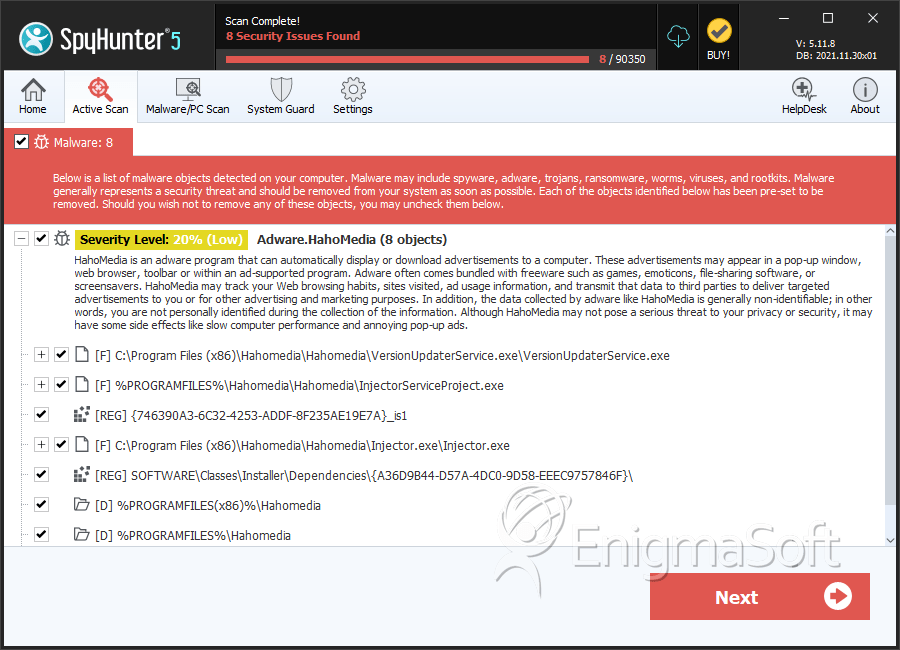
SpyHunter Detects & Remove HahoMedia
File System Details
| # | File Name | MD5 |
Detections
Detections: The number of confirmed and suspected cases of a particular threat detected on
infected computers as reported by SpyHunter.
|
|---|---|---|---|
| 1. | VersionUpdaterService.exe | 211eb4b123b7d8b8c621833864d06156 | 586 |
| 2. | InjectorServiceProject.exe | c6680e3c3cd5bb45a623ffeaac927c0d | 535 |
| 3. | Injector.exe | 14477e1a023d5ff440f7043b00651235 | 210 |
| 4. | license.exe | 24a657d8c999849768b3d83936c5e323 | 16 |
| 5. | DELA80F.tmp | bf4c6bdc4a5d59c52225922337b854ce | 14 |
Registry Details
Directories
HahoMedia may create the following directory or directories:
| %ALLUSERSPROFILE%\Package Cache\{87aec404-40de-4732-86ab-e9861ca5d01b} |
| %PROGRAMFILES%\Hahomedia |
| %PROGRAMFILES(x86)%\Hahomedia |
Analysis Report
General information
| Family Name: | Adware.HahoMedia |
|---|---|
| Signature status: | Root Not Trusted |
Known Samples
Known Samples
This section lists other file samples believed to be associated with this family.|
MD5:
7e485a2f5a762f9174581e97b8e7be3c
SHA1:
0315428bf2c4896cf633134103bdb1899b1851fb
SHA256:
018BA689E239A0BBBB3EDF93685781A5260675C49E4A21C03B1604BCAD0EE5C4
File Size:
661.98 KB, 661976 bytes
|
Windows Portable Executable Attributes
- File doesn't have "Rich" header
- File doesn't have debug information
- File doesn't have exports table
- File doesn't have relocations information
- File has TLS information
- File is 32-bit executable
- File is either console or GUI application
- File is GUI application (IMAGE_SUBSYSTEM_WINDOWS_GUI)
- File is Native application (NOT .NET application)
- File is not packed
Show More
- IMAGE_FILE_DLL is not set inside PE header (Executable)
- IMAGE_FILE_EXECUTABLE_IMAGE is set inside PE header (Executable Image)
File Icons
File Icons
This section displays icon resources found within family samples. Malware often replicates icons commonly associated with legitimate software to mislead users into believing the malware is safe.
Windows PE Version Information
Windows PE Version Information
This section displays values and attributes that have been set in the Windows file version information data structure for samples within this family. To mislead users, malware actors often add fake version information mimicking legitimate software.| Name | Value |
|---|---|
| Comments | This installation was built with Inno Setup. |
| Company Name | http://quickalarmclock.com/ |
| File Description | WinRarPasswordRemoverSetup Setup |
| File Version | 1.0.0.0 |
| Legal Copyright | Copyright © FVDTube. |
| Product Name | WinRarPasswordRemoverSetup |
| Product Version | 1.1 |
Digital Signatures
Digital Signatures
This section lists digital signatures that are attached to samples within this family. When analyzing and verifying digital signatures, it is important to confirm that the signature’s root authority is a well-known and trustworthy entity and that the status of the signature is good. Malware is often signed with non-trustworthy “Self Signed” digital signatures (which can be easily created by a malware author with no verification). Malware may also be signed by legitimate signatures that have an invalid status, and by signatures from questionable root authorities with fake or misleading “Signer” names.| Signer | Root | Status |
|---|---|---|
| ved priy pandey | COMODO RSA Certification Authority | Root Not Trusted |


