Trojan-Dropper.Agent.ane
Threat Scorecard
EnigmaSoft Threat Scorecard
EnigmaSoft Threat Scorecards are assessment reports for different malware threats which have been collected and analyzed by our research team. EnigmaSoft Threat Scorecards evaluate and rank threats using several metrics including real-world and potential risk factors, trends, frequency, prevalence, and persistence. EnigmaSoft Threat Scorecards are updated regularly based on our research data and metrics and are useful for a wide range of computer users, from end users seeking solutions to remove malware from their systems to security experts analyzing threats.
EnigmaSoft Threat Scorecards display a variety of useful information, including:
Popularity Rank: The ranking of a particular threat in EnigmaSoft’s Threat Database.
Severity Level: The determined severity level of an object, represented numerically, based on our risk modeling process and research, as explained in our Threat Assessment Criteria.
Infected Computers: The number of confirmed and suspected cases of a particular threat detected on infected computers as reported by SpyHunter.
See also Threat Assessment Criteria.
| Threat Level: | 90 % (High) |
| Infected Computers: | 106 |
| First Seen: | July 24, 2009 |
| Last Seen: | February 27, 2026 |
| OS(es) Affected: | Windows |
Trojan-Dropper.Agent.ane is a nasty Trojan that is capable to infect your system and install additional malware, including Trojans, viruses and other parasites. Trojan-Dropper.Agent.ane will open up a huge security hole on your machine, allowing remote attackers to reach your system and sensitive personal information. In addition, Trojan-Dropper.Agent.ane may also generate unwanted popup ads on your screen.
Table of Contents
SpyHunter Detects & Remove Trojan-Dropper.Agent.ane
File System Details
| # | File Name | MD5 |
Detections
Detections: The number of confirmed and suspected cases of a particular threat detected on
infected computers as reported by SpyHunter.
|
|---|---|---|---|
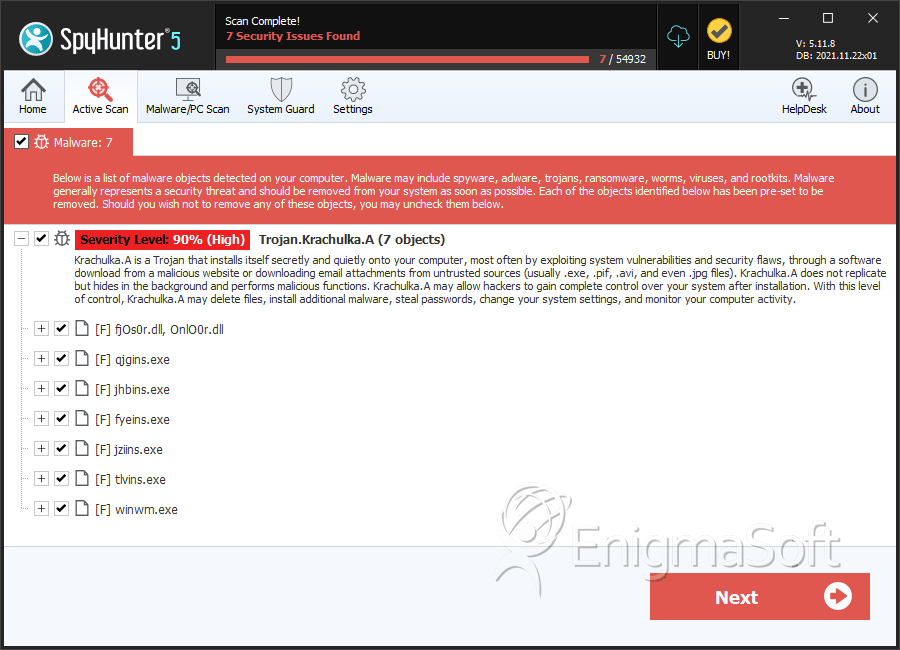
| 1. | fjOs0r.dll, OnlO0r.dll | 4659002858fef4ec54e43ff6e2afe2d9 | 0 |
| 2. | qjgins.exe | 8a1b469dc4bf2c2907f5563e2373ad69 | 0 |
| 3. | jhbins.exe | 350eec1e6834ee5d606bd36b1b0674f5 | 0 |
| 4. | fyeins.exe | f050b7cfadf8910b6d19b747b3b2540b | 0 |
| 5. | jziins.exe | 83bb9c7c55395edc95c9773195405e56 | 0 |
| 6. | tlvins.exe | 8b903a9185e7c02eeadeb84f3897a7d7 | 0 |
| 7. | winwm.exe | baff098613991208b7f107febc494d59 | 0 |
Analysis Report
General information
| Family Name: | Trojan.Krachulka.A |
|---|---|
| Signature status: | No Signature |
Known Samples
Known Samples
This section lists other file samples believed to be associated with this family.|
MD5:
221f7e3d51abfb26f74ffc292d41ff7d
SHA1:
9bcb3c556e9e540bc1a70bae06a1ebfa80d33bb3
SHA256:
4B9EE6AFE8F8CD87BBA57452B02FC1B9D4C379E56B6CA555E896F49A2F796937
File Size:
4.02 MB, 4019712 bytes
|
|
MD5:
b2e0f370f04c10b4e26aa17d82b6f3c2
SHA1:
7e6c7a82306fcf2e03bf97a6b0f468a645596d4f
SHA256:
500AF088EEAA17FDECD4156D5ECCDE89587B4268D1DD706D4DAF9191B279AE82
File Size:
6.14 MB, 6143648 bytes
|
|
MD5:
fe8e97c16912a29d45bd57aeb6ec15ec
SHA1:
b1254ae9ac364952e03d50fd7e4dbb443d4bf39f
SHA256:
194B8EE1F37B49FC093CA948A3C63CC9920A405A45C842E0C7B7E229F45866D6
File Size:
6.16 MB, 6162432 bytes
|
|
MD5:
511e804273c353d6d1b098e030548862
SHA1:
a49343373e40f8c29ccc22709673e90575afc439
SHA256:
354BCF86A7E66653C7481D9CAB89FF9AF2E3C54E15A92F4E2BE20BFDF052EE77
File Size:
6.15 MB, 6146048 bytes
|
Windows Portable Executable Attributes
- File doesn't have "Rich" header
- File doesn't have debug information
- File doesn't have security information
- File has exports table
- File is 32-bit executable
- File is either console or GUI application
- File is GUI application (IMAGE_SUBSYSTEM_WINDOWS_GUI)
- File is Native application (NOT .NET application)
- File is not packed
- IMAGE_FILE_DLL is not set inside PE header (Executable)
Show More
- IMAGE_FILE_EXECUTABLE_IMAGE is set inside PE header (Executable Image)
Windows PE Version Information
Windows PE Version Information
This section displays values and attributes that have been set in the Windows file version information data structure for samples within this family. To mislead users, malware actors often add fake version information mimicking legitimate software.| Name | Value |
|---|---|
| Company Name | Microsoft Corporation |
| File Description |
|
| File Version |
|
| Internal Name |
|
| Legal Copyright | © Microsoft Corporation. All rights reserved. |
| Original Filename | DbgEng.Dll |
| Product Name |
|
| Product Version |
|
| Program I D |
|
Digital Signatures
Digital Signatures
This section lists digital signatures that are attached to samples within this family. When analyzing and verifying digital signatures, it is important to confirm that the signature’s root authority is a well-known and trustworthy entity and that the status of the signature is good. Malware is often signed with non-trustworthy “Self Signed” digital signatures (which can be easily created by a malware author with no verification). Malware may also be signed by legitimate signatures that have an invalid status, and by signatures from questionable root authorities with fake or misleading “Signer” names.| Signer | Root | Status |
|---|---|---|
| ALLEN RIO SERV. E COM. DE PROD. DE INFORMATICA LTDA | thawte SHA256 Code Signing CA - G2 | Self Signed |
File Traits
- 2+ executable sections
- dll
- HighEntropy
- VirtualQueryEx
- x86
Block Information
Block Information
During analysis, EnigmaSoft breaks file samples into logical blocks for classification and comparison with other samples. Blocks can be used to generate malware detection rules and to group file samples into families based on shared source code, functionality and other distinguishing attributes and characteristics. This section lists a summary of this block data, as well as its classification by EnigmaSoft. A visual representation of the block data is also displayed, where available.| Total Blocks: | 12,160 |
|---|---|
| Potentially Malicious Blocks: | 223 |
| Whitelisted Blocks: | 11,932 |
| Unknown Blocks: | 5 |
Visual Map
? - Unknown Block
x - Potentially Malicious Block
Similar Families
Similar Families
This section lists other families that share similarities with this family, based on EnigmaSoft’s analysis. Many malware families are created from the same malware toolkits and use the same packing and encryption techniques but uniquely extend functionality. Similar families may also share source code, attributes, icons, subcomponents, compromised and/or invalid digital signatures, and network characteristics. Researchers leverage these similarities to rapidly and effectively triage file samples and extend malware detection rules.- Casbaneiro.A
- Delf.OF
- Downloader.Delf.C
- Filecoder.IFA
- Gamehack.ODB
Show More
- Ousaban.C
- Ulise.BE
- Vadokrist.B
Windows API Usage
Windows API Usage
This section lists Windows API calls that are used by the samples in this family. Windows API usage analysis is a valuable tool that can help identify malicious activity, such as keylogging, security privilege escalation, data encryption, data exfiltration, interference with antivirus software, and network request manipulation.| Category | API |
|---|---|
| Syscall Use |
Show More
|
| Process Shell Execute |
|
| Anti Debug |
|
| Process Manipulation Evasion |
|
Shell Command Execution
Shell Command Execution
This section lists Windows shell commands that are run by the samples in this family. Windows Shell commands are often leveraged by malware for nefarious purposes and can be used to elevate security privileges, download and launch other malware, exploit vulnerabilities, collect and exfiltrate data, and hide malicious activity.
C:\WINDOWS\SysWOW64\rundll32.exe C:\WINDOWS\system32\rundll32.exe c:\users\user\downloads\9bcb3c556e9e540bc1a70bae06a1ebfa80d33bb3_0004019712.,LiQMAxHB
|
C:\WINDOWS\SysWOW64\rundll32.exe C:\WINDOWS\system32\rundll32.exe c:\users\user\downloads\7e6c7a82306fcf2e03bf97a6b0f468a645596d4f_0006143648.,LiQMAxHB
|
C:\WINDOWS\SysWOW64\rundll32.exe C:\WINDOWS\system32\rundll32.exe c:\users\user\downloads\b1254ae9ac364952e03d50fd7e4dbb443d4bf39f_0006162432.,LiQMAxHB
|
C:\WINDOWS\SysWOW64\rundll32.exe C:\WINDOWS\system32\rundll32.exe c:\users\user\downloads\a49343373e40f8c29ccc22709673e90575afc439_0006146048.,LiQMAxHB
|