Storm Alert
Threat Scorecard
EnigmaSoft Threat Scorecard
EnigmaSoft Threat Scorecards are assessment reports for different malware threats which have been collected and analyzed by our research team. EnigmaSoft Threat Scorecards evaluate and rank threats using several metrics including real-world and potential risk factors, trends, frequency, prevalence, and persistence. EnigmaSoft Threat Scorecards are updated regularly based on our research data and metrics and are useful for a wide range of computer users, from end users seeking solutions to remove malware from their systems to security experts analyzing threats.
EnigmaSoft Threat Scorecards display a variety of useful information, including:
Popularity Rank: The ranking of a particular threat in EnigmaSoft’s Threat Database.
Severity Level: The determined severity level of an object, represented numerically, based on our risk modeling process and research, as explained in our Threat Assessment Criteria.
Infected Computers: The number of confirmed and suspected cases of a particular threat detected on infected computers as reported by SpyHunter.
See also Threat Assessment Criteria.
| Popularity Rank: | 10,743 |
| Threat Level: | 10 % (Normal) |
| Infected Computers: | 22,688 |
| First Seen: | February 12, 2014 |
| Last Seen: | June 29, 2026 |
| OS(es) Affected: | Windows |
Security analysts have received reports of intrusive advertisements delivered by Storm Alert, a Potentially Unwanted Program. Storm Alert advertisements are not difficult to be identified because they will either advertise content directly related to this PUP or will contain the identifier 'Advertisements by Storm Alert' somewhere on the advertisement. Unfortunately, for computer users affected by Storm Alert, these irritating advertisements may appear on almost every Web page viewed on the affected Web browser. Storm Alert advertisements are caused by an unwanted Web browser extension that is not considered threatening, but that has enough unwanted behaviors to be considered suspicious or potentially harmful. Storm Alert is not threatening and, in some cases, Storm Alert may have legitimate uses. However, Storm Alert advertisements may represent a threat to your privacy and cause other problems to your computer. Because of this, security analysts advise PC users to take steps to protect their machines from PUPs associated with Storm Alert and similar unwanted Web browser plug-ins.
Table of Contents
Why PUPs Linked to Storm Alert are Considered Potentially Harmful
Although PUPs are decidedly more innocent than known threats, it is important to note that PUPs may be more harmful than they appear. This is because adware companies and developers are mainly interested in preventing computer users from stopping the appearance of advertising material like Storm Alert advertisements and removing PUPs from their Web browsers. These types of Web browser extensions may allow marketers to generate quite a bit of revenue, making it in their best interest to keep your computer affected. Malware researchers consider that PUPs like those linked to Storm Alert do not deliver any type of useful or desirable service and should be removed at once. Because of this, PC security analysts suggest removing Storm Alert with the help of a reliable security program. Removing the PUP from your computer will stop Storm Alert advertisements from continuing to appear in your Web browser.
Who is Affected by Storm Alert Advertisements?
Traditionally, adware and suspicious advertisements such as the Storm Alert advertisements only affect computer users visiting websites with dubious content (such as pornographic websites or online casinos). However, it is common for legitimate and reputable websites to become affected by advertising content such as the Storm Alert advertisements. This can happen when third parties embed unwanted scripts into legitimate websites' content. In this case, the Storm Alert advertisements themselves are not the threatening component but, rather, are used to monetize another attack. This may be common. Although PUPs are not threatening, it is not uncommon for third parties to use Trojans or worms to deliver PUPs in order to make money from their attacks.
However, the most common way to become affected by Storm Alert is to install a PUP that has been bundled with a legitimate software download. PUPs may be bundled with other software downloaded from the Net. During installation, computer users may have the option to opt out of installing the PUP, but may not realize it, allowing Storm Alert to display repeated Storm Alert advertisements on the affected Web browser, seemingly out of nowhere.
Characteristics of the Storm Alert Advertisements
There are several problems inherent in many types of low-quality advertising material such as the Storm Alert advertisements. PC security analysts have observed the following issues:
- The Storm Alert advertisements may appear repeatedly, quickly becoming irritating as they interrupt computer users' activities.
- The Storm Alert advertisements may lead to dubious content that could expose computer users to online hoaxes or other PUPs.
- Storm Alert may be associated with unwanted changes made to affected Web browsers' settings. The Storm Alert Advertisements also may be inserted into sites that would ordinarily not include advertising material.
- Storm Alert may gather information about your online activities, Web browser and computer settings and share it with third parties.
SpyHunter Detects & Remove Storm Alert
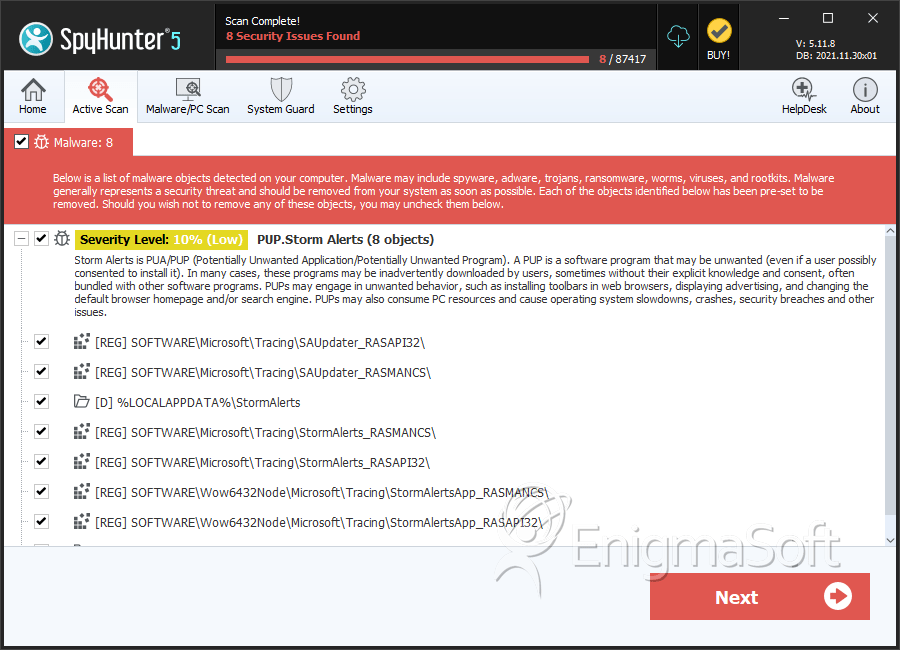
File System Details
| # | File Name | MD5 |
Detections
Detections: The number of confirmed and suspected cases of a particular threat detected on
infected computers as reported by SpyHunter.
|
|---|---|---|---|
| 1. | StormAlertsBrowser.exe | ef068fa52e7cfdc9766a90aa329792fe | 310 |
| 2. | StormAlertsuninstall.exe | 3e047cc27f943f38d45f912bf617a90d | 136 |
| 3. | StormAlerts.exe | b51f6bf2b38e79c481f35fff679fd7e2 | 4 |
| 4. | StormAlertsApp.exe | 0651536989336f99c879b93ca328e640 | 4 |
| 5. | uninstall.exe | d4c7a62ba12a7e5bf92d22e46e3bb248 | 3 |
| 6. | StormAlertsSetup[2].exe | 7ac14bb5ed49656369774f07d37f7b51 | 2 |
| 7. | StormAlerts.lnk | 49edbba787583337b32997ebe488c011 | 2 |
Registry Details
Directories
Storm Alert may create the following directory or directories:
| %ALLUSERSPROFILE%\StormAlert |
| %LOCALAPPDATA%\StormAlert |
| %LOCALAPPDATA%\StormAlerts |
| %LOCALAPPDATA%\Weather_Warnings_LLC |
| %UserProfile%\Local Settings\Application Data\Weather_Warnings_LLC |
| %appdata%\Microsoft\Windows\Start Menu\Programs\Storm Alerts |