PUP.Power Spy
Threat Scorecard
EnigmaSoft Threat Scorecard
EnigmaSoft Threat Scorecards are assessment reports for different malware threats which have been collected and analyzed by our research team. EnigmaSoft Threat Scorecards evaluate and rank threats using several metrics including real-world and potential risk factors, trends, frequency, prevalence, and persistence. EnigmaSoft Threat Scorecards are updated regularly based on our research data and metrics and are useful for a wide range of computer users, from end users seeking solutions to remove malware from their systems to security experts analyzing threats.
EnigmaSoft Threat Scorecards display a variety of useful information, including:
Popularity Rank: The ranking of a particular threat in EnigmaSoft’s Threat Database.
Severity Level: The determined severity level of an object, represented numerically, based on our risk modeling process and research, as explained in our Threat Assessment Criteria.
Infected Computers: The number of confirmed and suspected cases of a particular threat detected on infected computers as reported by SpyHunter.
See also Threat Assessment Criteria.
| Threat Level: | 10 % (Normal) |
| Infected Computers: | 1,291 |
| First Seen: | September 8, 2020 |
| Last Seen: | February 19, 2026 |
| OS(es) Affected: | Windows |
The detection of PUP.Power Spy on your system indicates the presence of a potentially unwanted program (PUP) that may be compromising your computer's security and privacy. This type of software is designed to perform functions that are not necessarily malicious but can still cause significant inconvenience and potential harm. It is essential to understand the nature of PUPs and take appropriate steps to remove them to protect your system and personal data.
Table of Contents
What Is PUP.Power Spy?
PUP.Power Spy, as the name suggests, is classified as a potentially unwanted program. PUPs are software applications that may exhibit unwanted behavior, such as displaying unwanted advertisements, collecting user data without consent, or modifying system settings. They often find their way onto computers through bundled software downloads, where they are included alongside legitimate programs. While not as overtly dangerous as malware, PUPs can still pose a significant risk to your privacy and system integrity.
How PUP.Power Spy Operates
PUPs like PUP.Power Spy typically operate by integrating themselves into your system in a way that makes them difficult to detect and remove. They may run in the background, consuming system resources, and can interfere with the performance of your computer. Some PUPs are designed to collect user data, such as browsing habits, search history, and other personal information, which can then be used for targeted advertising or sold to third parties. Others may modify your browser settings, redirecting you to unwanted websites or displaying pop-up advertisements.
Symptoms of Infection
The symptoms of a PUP infection can vary but often include a noticeable decrease in system performance, an increase in unwanted advertisements, and changes to your browser settings or homepage. You might also notice unfamiliar programs or toolbars in your browser that you did not install. In some cases, PUPs can lead to more severe issues, such as data breaches or the installation of additional, more harmful malware.
How to Remove PUP.Power Spy
- Enter Safe Mode with Networking to prevent the PUP from loading and to give you a clean environment to work in.
- Perform a full scan of your system using a reputable anti-malware tool, such as SpyHunter, to detect and remove all components of the PUP.
- Uninstall suspicious programs that you do not recognize or that were installed around the time the PUP was detected.
- Reset your browsers (Chrome, Firefox, Edge, etc.) to their default settings to remove any changes made by the PUP, such as unwanted extensions or modified homepage settings.
- Finally, reboot your computer and perform another scan to ensure that all components of the PUP have been removed and that your system is clean.
Conclusion
Removing PUP.Power Spy from your system is crucial to restoring your privacy and ensuring the integrity of your computer. By following the steps outlined above, you can effectively remove this potentially unwanted program and protect yourself against future infections. It's also important to be vigilant when downloading software, always opting for custom installations and carefully reviewing the terms and conditions to avoid unintentionally installing PUPs. Regular system scans and maintaining up-to-date antivirus software are also key components of a robust defense strategy against PUPs and more malicious forms of malware.
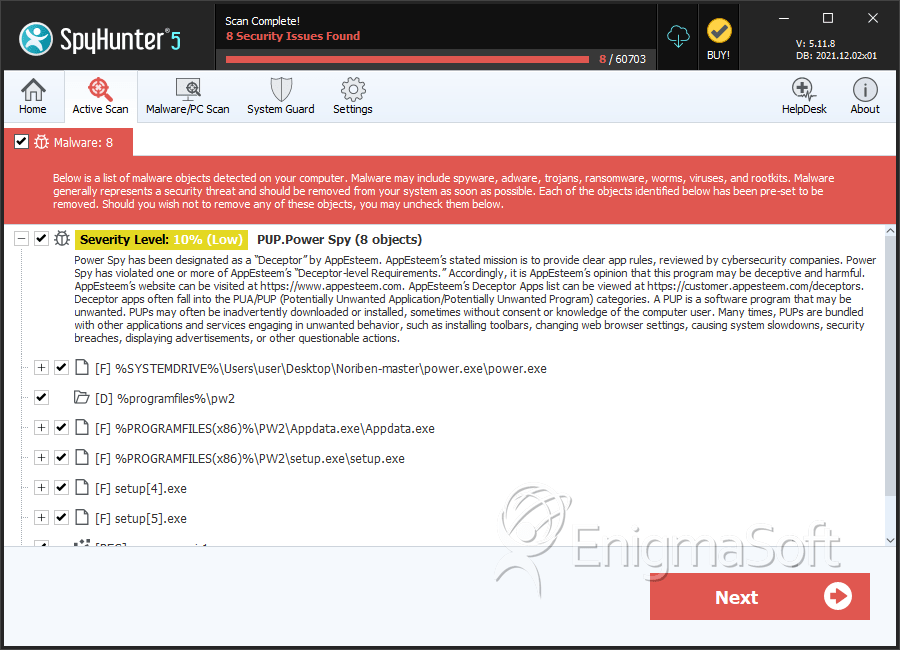
SpyHunter Detects & Remove PUP.Power Spy
File System Details
| # | File Name | MD5 |
Detections
Detections: The number of confirmed and suspected cases of a particular threat detected on
infected computers as reported by SpyHunter.
|
|---|---|---|---|
| 1. | power.exe | b2a4fbea06c8ac5cc93743044ad95175 | 1,238 |
| 2. | load.exe | 942e6972d3f27e0ff870fd9f8e659d3a | 3 |
| 3. | 8916485abc22fb24c5c039f32a3b31f9f27791b5a9c186be9fe6ce974c5be221.exe | 33ba1533cd72e42f229651be90111801 | 2 |
| 4. | 62ca09b155fa65b12382ee41618fefb8efac2fe76c70c1d66667260158b0f7c1.exe | fa01c468570c1418381b1f25f2cf9dbe | 2 |
| 5. | setup.exe | 2238da1103812beb94cb79f49e2ed847 | 2 |
| 6. | Appdata.exe | 53acbac9f6339785e8319378719981d6 | 1 |
| 7. | 6e4a280f98099c2d87fdc66ca572b4d456371cb7e257876439cfd44c753f2806.exe | 9854c5eec6452361d9ee83c4f872a0ea | 1 |
| 8. | 82fa375d81f80a5548870be16d7b7e5d774b9a1fdd77ea3ec890832b53d8437e.exe | a9c66474305145caf8f906184ec37bda | 1 |
| 9. | 63b8a8da4781646ab5d7ecc83686ed2e35f86a0d638bdf6a067a742eca632911.exe | fefd4b7efbbc5cef08d50fe23d9246e7 | 1 |
| 10. | setup [3 ].exe | bce2fd1460e430ab34aa6bc8af3b656d | 0 |
| 11. | Appdata4.exe | 0c4b7a2339edef44edf43af6f4ea0121 | 0 |
| 12. | load4.exe | 4e26bfd2719f113ee5af273fb5bcbdfe | 0 |
| 13. | setup4.exe | 5a6f8a6e27a2aa66da7873846816877f | 0 |
| 14. | setup5.exe | d02ed6a283a3e340db1c1dbf83e8f75e | 0 |
| 15. | p5 [7].exe | fb02b095437008a0981e0b5cdb00bd2b | 0 |
| 16. | setup [7].exe | e651605671672948c60a27f51cbc15f7 | 0 |
Registry Details
Directories
PUP.Power Spy may create the following directory or directories:
| %programfiles%\pw2 |