PUP.AdvancedSystemRepair
Threat Scorecard
EnigmaSoft Threat Scorecard
EnigmaSoft Threat Scorecards are assessment reports for different malware threats which have been collected and analyzed by our research team. EnigmaSoft Threat Scorecards evaluate and rank threats using several metrics including real-world and potential risk factors, trends, frequency, prevalence, and persistence. EnigmaSoft Threat Scorecards are updated regularly based on our research data and metrics and are useful for a wide range of computer users, from end users seeking solutions to remove malware from their systems to security experts analyzing threats.
EnigmaSoft Threat Scorecards display a variety of useful information, including:
Popularity Rank: The ranking of a particular threat in EnigmaSoft’s Threat Database.
Severity Level: The determined severity level of an object, represented numerically, based on our risk modeling process and research, as explained in our Threat Assessment Criteria.
Infected Computers: The number of confirmed and suspected cases of a particular threat detected on infected computers as reported by SpyHunter.
See also Threat Assessment Criteria.
| Popularity Rank: | 463 |
| Threat Level: | 10 % (Normal) |
| Infected Computers: | 6,416 |
| First Seen: | February 11, 2025 |
| Last Seen: | October 20, 2026 |
| OS(es) Affected: | Windows |
The detection of PUP.AdvancedSystemRepair on your system indicates the presence of a potentially unwanted program (PUP) that may be causing issues with your computer's performance and security. It is essential to understand the nature of this threat and take immediate action to remove it to prevent further damage.
Table of Contents
What Is PUP.AdvancedSystemRepair?
PUP.AdvancedSystemRepair is a type of malware that is classified as a potentially unwanted program. This means that while it may not be as malicious as other types of malware, such as viruses or Trojans, it can still cause problems with your system and compromise your privacy. PUPs are often installed unintentionally by users, usually through bundled software downloads or deceptive advertising.
How PUP.AdvancedSystemRepair Operates
PUP.AdvancedSystemRepair operates by installing itself on your system and then proceeding to perform various actions that can be detrimental to your computer's performance and security. It may display unwanted advertisements, collect your personal data, or even install additional malware. PUPs can also modify your system settings and configure your browser to display unwanted content. In some cases, PUPs can even compromise your system's security by creating vulnerabilities that can be exploited by other malware.
Symptoms of Infection
The symptoms of a PUP.AdvancedSystemRepair infection can vary, but common signs include unwanted advertisements, slow system performance, and unexpected changes to your browser settings. You may also notice that your system is crashing or freezing frequently, or that your browser is being redirected to unwanted websites. In some cases, you may even receive fake alerts or warnings that claim your system is infected with malware, when in fact the PUP itself is the culprit.
- Unwanted advertisements and pop-ups
- Slow system performance and crashes
- Unexpected changes to browser settings
- Redirects to unwanted websites
- Fake alerts and warnings
How to Remove PUP.AdvancedSystemRepair
- Boot your system in Safe Mode with Networking to prevent the PUP from loading and to allow you to download and install removal tools.
- Download and install a reputable anti-malware tool, such as SpyHunter, and perform a full scan of your system to detect and remove the PUP.
- Uninstall any suspicious programs that may be related to the PUP, using the Add/Remove Programs feature in your system's Control Panel.
- Reset your browser settings to their default values, including Chrome, Firefox, and Edge, to remove any changes made by the PUP.
- Reboot your system and perform another scan with your anti-malware tool to ensure that the PUP has been completely removed.
Conclusion
Removing PUP.AdvancedSystemRepair from your system is crucial to preventing further damage and protecting your privacy. By following the steps outlined above, you can effectively remove the PUP and restore your system to its normal state. It is also essential to be cautious when downloading software and to always read the terms and conditions before installing any program. By being vigilant and taking proactive measures, you can help protect your system from PUPs and other types of malware.
SpyHunter Detects & Remove PUP.AdvancedSystemRepair
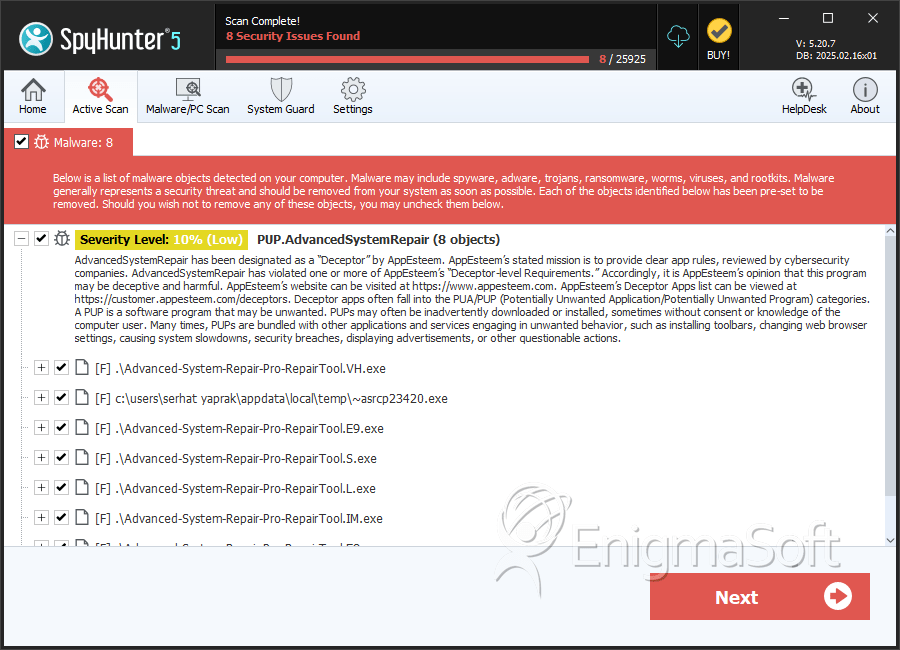
File System Details
| # | File Name | MD5 |
Detections
Detections: The number of confirmed and suspected cases of a particular threat detected on
infected computers as reported by SpyHunter.
|
|---|---|---|---|
| 1. | Advanced-System-Repair-Pro-RepairTool.VH.exe | ac34742253dde2adfcb06f0b2612ac3a | 823 |
| 2. | Advanced-System-Repair-Pro-RepairTool.E9.exe | 1bf71859a90cf7b91b349f29584491be | 374 |
| 3. | Advanced-System-Repair-Pro-RepairTool.E4.exe | f4d0eea8ec0a2171ad416314d39bc8c2 | 367 |
| 4. | Advanced-System-Repair-Pro-RepairTool.S.exe | d2c94f5989310d0ce83ce0b900ebbfe7 | 357 |
| 5. | ~asrcp23420.exe | dc01587fb026cefb7c3af98069dcb1f6 | 355 |
| 6. | Advanced-System-Repair-Pro-RepairTool.E8.exe | 7bfaf01292d28b4d38fbe36705616f49 | 345 |
| 7. | Advanced-System-Repair-Pro-RepairTool.A.exe | b03864c50bd2e2c426f0f694cd2e9090 | 343 |
| 8. | Advanced-System-Repair-Pro-RepairTool.L.exe | 0b1780fa5081265a5765d558f607d027 | 342 |
| 9. | Advanced-System-Repair-Pro-RepairTool.IM.exe | 09386009837a29a52e0f6ecf936b592a | 342 |
| 10. | Advanced-System-Repair-Pro-RepairTool.B.exe | 10f91baa7d9d81dfc14276f06b962130 | 342 |
| 11. | Advanced-System-Repair-Pro-RepairTool.9.exe | 5e33c355adeb42619a62d16c1cc1b5d1 | 342 |
Registry Details
Directories
PUP.AdvancedSystemRepair may create the following directory or directories:
| %APPDATA%\microsoft\windows\start menu\programs\advanced system repair pro |
Analysis Report
General information
| Family Name: | PUP.AdvancedSystemRepair |
|---|---|
| Signature status: | Self Signed |
Known Samples
Known Samples
This section lists other file samples believed to be associated with this family.|
MD5:
9d8e6f92881aa599091f3c45a7752d4b
SHA1:
3710eb9cd997e1861fa85e4dbf8c8424f8fa321e
SHA256:
000F7AC08DD42ECD8CE310A2A22C61CE21EA86C8F1C86CD5410AEC99412FA655
File Size:
1.37 MB, 1367192 bytes
|
|
MD5:
dda746e58dc614774a2037c176f14c45
SHA1:
cbe7b0ffb322d2fbe30a7238f96a049015ce3a7d
SHA256:
B2E96BFE2DE5A1C1A7301641BA961543C78294CCFA28A25F2D7CB67E51ABF4CE
File Size:
1.11 MB, 1113344 bytes
|
|
MD5:
0157f06e14aa48de28d382d1e6bec354
SHA1:
ef291e2617348e2ba4a017f140780f6c63045c90
SHA256:
EC5553903D50FA85CC5356E8323326DB73F9523051BDB08C4C49E35C98E6CC1A
File Size:
27.80 KB, 27800 bytes
|
|
MD5:
71e5d1197a8754e9a803c804d14ab161
SHA1:
8cf08c1ec8797e061d139148f853169fcdbafaf2
SHA256:
3D19D9AABA5698FE444D71E225DF31A079350146C2AF5F10A61C103B8F8D2CC6
File Size:
1.11 MB, 1110072 bytes
|
|
MD5:
a06c22399477af0768091e573674ce74
SHA1:
6f60af9e9bcffca0714fb5393ea92400b2282eac
SHA256:
E0D05289E8233FF5BD03FF5C638FA5F36D635F8F9584F0386BF2C4780FB24160
File Size:
1.09 MB, 1087608 bytes
|
Show More
|
MD5:
a84e7ca56cdf850fafc4d35ec7152ae5
SHA1:
18a8097b5adb500adf02f8373a79199bd9a85dfd
SHA256:
C864CC1B1CE1A69BAEBA2043D979A955D2EB308DEA83838FD412B1AC4253A5AE
File Size:
26.42 KB, 26424 bytes
|
|
MD5:
7a9272fa0e8a54e5a4da01621e8dec51
SHA1:
9306126b78aa89e79625a6c3ae82a89f331b7d49
SHA256:
1B17F1D5327BA23FE72DFF9550D1FE4A67056FB58882BC100B004D0A123294D0
File Size:
26.86 KB, 26856 bytes
|
|
MD5:
9a337727629dc6961651f72e5e24f03a
SHA1:
6c7e39de83bbbb081272d7d165acb3eef378bc0a
SHA256:
D90C3BA78F2C2E9B3A3EDF3C89B6DEC57D5CA5A935165B895C9ED52E09C08711
File Size:
23.70 KB, 23696 bytes
|
Windows Portable Executable Attributes
- File doesn't have "Rich" header
- File doesn't have debug information
- File doesn't have exports table
- File has TLS information
- File is .NET application
- File is 32-bit executable
- File is console application (IMAGE_SUBSYSTEM_WINDOWS_CUI)
- File is either console or GUI application
- File is GUI application (IMAGE_SUBSYSTEM_WINDOWS_GUI)
- File is Native application (NOT .NET application)
Show More
- File is not packed
- IMAGE_FILE_DLL is not set inside PE header (Executable)
- IMAGE_FILE_EXECUTABLE_IMAGE is set inside PE header (Executable Image)
Windows PE Version Information
Windows PE Version Information
This section displays values and attributes that have been set in the Windows file version information data structure for samples within this family. To mislead users, malware actors often add fake version information mimicking legitimate software.| Name | Value |
|---|---|
| Assembly Version |
|
| Comments | InfExtractor Module |
| Company Name |
|
| File Description |
|
| File Version |
|
| Internal Name |
|
| Legal Copyright |
|
| Original Filename |
|
| Product Name |
|
| Product Version |
|
Digital Signatures
Digital Signatures
This section lists digital signatures that are attached to samples within this family. When analyzing and verifying digital signatures, it is important to confirm that the signature’s root authority is a well-known and trustworthy entity and that the status of the signature is good. Malware is often signed with non-trustworthy “Self Signed” digital signatures (which can be easily created by a malware author with no verification). Malware may also be signed by legitimate signatures that have an invalid status, and by signatures from questionable root authorities with fake or misleading “Signer” names.| Signer | Root | Status |
|---|---|---|
| Advanced System Repair, Inc. | DigiCert Assured ID Code Signing CA-1 | Self Signed |
| Advanced System Repair, Inc. | DigiCert High Assurance EV Root CA | Root Not Trusted |
| Advanced System Repair, Inc. | DigiCert Trusted G4 Code Signing RSA4096 SHA384 2021 CA1 | Self Signed |
| Advanced System Repair Inc | DigiCert Trusted Root G4 | Root Not Trusted |
Block Information
Block Information
During analysis, EnigmaSoft breaks file samples into logical blocks for classification and comparison with other samples. Blocks can be used to generate malware detection rules and to group file samples into families based on shared source code, functionality and other distinguishing attributes and characteristics. This section lists a summary of this block data, as well as its classification by EnigmaSoft. A visual representation of the block data is also displayed, where available.| Total Blocks: | 32 |
|---|---|
| Potentially Malicious Blocks: | 0 |
| Whitelisted Blocks: | 10 |
| Unknown Blocks: | 22 |
Visual Map
? - Unknown Block
x - Potentially Malicious Block
Similar Families
Similar Families
This section lists other families that share similarities with this family, based on EnigmaSoft’s analysis. Many malware families are created from the same malware toolkits and use the same packing and encryption techniques but uniquely extend functionality. Similar families may also share source code, attributes, icons, subcomponents, compromised and/or invalid digital signatures, and network characteristics. Researchers leverage these similarities to rapidly and effectively triage file samples and extend malware detection rules.- AV-Killer.A
Files Modified
Files Modified
This section lists files that were created, modified, moved and/or deleted by samples in this family. File system activity can provide valuable insight into how malware functions on the operating system.| File | Attributes |
|---|---|
| c:\programdata\tsr7settings\av\srv.txt | Generic Write,Read Attributes |
Windows API Usage
Windows API Usage
This section lists Windows API calls that are used by the samples in this family. Windows API usage analysis is a valuable tool that can help identify malicious activity, such as keylogging, security privilege escalation, data encryption, data exfiltration, interference with antivirus software, and network request manipulation.| Category | API |
|---|---|
| Other Suspicious |
|
| Service Control |
|
| Syscall Use |
Show More
|


