Backdoor.Nitol
Threat Scorecard
EnigmaSoft Threat Scorecard
EnigmaSoft Threat Scorecards are assessment reports for different malware threats which have been collected and analyzed by our research team. EnigmaSoft Threat Scorecards evaluate and rank threats using several metrics including real-world and potential risk factors, trends, frequency, prevalence, and persistence. EnigmaSoft Threat Scorecards are updated regularly based on our research data and metrics and are useful for a wide range of computer users, from end users seeking solutions to remove malware from their systems to security experts analyzing threats.
EnigmaSoft Threat Scorecards display a variety of useful information, including:
Popularity Rank: The ranking of a particular threat in EnigmaSoft’s Threat Database.
Severity Level: The determined severity level of an object, represented numerically, based on our risk modeling process and research, as explained in our Threat Assessment Criteria.
Infected Computers: The number of confirmed and suspected cases of a particular threat detected on infected computers as reported by SpyHunter.
See also Threat Assessment Criteria.
| Threat Level: | 80 % (High) |
| Infected Computers: | 4,912 |
| First Seen: | April 17, 2012 |
| Last Seen: | April 12, 2026 |
| OS(es) Affected: | Windows |
Backdoor.Nitol is a backdoor Trojan that opens a back door on the infected PC. Once Backdoor.Nitol is executed, it copies itself as the executable file composed of the six letters excluding the .exe extension. Backdoor.Nitol then tries to stop two processes named RavMonD.exe and rfwsrv.exe if they are running. Backdoor.Nitol tries to collect information from the corrupted machine such as operating system and version, CPU, computer name and locale. Backdoor.Nitol creates one of the two services. Backdoor.Nitol also creates a mutex with the name similar to one of the service names. Backdoor.Nitol tries to open a back door and connect to the certain locations. Once a connection is created, Backdoor.Nitol tries to forward the collected information and execute a distributed denial of service (DDoS) attack on another PC. Backdoor.Nitol also tries to drop a malicious file. Uninstall Backdoor.Nitol by using a recognized security tool.
Table of Contents
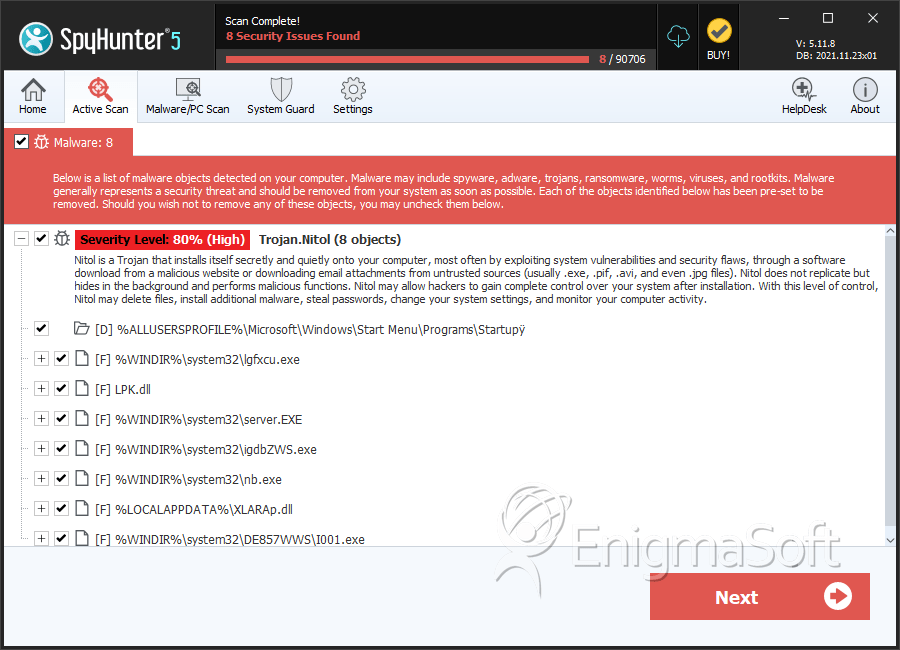
SpyHunter Detects & Remove Backdoor.Nitol
File System Details
| # | File Name | MD5 |
Detections
Detections: The number of confirmed and suspected cases of a particular threat detected on
infected computers as reported by SpyHunter.
|
|---|---|---|---|
| 1. | lgfxcu.exe | a7027359c127c41f595e192d5bc6f93c | 29 |
| 2. | LPK.dll | 1005f5b7d887c69dad445ef8bfe2ba6e | 17 |
| 3. | server.EXE | fa83218ca7e58eadde29e52cce1981a8 | 10 |
| 4. | igdbZWS.exe | 355b78b054d18792f0f39345e5dca25d | 9 |
| 5. | xx25.exe | 28fa5862ecbc2dce373b579e0f263393 | 4 |
| 6. | nb.exe | a9c935ff66adf8ae61fbac6eda9dc652 | 3 |
| 7. | XLARAp.dll | 2dc44a37b451a41562932bac95bad639 | 1 |
| 8. | I001.exe | 5990ff99244da1b3be2d566456ed9187 | 1 |
| 9. | %Temp%stf[FIVE RANDOM CHARACTERS].exe | ||
| 10. | %ProgramFiles%\[SIX RANDOM CHARACTERS].exe | ||
| 11. | file.exe | ddf0134ee920b0b9930f7d7aa2d1e038 | 0 |
Registry Details
Directories
Backdoor.Nitol may create the following directory or directories:
| %ALLUSERSPROFILE%\Microsoft\Windows\Start Menu\Programs\Startupÿ |
Analysis Report
General information
| Family Name: | Trojan.Nitol |
|---|---|
| Signature status: | No Signature |
Known Samples
Known Samples
This section lists other file samples believed to be associated with this family.|
MD5:
2f68931c651e4366b7dbd39d0bf7d0f9
SHA1:
9b05c054dff4029a2a7a4b536441431fcc7f0c07
SHA256:
A4582973F2E1B84A7634B64783CA8E23D8A8227F9F8E027725656D11B73D7946
File Size:
122.88 KB, 122880 bytes
|
Windows Portable Executable Attributes
- File doesn't have "Rich" header
- File doesn't have exports table
- File doesn't have relocations information
- File doesn't have security information
- File is 64-bit executable
- File is console application (IMAGE_SUBSYSTEM_WINDOWS_CUI)
- File is either console or GUI application
- File is Native application (NOT .NET application)
- File is not packed
- IMAGE_FILE_DLL is not set inside PE header (Executable)
Show More
- IMAGE_FILE_EXECUTABLE_IMAGE is set inside PE header (Executable Image)
Windows PE Version Information
Windows PE Version Information
This section displays values and attributes that have been set in the Windows file version information data structure for samples within this family. To mislead users, malware actors often add fake version information mimicking legitimate software.| Name | Value |
|---|---|
| Company Name | Windows (R) Server 2003 DDK provider |
| File Description | network config sample |
| File Version | 5.2.3790.0 built by: WinDDK |
| Internal Name | snetcfg.exe |
| Legal Copyright | © Microsoft Corporation. All rights reserved. |
| Original Filename | snetcfg.exe |
| Product Name | Windows (R) Server 2003 DDK driver |
| Product Version | 5.2.3790.0 |
File Traits
- 2+ executable sections
- x64
Block Information
Block Information
During analysis, EnigmaSoft breaks file samples into logical blocks for classification and comparison with other samples. Blocks can be used to generate malware detection rules and to group file samples into families based on shared source code, functionality and other distinguishing attributes and characteristics. This section lists a summary of this block data, as well as its classification by EnigmaSoft. A visual representation of the block data is also displayed, where available.| Total Blocks: | 9 |
|---|---|
| Potentially Malicious Blocks: | 1 |
| Whitelisted Blocks: | 8 |
| Unknown Blocks: | 0 |
Visual Map
? - Unknown Block
x - Potentially Malicious Block
Windows API Usage
Windows API Usage
This section lists Windows API calls that are used by the samples in this family. Windows API usage analysis is a valuable tool that can help identify malicious activity, such as keylogging, security privilege escalation, data encryption, data exfiltration, interference with antivirus software, and network request manipulation.| Category | API |
|---|---|
| Syscall Use |
Show More
|