Adware.RegistrySmart
Threat Scorecard
EnigmaSoft Threat Scorecard
EnigmaSoft Threat Scorecards are assessment reports for different malware threats which have been collected and analyzed by our research team. EnigmaSoft Threat Scorecards evaluate and rank threats using several metrics including real-world and potential risk factors, trends, frequency, prevalence, and persistence. EnigmaSoft Threat Scorecards are updated regularly based on our research data and metrics and are useful for a wide range of computer users, from end users seeking solutions to remove malware from their systems to security experts analyzing threats.
EnigmaSoft Threat Scorecards display a variety of useful information, including:
Popularity Rank: The ranking of a particular threat in EnigmaSoft’s Threat Database.
Severity Level: The determined severity level of an object, represented numerically, based on our risk modeling process and research, as explained in our Threat Assessment Criteria.
Infected Computers: The number of confirmed and suspected cases of a particular threat detected on infected computers as reported by SpyHunter.
See also Threat Assessment Criteria.
| Threat Level: | 20 % (Normal) |
| Infected Computers: | 8 |
| First Seen: | July 24, 2009 |
| Last Seen: | January 15, 2026 |
| OS(es) Affected: | Windows |
The detection of Adware.RegistrySmart on your system indicates the presence of a potentially unwanted program that could be compromising your computer's security and performance. Adware programs like this are designed to display unwanted advertisements, collect user data, and sometimes even install additional malicious software. It's essential to understand the nature of this threat and take prompt action to remove it.
Table of Contents
What Is Adware.RegistrySmart?
Adware.RegistrySmart is a type of adware that, as the name suggests, involves the manipulation of the Windows Registry to carry out its operations. The Windows Registry is a critical component of the operating system, containing settings and options that control the behavior of Windows and installed applications. Adware that targets the Registry can modify these settings to ensure its persistence and to facilitate the display of unwanted advertisements. This type of malware can be particularly problematic because it can be difficult to remove without causing system instability, due to its deep integration with system settings.
How Adware.RegistrySmart Operates
Adware.RegistrySmart operates by first infiltrating the system, often through deceptive means such as bundling with legitimate software, exploiting vulnerabilities, or tricking users into installing it. Once installed, it modifies the Windows Registry to achieve its goals, which can include displaying pop-up advertisements, changing the default search engine or homepage of the web browser, and collecting user data for marketing purposes. The adware may also communicate with its command and control servers to receive updates or to send back collected data. Its ability to alter Registry settings allows it to start automatically with Windows and to resist removal efforts.
Symptoms of Infection
Symptoms of an Adware.RegistrySmart infection can vary but commonly include an increase in unwanted advertisements appearing on the computer, unexpected changes to browser settings, slow system performance, and potentially the installation of additional unwanted software. Users may also notice that their web browsing experience is being hijacked, with frequent redirects to unwanted websites or the appearance of pop-ups even when no browser windows are open. These symptoms can significantly disrupt the user's experience and pose a risk to the security and privacy of personal data.
How to Remove Adware.RegistrySmart
- Enter Safe Mode with Networking to prevent the adware from loading and to give you a cleaner environment to work in.
- Perform a full scan of your system using a reputable anti-malware tool such as SpyHunter. This can help identify and remove all components of the adware.
- Uninstall suspicious programs that you do not recognize or that were installed around the time the symptoms began. Be cautious and ensure you are not uninstalling critical system components.
- Reset your web browsers (Chrome, Firefox, Edge, etc.) to their default settings to remove any changes made by the adware, such as altered homepages or search engines.
- Reboot your computer and then perform another scan with your anti-malware tool to ensure that all remnants of the adware have been removed.
Conclusion
Removing Adware.RegistrySmart requires careful and thorough action to ensure all components are eliminated from the system. It's crucial to be vigilant and proactive in protecting your computer from such threats by keeping your operating system and software up to date, using strong antivirus software, and being cautious when installing new programs. Remember, prevention is key, but when infections do occur, taking the right steps can help restore your system's security and performance.
Aliases
2 security vendors flagged this file as malicious.
| Antivirus Vendor | Detection |
|---|---|
| NOD32 | Win32/Adware.RegistrySmart |
| Fortinet | Misc/PUP |
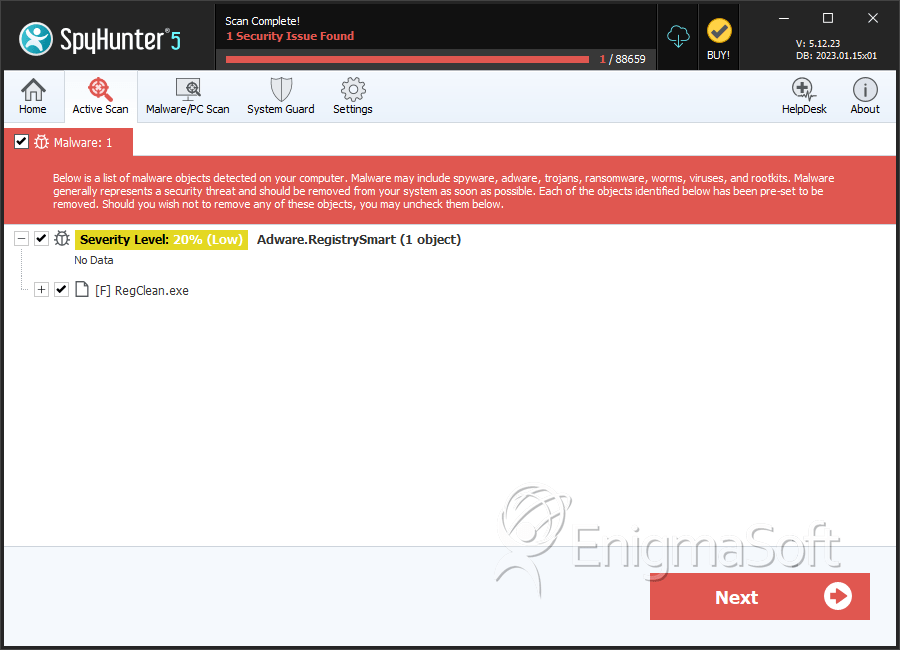
SpyHunter Detects & Remove Adware.RegistrySmart
File System Details
| # | File Name | MD5 |
Detections
Detections: The number of confirmed and suspected cases of a particular threat detected on
infected computers as reported by SpyHunter.
|
|---|---|---|---|
| 1. | RegClean.exe | 158318749961910e631fe32ec3099199 | 0 |
Analysis Report
General information
| Family Name: | Adware.RegistrySmart |
|---|---|
| Signature status: | No Signature |
Known Samples
Known Samples
This section lists other file samples believed to be associated with this family.|
MD5:
c7ca4eae9ba8634da02a6cbd250e5c0c
SHA1:
facf98b932b81d0ba1c00614663ab244142bca79
SHA256:
4C667E9BF609F318F63DEF9E70CBF0DC3E764B9F0B9E2BDBFC9D533416A6B229
File Size:
2.46 MB, 2458757 bytes
|
|
MD5:
0c111b1b9ad0a2fb6c08fd330b1d0204
SHA1:
713f519a58b82027899045590edd513b3adcd2cb
SHA256:
04344681A7A27524F322FD1E78BFB54B1D6404B47E8B0122267CBFFA695E7181
File Size:
2.46 MB, 2459328 bytes
|
Windows Portable Executable Attributes
- File doesn't have "Rich" header
- File doesn't have debug information
- File doesn't have exports table
- File doesn't have relocations information
- File doesn't have security information
- File has TLS information
- File is 32-bit executable
- File is either console or GUI application
- File is GUI application (IMAGE_SUBSYSTEM_WINDOWS_GUI)
- File is Native application (NOT .NET application)
Show More
- File is not packed
- IMAGE_FILE_DLL is not set inside PE header (Executable)
- IMAGE_FILE_EXECUTABLE_IMAGE is set inside PE header (Executable Image)
File Icons
File Icons
This section displays icon resources found within family samples. Malware often replicates icons commonly associated with legitimate software to mislead users into believing the malware is safe.


Windows PE Version Information
Windows PE Version Information
This section displays values and attributes that have been set in the Windows file version information data structure for samples within this family. To mislead users, malware actors often add fake version information mimicking legitimate software.| Name | Value |
|---|---|
| Comments | This installation was built with Inno Setup: http://www.innosetup.com |
| Company Name | RegistrySmart |
| File Description | RegistrySmart Setup |
| Legal Copyright | Copyright 2005, All rights reserved. |
File Traits
- Inno
- InnoSetup Installer
- Installer Manifest
- Installer Version
- x86
Files Modified
Files Modified
This section lists files that were created, modified, moved and/or deleted by samples in this family. File system activity can provide valuable insight into how malware functions on the operating system.| File | Attributes |
|---|---|
| \device\namedpipe\gmdasllogger | Generic Write,Read Attributes |
| c:\users\user\appdata\local\temp\is-4cnhf.tmp\_isetup\_regdll.tmp | Generic Read,Write Data,Write Attributes,Write extended,Append data |
| c:\users\user\appdata\local\temp\is-4cnhf.tmp\_isetup\_setup64.tmp | Generic Read,Write Data,Write Attributes,Write extended,Append data |
| c:\users\user\appdata\local\temp\is-4cnhf.tmp\_isetup\_shfoldr.dll | Generic Read,Write Data,Write Attributes,Write extended,Append data |
| c:\users\user\appdata\local\temp\is-ea6js.tmp\is-7n6d9.tmp | Generic Write,Read Attributes |
| c:\users\user\appdata\local\temp\is-j59lm.tmp\_isetup\_regdll.tmp | Generic Read,Write Data,Write Attributes,Write extended,Append data |
| c:\users\user\appdata\local\temp\is-j59lm.tmp\_isetup\_setup64.tmp | Generic Read,Write Data,Write Attributes,Write extended,Append data |
| c:\users\user\appdata\local\temp\is-j59lm.tmp\_isetup\_shfoldr.dll | Generic Read,Write Data,Write Attributes,Write extended,Append data |
| c:\users\user\appdata\local\temp\is-tuko9.tmp\is-euq3a.tmp | Generic Write,Read Attributes |
Windows API Usage
Windows API Usage
This section lists Windows API calls that are used by the samples in this family. Windows API usage analysis is a valuable tool that can help identify malicious activity, such as keylogging, security privilege escalation, data encryption, data exfiltration, interference with antivirus software, and network request manipulation.| Category | API |
|---|---|
| Anti Debug |
|
| User Data Access |
|
| Process Manipulation Evasion |
|
| Process Shell Execute |
|
Shell Command Execution
Shell Command Execution
This section lists Windows shell commands that are run by the samples in this family. Windows Shell commands are often leveraged by malware for nefarious purposes and can be used to elevate security privileges, download and launch other malware, exploit vulnerabilities, collect and exfiltrate data, and hide malicious activity.
"C:\Users\Xfcsxvsb\AppData\Local\Temp\is-EA6JS.tmp\is-7N6D9.tmp" /SL4 $6033C "c:\users\user\downloads\facf98b932b81d0ba1c00614663ab244142bca79_0002458757" 2149993 54784
|
"C:\Users\Iomdokci\AppData\Local\Temp\is-TUKO9.tmp\is-EUQ3A.tmp" /SL4 $A001E "c:\users\user\downloads\713f519a58b82027899045590edd513b3adcd2cb_0002459328" 2150442 54784
|