Win32/Agent.SFM
Threat Scorecard
EnigmaSoft Threat Scorecard
EnigmaSoft Threat Scorecards are assessment reports for different malware threats which have been collected and analyzed by our research team. EnigmaSoft Threat Scorecards evaluate and rank threats using several metrics including real-world and potential risk factors, trends, frequency, prevalence, and persistence. EnigmaSoft Threat Scorecards are updated regularly based on our research data and metrics and are useful for a wide range of computer users, from end users seeking solutions to remove malware from their systems to security experts analyzing threats.
EnigmaSoft Threat Scorecards display a variety of useful information, including:
Popularity Rank: The ranking of a particular threat in EnigmaSoft’s Threat Database.
Severity Level: The determined severity level of an object, represented numerically, based on our risk modeling process and research, as explained in our Threat Assessment Criteria.
Infected Computers: The number of confirmed and suspected cases of a particular threat detected on infected computers as reported by SpyHunter.
See also Threat Assessment Criteria.
| Popularity Rank: | 21,420 |
| Threat Level: | 100 % (High) |
| Infected Computers: | 1,425 |
| First Seen: | August 31, 2012 |
| Last Seen: | June 24, 2026 |
| OS(es) Affected: | Windows |
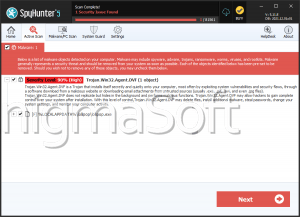
Win32/Agent.SFM is a Trojan that targets credentials used to log into websites designed by cybercriminals. Win32/Agent.SFM does not send a lot of information on recent activities on the compromised machine, but is picky in transferring the gathered data. While being run, Win32/Agent.SFM drops and executes infected files on the corrupted PC from a remote server and/or the web. Win32/Agent.SFM also modifies the Windows Registry by creating Registry entries. Win32/Agent.SFM collects confidential information and various data linked to the infected computer system.
Table of Contents
SpyHunter Detects & Remove Win32/Agent.SFM
File System Details
| # | File Name | MD5 |
Detections
Detections: The number of confirmed and suspected cases of a particular threat detected on
infected computers as reported by SpyHunter.
|
|---|---|---|---|
| 1. | %RANDOM CHARACTERS1%.dll | ||
| 2. | %Temp%\flash_player_update.exe | ||
| 3. | %Commonappdata%\ur | ||
| 4. | %Commonappdata%\ur%RANDOM CHARACTERS2% | ||
| 5. | %CommonAppData%\cf | ||
| 6. | file.dll | 4799e330f3bf548d48f691935628fdd9 | 0 |
| 7. | file.exe | 380ed56089198a1c5d53e237a0306bdb | 0 |
Registry Details
Analysis Report
General information
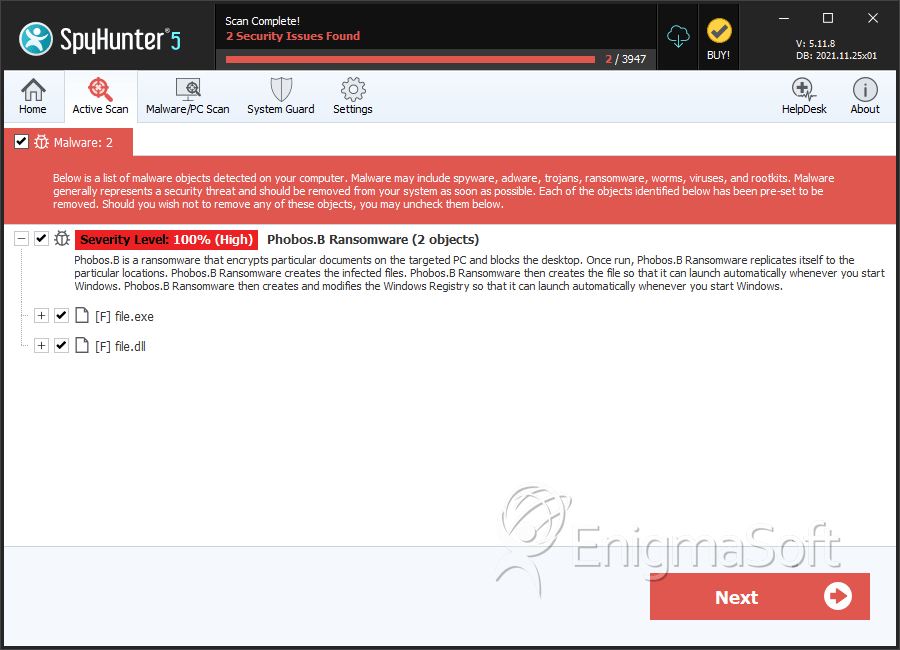
| Family Name: | Phobos.B Ransomware |
|---|---|
| Signature status: | No Signature |
Known Samples
Known Samples
This section lists other file samples believed to be associated with this family.|
MD5:
6782f4eea3be727a01ba115011e20012
SHA1:
bceb8404e062954db8ce3d76ce889c17e0f52b76
SHA256:
567AC1BD56DEEA1C240366A9EE08255DA8B8FDDEB7CFBCA713B4064A67C72202
File Size:
50.69 KB, 50688 bytes
|
|
MD5:
f04690482fdfc6353d8568b83f0773f2
SHA1:
f418f866abba36a63ca42c0c7dd108bac19e7f60
SHA256:
F33A3DBD989525C0DD02A29D2E98531476F7F3B8BCFCB13DEE959358EC890519
File Size:
50.18 KB, 50176 bytes
|
|
MD5:
c386ccbd1b8b92646cf48797034ec15c
SHA1:
e04204ef7eb6809b5676111bdca3bf5896d34b16
SHA256:
696090BB23B39AD905E9DED07D075EF145DCBBA1388700DF7FE432E815F20855
File Size:
50.18 KB, 50176 bytes
|
|
MD5:
9d12cfe482d9223ee375ac15b674a879
SHA1:
ca7d3f7a5c8f2500c173e9f18d96a3b7a7b5dca9
SHA256:
72EF08225B250B247673AC5BDA01465A317809EE986D3E47043A043F2C007E71
File Size:
50.18 KB, 50176 bytes
|
|
MD5:
839fd6c30470a9c3a7179c4c57ce98aa
SHA1:
bd3065e6b4d807276e959f99a00d68fa75cb29f4
SHA256:
91501F6FB1DF81478EF00622AF0452BAE0D97D5BF1048F5E190EFE84E49E218E
File Size:
50.18 KB, 50176 bytes
|
Windows Portable Executable Attributes
- File doesn't have "Rich" header
- File doesn't have debug information
- File doesn't have exports table
- File doesn't have relocations information
- File doesn't have security information
- File is 32-bit executable
- File is either console or GUI application
- File is GUI application (IMAGE_SUBSYSTEM_WINDOWS_GUI)
- File is Native application (NOT .NET application)
- File is not packed
Show More
- IMAGE_FILE_DLL is not set inside PE header (Executable)
- IMAGE_FILE_EXECUTABLE_IMAGE is set inside PE header (Executable Image)
File Traits
- HighEntropy
- nosig nsis
- No Version Info
- x86
Block Information
Block Information
During analysis, EnigmaSoft breaks file samples into logical blocks for classification and comparison with other samples. Blocks can be used to generate malware detection rules and to group file samples into families based on shared source code, functionality and other distinguishing attributes and characteristics. This section lists a summary of this block data, as well as its classification by EnigmaSoft. A visual representation of the block data is also displayed, where available.| Total Blocks: | 162 |
|---|---|
| Potentially Malicious Blocks: | 121 |
| Whitelisted Blocks: | 26 |
| Unknown Blocks: | 15 |
Visual Map
? - Unknown Block
x - Potentially Malicious Block
Similar Families
Similar Families
This section lists other families that share similarities with this family, based on EnigmaSoft’s analysis. Many malware families are created from the same malware toolkits and use the same packing and encryption techniques but uniquely extend functionality. Similar families may also share source code, attributes, icons, subcomponents, compromised and/or invalid digital signatures, and network characteristics. Researchers leverage these similarities to rapidly and effectively triage file samples and extend malware detection rules.- Phobos.B
Windows API Usage
Windows API Usage
This section lists Windows API calls that are used by the samples in this family. Windows API usage analysis is a valuable tool that can help identify malicious activity, such as keylogging, security privilege escalation, data encryption, data exfiltration, interference with antivirus software, and network request manipulation.| Category | API |
|---|---|
| Encryption Used |
|
| User Data Access |
|