TROJ_PIDIEF.EVF
Threat Scorecard
EnigmaSoft Threat Scorecard
EnigmaSoft Threat Scorecards are assessment reports for different malware threats which have been collected and analyzed by our research team. EnigmaSoft Threat Scorecards evaluate and rank threats using several metrics including real-world and potential risk factors, trends, frequency, prevalence, and persistence. EnigmaSoft Threat Scorecards are updated regularly based on our research data and metrics and are useful for a wide range of computer users, from end users seeking solutions to remove malware from their systems to security experts analyzing threats.
EnigmaSoft Threat Scorecards display a variety of useful information, including:
Popularity Rank: The ranking of a particular threat in EnigmaSoft’s Threat Database.
Severity Level: The determined severity level of an object, represented numerically, based on our risk modeling process and research, as explained in our Threat Assessment Criteria.
Infected Computers: The number of confirmed and suspected cases of a particular threat detected on infected computers as reported by SpyHunter.
See also Threat Assessment Criteria.
| Threat Level: | 90 % (High) |
| Infected Computers: | 0 |
| First Seen: | February 25, 2013 |
| OS(es) Affected: | Windows |
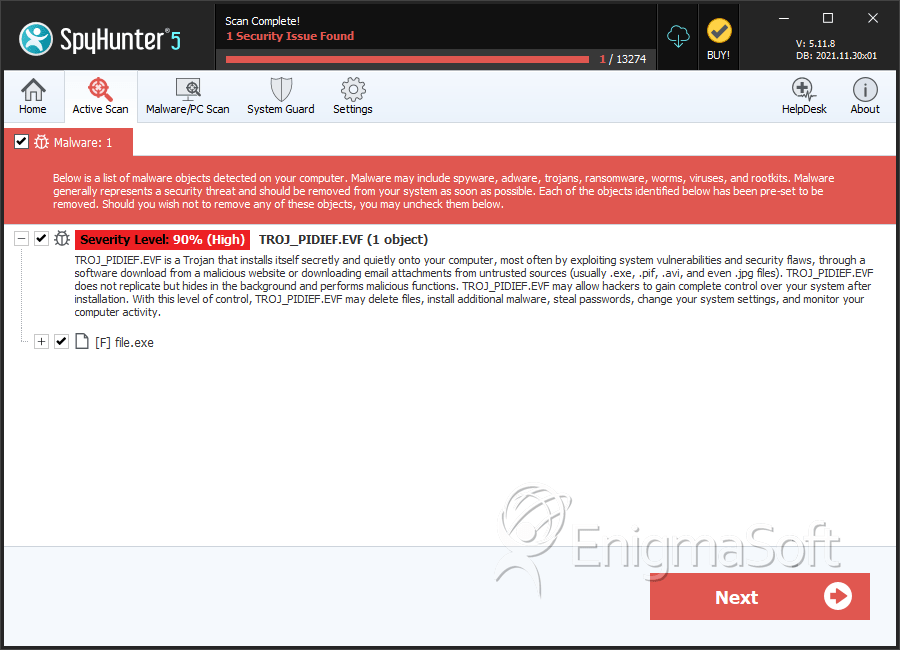
If your security software is detecting a TROJ_PIDIEF.EVF infection, this means that you have attempted to download or open a malicious PDF file that infects your computer with malware. TROJ_PIDIEF.EVF typically refers to dangerous PDF files that use a known vulnerability in Adobe's software in order to execute malicious code on the victim's computer. These kinds of attacks are highly effective because the PDF file will still be displayed, allowing the TROJ_PIDIEF.EVF attack to occur in the background, installing a backdoor or banking Trojan on the victim's computer without the victim being aware of its presence. This is often done with these kinds of threats that rely on secrecy and avoiding making the victim aware of their presence (unlike scams such as rogue security programs or Police Ransomware Trojans). TROJ_PIDIEF.EVF attacks have been associated with numerous social engineering lures, usually spread through spam email messages.
Table of Contents
Criminals Use a Clever Social Engineering Tactic to Spread TROJ_PIDIEF.EVF
One of the most recent attacks involving TROJ_PIDIEF.EVF has spread using a clever social engineering tactic that delivers the TROJ_PIDIEF.EVF attack from a much unexpected source. Criminals have sent out spam email messages containing a malicious PDF file that contains information about malware attacks coming from China that use malicious PDF files to infect computers! When the victim opens this PDF file, it infects the computer with the very malware the PDF file warns about. ESG security researchers strongly advise computer users to remain vigilant and to view unexpected or unsolicited email attachments with suspicious as they are often used to distribute malware. This social engineering twist is something that PC security researchers have observed before and, for a long time, fake security software and guides have been used to distribute malware.
It is essential to ensure that your applications are fully updated at all times. This is especially true of the Adobe Systems software which, due to its popularity, is often an attack vector for these kinds of malware infections. Adobe Flash and Adobe Reader, along with the Java Runtime Environment, are some of the third-party platforms most commonly used to spread malware. This is mainly because of their popularity and because malicious files like TROJ_PIDIEF.EVF can be used to infect computers across multiple operating systems, unlike traditional malware that is often limited to a single operating system.
SpyHunter Detects & Remove TROJ_PIDIEF.EVF
File System Details
| # | File Name | MD5 |
Detections
Detections: The number of confirmed and suspected cases of a particular threat detected on
infected computers as reported by SpyHunter.
|
|---|---|---|---|
| 1. | %User Temp%\AdobeARM.exe | ||
| 2. | %User Temp%\Adobe Reader .pdf | ||
| 3. | file.exe | 2a42bf17393c3caaa663a6d1dade9c93 | 0 |


