Trojan.Tobfy.H
Threat Scorecard
EnigmaSoft Threat Scorecard
EnigmaSoft Threat Scorecards are assessment reports for different malware threats which have been collected and analyzed by our research team. EnigmaSoft Threat Scorecards evaluate and rank threats using several metrics including real-world and potential risk factors, trends, frequency, prevalence, and persistence. EnigmaSoft Threat Scorecards are updated regularly based on our research data and metrics and are useful for a wide range of computer users, from end users seeking solutions to remove malware from their systems to security experts analyzing threats.
EnigmaSoft Threat Scorecards display a variety of useful information, including:
Popularity Rank: The ranking of a particular threat in EnigmaSoft’s Threat Database.
Severity Level: The determined severity level of an object, represented numerically, based on our risk modeling process and research, as explained in our Threat Assessment Criteria.
Infected Computers: The number of confirmed and suspected cases of a particular threat detected on infected computers as reported by SpyHunter.
See also Threat Assessment Criteria.
| Threat Level: | 80 % (High) |
| Infected Computers: | 151 |
| First Seen: | November 19, 2012 |
| Last Seen: | March 11, 2021 |
| OS(es) Affected: | Windows |
The detection of Trojan.Tobfy.H indicates that your system has been compromised by a potentially malicious program. This type of threat is designed to infiltrate your computer without your knowledge or consent, and it can cause a range of problems, from slowing down your system to stealing sensitive information. In this report, we will provide an overview of what Trojan.Tobfy.H is, how it operates, and the symptoms of infection, as well as guidance on how to remove it from your system.
Table of Contents
What Is Trojan.Tobfy.H?
Trojan.Tobfy.H is a type of Trojan horse malware, which is a broad category of malicious software that disguises itself as a legitimate program. Trojans are often used by attackers to gain unauthorized access to a system, and they can be used to steal data, install additional malware, or disrupt system operation. The name Trojan.Tobfy.H suggests that it is a specific variant of Trojan malware, but the exact nature and behavior of this threat can vary.
How Trojan.Tobfy.H Operates
Trojan.Tobfy.H, like other Trojans, is designed to operate stealthily, making it difficult to detect and remove. It may use various techniques to evade detection, such as disguising itself as a legitimate program or hiding in the system's temporary files. Once installed, the Trojan can communicate with its command and control server to receive instructions, which can include stealing sensitive information, installing additional malware, or disrupting system operation. The exact mechanisms used by Trojan.Tobfy.H can depend on its specific design and the goals of its creators.
Symptoms of Infection
Systems infected with Trojan.Tobfy.H may exhibit a range of symptoms, including slow system performance, unexpected crashes, and unfamiliar programs or icons on the desktop. You may also notice unusual network activity, such as unexpected outgoing connections or data transfers. In some cases, the Trojan may attempt to steal sensitive information, such as login credentials or financial data, which can lead to identity theft or financial loss. If you suspect that your system has been infected with Trojan.Tobfy.H, it is essential to take immediate action to remove the threat and prevent further damage.
How to Remove Trojan.Tobfy.H
- Restart your system in Safe Mode with Networking to prevent the Trojan from loading and to allow for a more thorough removal process.
- Use a reputable anti-malware tool, such as SpyHunter, to perform a full scan of your system and detect any malicious files or programs associated with Trojan.Tobfy.H.
- Uninstall any suspicious programs or applications that may be related to the Trojan, using the Add/Remove Programs feature in your system's Control Panel.
- Reset your web browsers, including Chrome, Firefox, and Edge, to their default settings to remove any malicious extensions or add-ons that may have been installed by the Trojan.
- Reboot your system and perform a follow-up scan with your anti-malware tool to ensure that all remnants of the Trojan have been removed.
Conclusion
Removing Trojan.Tobfy.H from your system requires careful attention to detail and a thorough understanding of the threat. By following the steps outlined in this report, you can help to ensure that your system is free from this malicious software and that your sensitive information is protected. Remember to always use reputable anti-malware tools and to keep your system and software up to date to prevent future infections. If you are unsure about any aspect of the removal process, consider seeking the advice of a qualified computer security professional.
Aliases
15 security vendors flagged this file as malicious.
| Antivirus Vendor | Detection |
|---|---|
| Panda | Trj/Ransom.AB |
| AVG | SHeur4.AWTL |
| Fortinet | W32/Injector.AAIQ |
| Ikarus | Trojan.Win32.LockScreen |
| AntiVir | TR/Tobfy.G.85 |
| Kaspersky | UDS:DangerousObject.Multi.Generic |
| Avast | Win32:Malware-gen |
| Symantec | Trojan.Gen.2 |
| McAfee | Artemis!E501E42CDAAF |
| CAT-QuickHeal | Trojan.Tobfy |
| Panda | Trj/Genetic.gen |
| AVG | Dropper.Generic7.AJGU |
| Fortinet | W32/EncPk.AFN!tr |
| Ikarus | Trojan.Win32.Loktrom |
| AhnLab-V3 | Trojan/Win32.Zbot |
SpyHunter Detects & Remove Trojan.Tobfy.H
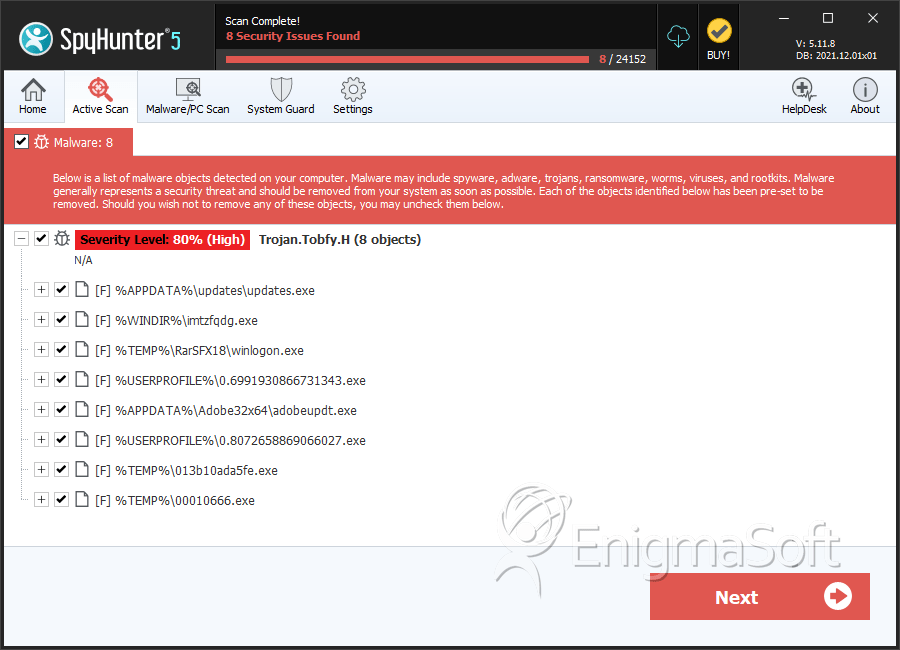
File System Details
| # | File Name | MD5 |
Detections
Detections: The number of confirmed and suspected cases of a particular threat detected on
infected computers as reported by SpyHunter.
|
|---|---|---|---|
| 1. | updates.exe | 1ad10c921d53939f323632dd156b111d | 23 |
| 2. | imtzfqdg.exe | d0f095fa20084a0cef8654d3c3d40f43 | 4 |
| 3. | winlogon.exe | 7d87bd1f1d1c064789c94b66d833f8c5 | 3 |
| 4. | 0.6991930866731343.exe | 2bd9b6cd76955ba03d7efee34b25bc2f | 3 |
| 5. | adobeupdt.exe | b808906235e8f1e93b0dfb11b971171a | 2 |
| 6. | 0.8072658869066027.exe | dc476d7f1407aa9ebf75b51cfedea3aa | 1 |
| 7. | 013b10ada5fe.exe | f6012242664588446ca96d9107d5375b | 1 |
| 8. | 00010666.exe | 367080e33aa7ac00764c3973b36f8fd8 | 1 |
| 9. | 0000e021.exe | 62de98869d17e029afb83624720c1efb | 1 |
| 10. | utVL7pd.exe | 30b14e604caa00082cae777c8fec833c | 1 |
| 11. | cccccc.exe | bb474cabc75a74b9585f0f47988aba53 | 1 |
| 12. | 00afdb73.exe | 32ed4d94852a1c0bd34a399824443030 | 1 |
| 13. | 0001ff06.exe | fa985ef3f454570aaf54ec4c18d64434 | 1 |
| 14. | 7.045764488892751E8.exe | e501e42cdaafaf9e5ed0ac9463bcc3c6 | 1 |