Trojan.Spy.Banbra.I
Threat Scorecard
EnigmaSoft Threat Scorecard
EnigmaSoft Threat Scorecards are assessment reports for different malware threats which have been collected and analyzed by our research team. EnigmaSoft Threat Scorecards evaluate and rank threats using several metrics including real-world and potential risk factors, trends, frequency, prevalence, and persistence. EnigmaSoft Threat Scorecards are updated regularly based on our research data and metrics and are useful for a wide range of computer users, from end users seeking solutions to remove malware from their systems to security experts analyzing threats.
EnigmaSoft Threat Scorecards display a variety of useful information, including:
Popularity Rank: The ranking of a particular threat in EnigmaSoft’s Threat Database.
Severity Level: The determined severity level of an object, represented numerically, based on our risk modeling process and research, as explained in our Threat Assessment Criteria.
Infected Computers: The number of confirmed and suspected cases of a particular threat detected on infected computers as reported by SpyHunter.
See also Threat Assessment Criteria.
| Threat Level: | 80 % (High) |
| Infected Computers: | 85 |
| First Seen: | February 22, 2013 |
| Last Seen: | January 30, 2022 |
| OS(es) Affected: | Windows |
The detection of Trojan.Spy.Banbra.I on your system indicates a potential security threat that requires immediate attention. This type of malware is designed to compromise your privacy and security, making it essential to understand its nature and take appropriate steps to remove it.
Table of Contents
What Is Trojan.Spy.Banbra.I?
Trojan.Spy.Banbra.I is a type of spyware that is designed to secretly monitor and collect sensitive information from infected computers. The name itself suggests that it is a Trojan horse-type malware with spyware capabilities, but the specifics of its operation and the exact nature of the data it collects can vary. It's crucial to approach this threat with caution and follow best practices for removal to minimize potential damage.
How Trojan.Spy.Banbra.I Operates
Malware like Trojan.Spy.Banbra.I typically operates by infiltrating a system through various means, such as exploiting vulnerabilities, phishing attacks, or by being bundled with other software. Once inside, it can install itself in a way that makes it difficult to detect, often disguising itself as a legitimate program or process. It may then proceed to collect sensitive information, such as login credentials, browsing history, or other personal data, which can be transmitted back to its creators or used for malicious purposes on the infected machine.
Symptoms of Infection
Symptoms of an infection can be subtle and may include slow system performance, unexpected pop-ups, changes in browser settings, or the appearance of unfamiliar programs. In some cases, there may be no noticeable symptoms at all, which is why regular system scans and monitoring are essential for early detection. If you suspect that your system has been infected with Trojan.Spy.Banbra.I, it's important not to delay in taking action to remove it.
How to Remove Trojan.Spy.Banbra.I
- Enter Safe Mode with Networking to prevent the malware from loading and to allow for a clean environment to perform removal steps.
- Conduct a full scan of your system using a reputable anti-malware tool, such as SpyHunter, to detect and remove all traces of the malware.
- Uninstall suspicious programs that you do not recognize or that were installed around the time you suspect the infection occurred.
- Reset your browsers (Chrome, Firefox, Edge, etc.) to their default settings to remove any malicious extensions or settings changes made by the malware.
- After completing the above steps, reboot your system and perform another scan to ensure that all remnants of the malware have been removed.
Conclusion
Removing Trojan.Spy.Banbra.I requires careful and thorough steps to ensure that all components of the malware are eliminated from your system. It's also a good opportunity to review your security practices, including ensuring your operating system and software are up to date, using strong, unique passwords, and being cautious with emails and downloads from unknown sources. By taking these measures, you can help protect your system from future infections and maintain your digital security and privacy.
Aliases
15 security vendors flagged this file as malicious.
| Antivirus Vendor | Detection |
|---|---|
| AVG | Generic17.ETF |
| Comodo | Heur.Suspicious |
| Symantec | Trojan.Gen.2 |
| F-Prot | W32/Trojan2.MTFF |
| Fortinet | W32/Dx.UFE!tr |
| AhnLab-V3 | Win-Trojan/Xema.variant |
| McAfee-GW-Edition | Heuristic.BehavesLike.Win32.Suspicious-BAY.G |
| Comodo | UnclassifiedMalware |
| Sophos | Mal/Behav-374 |
| eSafe | Win32.TRDynamer.Dtc |
| Symantec | Trojan.Gen |
| F-Prot | W32/Themida_Packed!Eldorado |
| McAfee | Generic.dx!ufe |
| CAT-QuickHeal | (Suspicious) - DNAScan |
| Panda | Trj/Dtcontx.B |
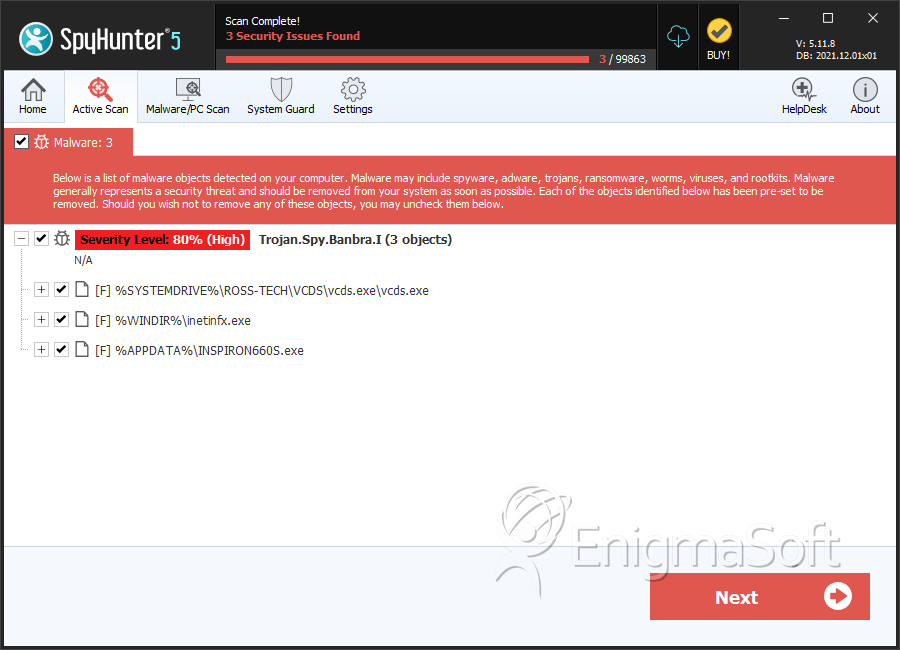
SpyHunter Detects & Remove Trojan.Spy.Banbra.I
File System Details
| # | File Name | MD5 |
Detections
Detections: The number of confirmed and suspected cases of a particular threat detected on
infected computers as reported by SpyHunter.
|
|---|---|---|---|
| 1. | vcds.exe | 49233959cd0dffc71cd7122fa78ca8af | 48 |
| 2. | inetinfx.exe | 5e64d1a72e8669da941abd6d6b1e2079 | 2 |
| 3. | INSPIRON660S.exe | be66e3f03ab7167c93d0afc95bebe531 | 2 |