Trojan.Regin
Threat Scorecard
EnigmaSoft Threat Scorecard
EnigmaSoft Threat Scorecards are assessment reports for different malware threats which have been collected and analyzed by our research team. EnigmaSoft Threat Scorecards evaluate and rank threats using several metrics including real-world and potential risk factors, trends, frequency, prevalence, and persistence. EnigmaSoft Threat Scorecards are updated regularly based on our research data and metrics and are useful for a wide range of computer users, from end users seeking solutions to remove malware from their systems to security experts analyzing threats.
EnigmaSoft Threat Scorecards display a variety of useful information, including:
Popularity Rank: The ranking of a particular threat in EnigmaSoft’s Threat Database.
Severity Level: The determined severity level of an object, represented numerically, based on our risk modeling process and research, as explained in our Threat Assessment Criteria.
Infected Computers: The number of confirmed and suspected cases of a particular threat detected on infected computers as reported by SpyHunter.
See also Threat Assessment Criteria.
| Threat Level: | 80 % (High) |
| Infected Computers: | 20 |
| First Seen: | August 21, 2018 |
| Last Seen: | October 24, 2025 |
| OS(es) Affected: | Windows |
The detection of Trojan.Regin on your system indicates a potential security threat that requires immediate attention. This type of malware is designed to compromise the security and integrity of your computer, potentially leading to unauthorized access, data theft, and other malicious activities. It is essential to understand the nature of this threat and take prompt action to remove it and prevent future infections.
Table of Contents
What Is Trojan.Regin?
Trojan.Regin is a type of Trojan horse malware, which is a broad category of threats that disguise themselves as legitimate software or files to gain unauthorized access to a computer system. The name "Trojan.Regin" suggests that it may be related to a specific strain or variant of Trojan malware, but without further information, it is difficult to determine its exact characteristics or behaviors. Generally, Trojans are designed to exploit vulnerabilities in software or human psychology to infect systems and carry out malicious activities.
How Trojan.Regin Operates
Like other Trojans, Trojan.Regin likely operates by disguising itself as a legitimate file or program, tricking users into downloading or installing it. Once inside the system, it may attempt to connect to a command and control server to receive instructions or download additional malware components. The malware may also try to evade detection by using various techniques such as code obfuscation, encryption, or anti-debugging methods. Its primary goal is to maintain a persistent presence on the infected system, allowing it to steal sensitive information, disrupt system operations, or provide a conduit for other malicious activities.
Symptoms of Infection
Systems infected with Trojan.Regin may exhibit a range of symptoms, including but not limited to, slow system performance, frequent crashes, or unusual network activity. Users may also notice unfamiliar programs or icons on their desktop, unexpected changes to their browser settings, or pop-up advertisements. In some cases, the malware may operate stealthily, making it difficult to detect without the aid of security software. It is crucial to be vigilant and monitor your system for any suspicious behavior, as early detection can significantly simplify the removal process.
How to Remove Trojan.Regin
- Boot your computer in Safe Mode with Networking to prevent the malware from loading and to allow for easier removal.
- Perform a full scan of your system using a reputable anti-malware tool, such as SpyHunter, to detect and remove all components of the Trojan.
- Uninstall any suspicious programs or applications that were installed around the time of the infection.
- Reset your web browsers (Chrome, Firefox, Edge) to their default settings to remove any malicious extensions or settings changes.
- Reboot your computer and perform another full scan to ensure that all remnants of the malware have been removed.
Conclusion
Removing Trojan.Regin from your system requires a combination of technical knowledge, the right tools, and caution. By following the steps outlined above and maintaining good security practices, such as keeping your operating system and software up to date, using strong antivirus software, and being cautious when downloading files or clicking on links, you can significantly reduce the risk of future infections. Remember, the key to protecting your digital assets is vigilance and proactive security measures. If you are unsure about any aspect of the removal process, consider seeking help from a professional to ensure your system is thoroughly cleaned and secured.
SpyHunter Detects & Remove Trojan.Regin
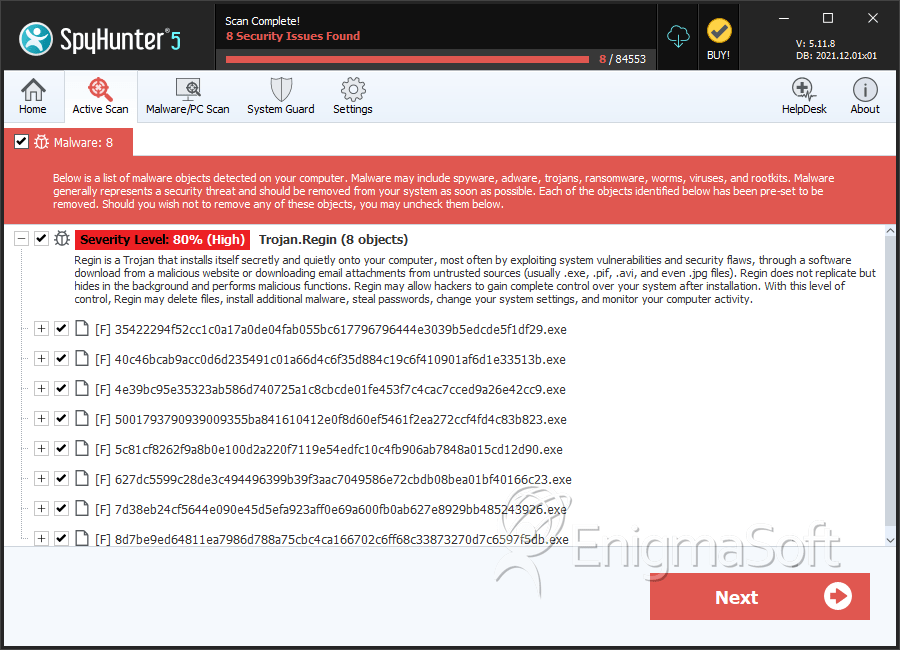
File System Details
| # | File Name | MD5 |
Detections
Detections: The number of confirmed and suspected cases of a particular threat detected on
infected computers as reported by SpyHunter.
|
|---|---|---|---|
| 1. | 40c46bcab9acc0d6d235491c01a66d4c6f35d884c19c6f410901af6d1e33513b.exe | 4b6b86c7fec1c574706cecedf44abded | 3 |
| 2. | 4e39bc95e35323ab586d740725a1c8cbcde01fe453f7c4cac7cced9a26e42cc9.exe | b505d65721bb2453d5039a389113b566 | 1 |
| 3. | 5001793790939009355ba841610412e0f8d60ef5461f2ea272ccf4fd4c83b823.exe | ba7bb65634ce1e30c1e5415be3d1db1d | 1 |
| 4. | 7d38eb24cf5644e090e45d5efa923aff0e69a600fb0ab627e8929bb485243926.exe | 2c8b9d2885543d7ade3cae98225e263b | 1 |
| 5. | 8d7be9ed64811ea7986d788a75cbc4ca166702c6ff68c33873270d7c6597f5db.exe | bfbe8c3ee78750c3a520480700e440f8 | 1 |
| 6. | 9cd5127ef31da0e8a4e36292f2af5a9ec1de3b294da367d7c05786fe2d5de44f.exe | d240f06e98c8d3e647cbf4d442d79475 | 1 |
| 7. | a0d82c3730bc41e267711480c8009883d1412b68977ab175421eabc34e4ef355.exe | b29ca4f22ae7b7b25f79c1d4a421139d | 1 |
| 8. | a7493fac96345a989b1a03772444075754a2ef11daa22a7600466adc1f69a669.exe | b269894f434657db2b15949641a67532 | 1 |
| 9. | a7e3ad8ea7edf1ca10b0e5b0d976675c3016e5933219f97e94900dea0d470abe.exe | 187044596bc1328efa0ed636d8aa4a5c | 1 |
| 10. | b12c7d57507286bbbe36d7acf9b34c22c96606ffd904e3c23008399a4a50c047.exe | ffb0b9b5b610191051a7bdf0806e1e47 | 1 |
| 11. | c0cf8e008fbfa0cb2c61d968057b4a077d62f64d7320769982d28107db370513.exe | 1c024e599ac055312a4ab75b3950040a | 1 |
| 12. | f1d903251db466d35533c28e3c032b7212aa43c8d64ddf8c5521b43031e69e1e.exe | 06665b96e293b23acc80451abb413e50 | 1 |
| 13. | 35422294f52cc1c0a17a0de04fab055bc617796796444e3039b5edcde5f1df29.exe | 766832f4a93447ba027317b190a5e838 | 0 |
| 14. | 5c81cf8262f9a8b0e100d2a220f7119e54edfc10c4fb906ab7848a015cd12d90.exe | 22bfc970f707fd775d49e875b63c2f0c | 0 |
| 15. | 627dc5599c28de3c494496399b39f3aac7049586e72cbdb08bea01bf40166c23.exe | d789f44f06ff840656903ba67a240238 | 0 |
| 16. | a0e3c52a2c99c39b70155a9115a6c74ea79f8a68111190faa45a8fd1e50f8880.exe | 1352a9210c8d9120f55f98f90fa5fc5c | 0 |