Trojan.Dropper.Dexel
Threat Scorecard
EnigmaSoft Threat Scorecard
EnigmaSoft Threat Scorecards are assessment reports for different malware threats which have been collected and analyzed by our research team. EnigmaSoft Threat Scorecards evaluate and rank threats using several metrics including real-world and potential risk factors, trends, frequency, prevalence, and persistence. EnigmaSoft Threat Scorecards are updated regularly based on our research data and metrics and are useful for a wide range of computer users, from end users seeking solutions to remove malware from their systems to security experts analyzing threats.
EnigmaSoft Threat Scorecards display a variety of useful information, including:
Popularity Rank: The ranking of a particular threat in EnigmaSoft’s Threat Database.
Severity Level: The determined severity level of an object, represented numerically, based on our risk modeling process and research, as explained in our Threat Assessment Criteria.
Infected Computers: The number of confirmed and suspected cases of a particular threat detected on infected computers as reported by SpyHunter.
See also Threat Assessment Criteria.
| Popularity Rank: | 13,558 |
| Threat Level: | 80 % (High) |
| Infected Computers: | 1,680 |
| First Seen: | December 18, 2016 |
| Last Seen: | September 24, 2026 |
| OS(es) Affected: | Windows |
The detection of Trojan.Dropper.Dexel on your system indicates a potential security threat that requires immediate attention. This type of malware is designed to infiltrate your computer and cause harm, making it essential to understand its nature and take steps to remove it.
Table of Contents
What Is Trojan.Dropper.Dexel?
Trojan.Dropper.Dexel is a type of Trojan horse malware that is designed to drop additional malicious components onto an infected system. The term "Trojan" refers to the fact that this malware disguises itself as a legitimate program or file, allowing it to evade detection and gain access to your computer. The "Dropper" part of the name indicates that it is designed to install additional malware or malicious tools onto your system.
How Trojan.Dropper.Dexel Operates
Once Trojan.Dropper.Dexel has infected your system, it can operate in various ways, depending on its intended purpose. It may attempt to connect to a command and control server to receive instructions from its creators, or it may begin to install additional malware or tools onto your system. This malware can also modify system settings, create new user accounts, or disable security software to maintain its presence on your computer.
Trojan.Dropper.Dexel can spread through various means, including infected software downloads, phishing emails, or exploited vulnerabilities in operating systems or applications. It's crucial to practice safe computing habits, such as avoiding suspicious downloads and keeping your software up to date, to reduce the risk of infection.
Symptoms of Infection
Identifying the symptoms of a Trojan.Dropper.Dexel infection can be challenging, as it often disguises itself as a legitimate program. However, some common signs of infection include slow system performance, unexpected pop-ups or ads, and unfamiliar programs or icons on your desktop. You may also notice that your system is connecting to the internet without your knowledge or that your antivirus software is disabled.
In some cases, Trojan.Dropper.Dexel may not exhibit any noticeable symptoms, making it difficult to detect without the aid of antivirus software. Regular system scans and monitoring of system activity can help identify potential infections.
How to Remove Trojan.Dropper.Dexel
- Boot your system into Safe Mode with Networking to prevent the malware from loading and to allow for easier removal.
- Perform a full scan of your system using a reputable antivirus tool, such as SpyHunter, to detect and remove Trojan.Dropper.Dexel and any associated malware.
- Uninstall any suspicious programs or applications that may be related to the infection.
- Reset your web browsers, including Chrome, Firefox, and Edge, to their default settings to remove any malicious extensions or add-ons.
- Reboot your system and perform another full scan to ensure that the malware has been completely removed.
Conclusion
Removing Trojan.Dropper.Dexel from your system requires a combination of technical knowledge and the right tools. By following the steps outlined above and practicing safe computing habits, you can reduce the risk of infection and protect your system from this type of malware. Remember to always keep your antivirus software up to date and to be cautious when downloading software or clicking on links from unknown sources.
SpyHunter Detects & Remove Trojan.Dropper.Dexel
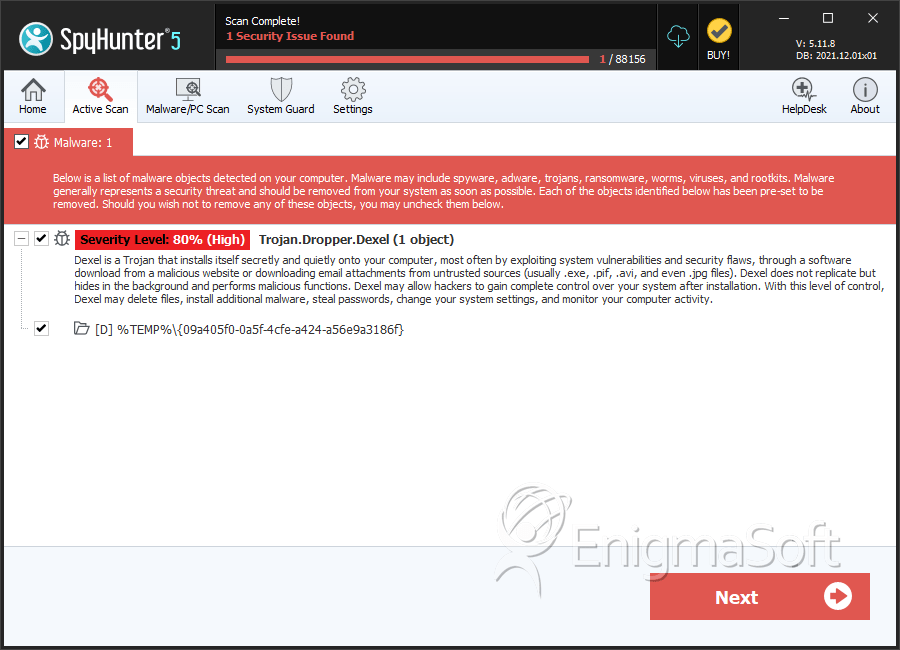
Registry Details
Directories
Trojan.Dropper.Dexel may create the following directory or directories:
| %TEMP%\{09a405f0-0a5f-4cfe-a424-a56e9a3186f} |
Analysis Report
General information
| Family Name: | Trojan.Dropper.Dexel |
|---|---|
| Signature status: | No Signature |
Known Samples
Known Samples
This section lists other file samples believed to be associated with this family.|
MD5:
700f189d38777b0aa09bcfa70d285b34
SHA1:
af3f139f1164f133932ba82655401053e7cd70b4
SHA256:
9B14EBDF114B7421DFF51D4C167664BD718F0A76392EDAFC802D87CB19394A4D
File Size:
630.78 KB, 630784 bytes
|
Windows Portable Executable Attributes
- File doesn't have "Rich" header
- File doesn't have exports table
- File doesn't have security information
- File is 32-bit executable
- File is either console or GUI application
- File is GUI application (IMAGE_SUBSYSTEM_WINDOWS_GUI)
- File is Native application (NOT .NET application)
- File is not packed
- IMAGE_FILE_DLL is not set inside PE header (Executable)
- IMAGE_FILE_EXECUTABLE_IMAGE is set inside PE header (Executable Image)
File Icons
File Icons
This section displays icon resources found within family samples. Malware often replicates icons commonly associated with legitimate software to mislead users into believing the malware is safe.
Windows PE Version Information
Windows PE Version Information
This section displays values and attributes that have been set in the Windows file version information data structure for samples within this family. To mislead users, malware actors often add fake version information mimicking legitimate software.| Name | Value |
|---|---|
| File Description | AI_Get v2.19.11.29 |
| File Version | 2, 19, 11, 29 |
| Legal Copyright | Loic CLIQUOT - Copyright (C) 2019 |
| Product Name | AI_Get |
| Product Version | 2, 19, 11, 29 |
File Traits
- HighEntropy
- x86
Block Information
Block Information
During analysis, EnigmaSoft breaks file samples into logical blocks for classification and comparison with other samples. Blocks can be used to generate malware detection rules and to group file samples into families based on shared source code, functionality and other distinguishing attributes and characteristics. This section lists a summary of this block data, as well as its classification by EnigmaSoft. A visual representation of the block data is also displayed, where available.| Total Blocks: | 1,255 |
|---|---|
| Potentially Malicious Blocks: | 44 |
| Whitelisted Blocks: | 1,211 |
| Unknown Blocks: | 0 |
Visual Map
? - Unknown Block
x - Potentially Malicious Block