Trojan-Downloader:W32/Agent.DTIW
Threat Scorecard
EnigmaSoft Threat Scorecard
EnigmaSoft Threat Scorecards are assessment reports for different malware threats which have been collected and analyzed by our research team. EnigmaSoft Threat Scorecards evaluate and rank threats using several metrics including real-world and potential risk factors, trends, frequency, prevalence, and persistence. EnigmaSoft Threat Scorecards are updated regularly based on our research data and metrics and are useful for a wide range of computer users, from end users seeking solutions to remove malware from their systems to security experts analyzing threats.
EnigmaSoft Threat Scorecards display a variety of useful information, including:
Popularity Rank: The ranking of a particular threat in EnigmaSoft’s Threat Database.
Severity Level: The determined severity level of an object, represented numerically, based on our risk modeling process and research, as explained in our Threat Assessment Criteria.
Infected Computers: The number of confirmed and suspected cases of a particular threat detected on infected computers as reported by SpyHunter.
See also Threat Assessment Criteria.
| Popularity Rank: | 19,706 |
| Threat Level: | 90 % (High) |
| Infected Computers: | 29 |
| First Seen: | November 15, 2011 |
| Last Seen: | January 7, 2026 |
| OS(es) Affected: | Windows |
Trojan-Downloader:W32/Agent.DTIW is a damaging Trojan that is able to bypass the warnings released by Windows about unsafe software. Trojan-Downloader:W32/Agent.DTIW uses a private signing certificate that belongs to the Malaysian government. Trojan-Downloader:W32/Agent.DTIW is distributed via infected PDF files that install it once Adobe Reader 8 has been exploited. Trojan-Downloader:W32/Agent.DTIW downloads other malware threats from a server called worldnewsmagazines.org. Some of these malware threats, as well as Trojan-Downloader:W32/Agent.DTIW, are signed by a domain called www.esupplychain.com.tw. Remove Trojan-Downloader:W32/Agent.DTIW immediately after detection.
Table of Contents
SpyHunter Detects & Remove Trojan-Downloader:W32/Agent.DTIW
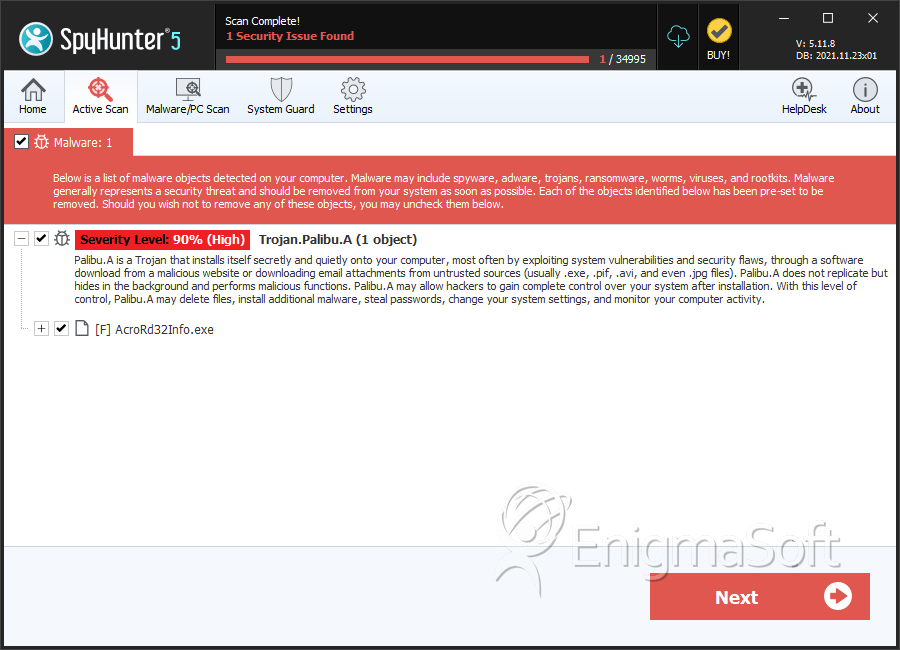
File System Details
| # | File Name | MD5 |
Detections
Detections: The number of confirmed and suspected cases of a particular threat detected on
infected computers as reported by SpyHunter.
|
|---|---|---|---|
| 1. | AcroRd32Info.exe | e9f89d406e32ca88c32ac22852c25841 | 0 |
Analysis Report
General information
| Family Name: | Trojan.Palibu.A |
|---|---|
| Packers: | UPX! |
| Signature status: | No Signature |
Known Samples
Known Samples
This section lists other file samples believed to be associated with this family.|
MD5:
7f2d76b6974aa24a6ce2a4ecc511be75
SHA1:
60c3609ce13b0e474dad4a59bfbcaf52778adee4
SHA256:
6BF979307B68D0A91DCC9BA691183E4DF71EBF558E12B6A17DDAAE6A0AD93540
File Size:
611.84 KB, 611840 bytes
|
|
MD5:
95bbe4d0bdb4abe64fb0de6d6732e601
SHA1:
e15eee6f478d9ba02713c465c8c5749bb536b099
SHA256:
B825A18C699F2275219E05430D62197A9DF4337D439E805DFB16CC06945072E5
File Size:
1.56 MB, 1561088 bytes
|
Windows Portable Executable Attributes
- File doesn't have "Rich" header
- File doesn't have debug information
- File doesn't have security information
- File has been packed
- File has exports table
- File is 32-bit executable
- File is either console or GUI application
- File is GUI application (IMAGE_SUBSYSTEM_WINDOWS_GUI)
- File is Native application (NOT .NET application)
- IMAGE_FILE_DLL is not set inside PE header (Executable)
Show More
- IMAGE_FILE_EXECUTABLE_IMAGE is set inside PE header (Executable Image)
Windows PE Version Information
Windows PE Version Information
This section displays values and attributes that have been set in the Windows file version information data structure for samples within this family. To mislead users, malware actors often add fake version information mimicking legitimate software.| Name | Value |
|---|---|
| Company Name | Microsoft Corporation |
| File Version | 1.0.0.0 |
| Legal Copyright | Copyright 2016 |
| Product Version | 1.0.0.0 |
File Traits
- 2+ executable sections
- dll
- packed
- VirtualQueryEx
- WriteProcessMemory
- x86
Block Information
Block Information
During analysis, EnigmaSoft breaks file samples into logical blocks for classification and comparison with other samples. Blocks can be used to generate malware detection rules and to group file samples into families based on shared source code, functionality and other distinguishing attributes and characteristics. This section lists a summary of this block data, as well as its classification by EnigmaSoft. A visual representation of the block data is also displayed, where available.| Total Blocks: | 8,056 |
|---|---|
| Potentially Malicious Blocks: | 83 |
| Whitelisted Blocks: | 7,799 |
| Unknown Blocks: | 174 |
Visual Map
? - Unknown Block
x - Potentially Malicious Block
Similar Families
Similar Families
This section lists other families that share similarities with this family, based on EnigmaSoft’s analysis. Many malware families are created from the same malware toolkits and use the same packing and encryption techniques but uniquely extend functionality. Similar families may also share source code, attributes, icons, subcomponents, compromised and/or invalid digital signatures, and network characteristics. Researchers leverage these similarities to rapidly and effectively triage file samples and extend malware detection rules.- Banker.FD
- Banker.RF
- Banker.Spy.DC
- Casbaneiro.A
- DealPly.GB
Show More
- Delf.FC
- Delf.OD
- Injector.JDA
- Ropalidia.D
Windows API Usage
Windows API Usage
This section lists Windows API calls that are used by the samples in this family. Windows API usage analysis is a valuable tool that can help identify malicious activity, such as keylogging, security privilege escalation, data encryption, data exfiltration, interference with antivirus software, and network request manipulation.| Category | API |
|---|---|
| Syscall Use |
Show More
|
| Process Shell Execute |
|
| Anti Debug |
|
| Process Manipulation Evasion |
|
Shell Command Execution
Shell Command Execution
This section lists Windows shell commands that are run by the samples in this family. Windows Shell commands are often leveraged by malware for nefarious purposes and can be used to elevate security privileges, download and launch other malware, exploit vulnerabilities, collect and exfiltrate data, and hide malicious activity.
C:\WINDOWS\SysWOW64\rundll32.exe C:\WINDOWS\system32\rundll32.exe c:\users\user\downloads\60c3609ce13b0e474dad4a59bfbcaf52778adee4_0000611840.,LiQMAxHB
|
C:\WINDOWS\SysWOW64\rundll32.exe C:\WINDOWS\system32\rundll32.exe c:\users\user\downloads\e15eee6f478d9ba02713c465c8c5749bb536b099_0001561088.,LiQMAxHB
|